

300
K. M. G. Mostofa et al.
the following points are considered: (i) Probability for the symmetrical HO
• addition to the benzene ring is identical (ii) Addition to the ipso-position is negligible
for the aromatic compounds with single functional groups (e.g., <8 % for phenol
and <1 % for chloro benzene) due to the significant steric effect (Raghavan and
Steenken 1980; Merga et al. 1996; Mvula et al. 2001). Therefore, only when all
positions on the aromatic ring are filled with functional groups, HO
• adds to the
ipso-position with identical probability for all the available positions.
For the determination of the reaction rate constant, the E a is a sum of two parts:
(i) a base part, Eº a , resulting from the HO
• addition to the aromatic ring depending
on the number(s) and position(s) of the functional groups and (ii) group contribution parameter(s), E a,add-aromatic Rm, due to the functional group(s), R m (where m
is the number of functional group(s), m = 1–6), on the aromatic ring. To reduce
the number of group contribution factors to calibrate, it is assumed that A differs not by the type of the functional groups but by their number and position.
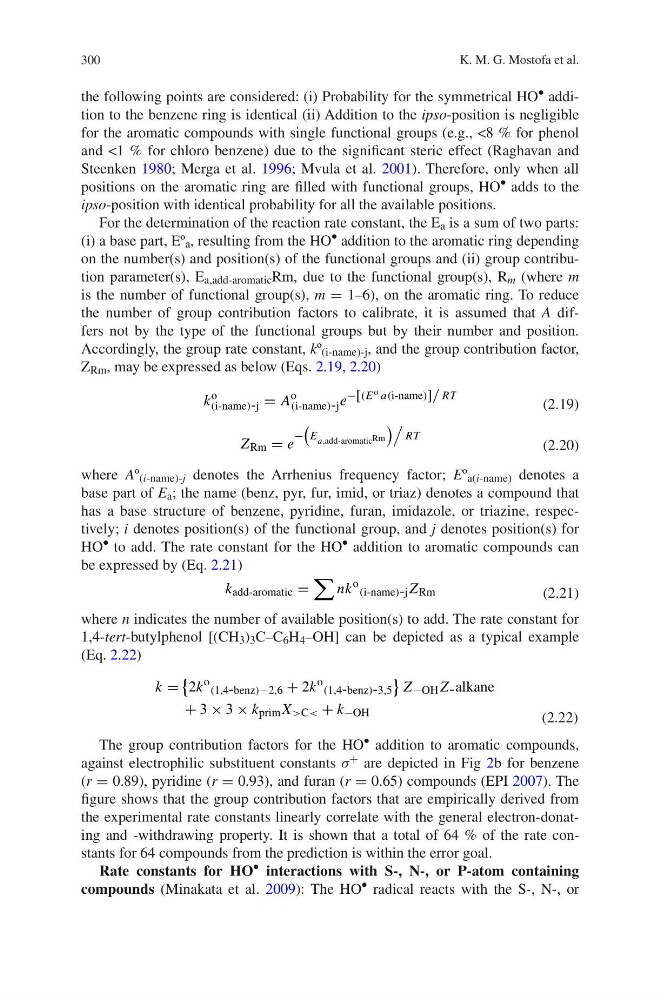
Accordingly, the group rate constant, kº (i-name)-j , and the group contribution factor,
Z Rm , may be expressed as below (Eqs. 2.19, 2.20)
where Aº (i-name)-j denotes the Arrhenius frequency factor; Eº a(i-name) denotes a
base part of E a ; the name (benz, pyr, fur, imid, or triaz) denotes a compound that
has a base structure of benzene, pyridine, furan, imidazole, or triazine, respectively; i denotes position(s) of the functional group, and j denotes position(s) for
HO
• to add. The rate constant for the HO
• addition to aromatic compounds can
be expressed by (Eq. 2.21)
where n indicates the number of available position(s) to add. The rate constant for
1,4-tert-butylphenol [(CH 3 ) 3 C–C 6 H 4 –OH] can be depicted as a typical example
(Eq. 2.22)
The group contribution factors for the HO
• addition to aromatic compounds,
against electrophilic substituent constants σ + are depicted in Fig 2b for benzene
(r = 0.89), pyridine (r = 0.93), and furan (r = 0.65) compounds (EPI 2007). The
figure shows that the group contribution factors that are empirically derived from
the experimental rate constants linearly correlate with the general electron-donating and -withdrawing property. It is shown that a total of 64 % of the rate constants for 64 compounds from the prediction is within the error goal.
Rate constants for HO
•
interactions with S-, N-, or P-atom containing
compounds (Minakata et al. 2009): The HO
• radical reacts with the S-, N-, or
(2.19)
k
o
(i-name)-j = A
o
(i-name)-j e
−[(E o a(i-name)]
RT
(2.20)
Z Rm = e
−
E a,add-aromatic Rm
RT
(2.21)
k add-aromatic =
nk
o
(i-name)-j Z Rm
(2.22)
k =
2k
o
(1,4-benz)−2,6 + 2k
o
(1,4-benz)-3,5
Z −OH Z - alkane
+ 3 × 3 × k prim X >C< + k −OH
K. M. G. Mostofa et al.
the following points are considered: (i) Probability for the symmetrical HO
• addition to the benzene ring is identical (ii) Addition to the ipso-position is negligible
for the aromatic compounds with single functional groups (e.g., <8 % for phenol
and <1 % for chloro benzene) due to the significant steric effect (Raghavan and
Steenken 1980; Merga et al. 1996; Mvula et al. 2001). Therefore, only when all
positions on the aromatic ring are filled with functional groups, HO
• adds to the
ipso-position with identical probability for all the available positions.
For the determination of the reaction rate constant, the E a is a sum of two parts:
(i) a base part, Eº a , resulting from the HO
• addition to the aromatic ring depending
on the number(s) and position(s) of the functional groups and (ii) group contribution parameter(s), E a,add-aromatic Rm, due to the functional group(s), R m (where m
is the number of functional group(s), m = 1–6), on the aromatic ring. To reduce
the number of group contribution factors to calibrate, it is assumed that A differs not by the type of the functional groups but by their number and position.
Accordingly, the group rate constant, kº (i-name)-j , and the group contribution factor,
Z Rm , may be expressed as below (Eqs. 2.19, 2.20)
where Aº (i-name)-j denotes the Arrhenius frequency factor; Eº a(i-name) denotes a
base part of E a ; the name (benz, pyr, fur, imid, or triaz) denotes a compound that
has a base structure of benzene, pyridine, furan, imidazole, or triazine, respectively; i denotes position(s) of the functional group, and j denotes position(s) for
HO
• to add. The rate constant for the HO
• addition to aromatic compounds can
be expressed by (Eq. 2.21)
where n indicates the number of available position(s) to add. The rate constant for
1,4-tert-butylphenol [(CH 3 ) 3 C–C 6 H 4 –OH] can be depicted as a typical example
(Eq. 2.22)
The group contribution factors for the HO
• addition to aromatic compounds,
against electrophilic substituent constants σ + are depicted in Fig 2b for benzene
(r = 0.89), pyridine (r = 0.93), and furan (r = 0.65) compounds (EPI 2007). The
figure shows that the group contribution factors that are empirically derived from
the experimental rate constants linearly correlate with the general electron-donating and -withdrawing property. It is shown that a total of 64 % of the rate constants for 64 compounds from the prediction is within the error goal.
Rate constants for HO
•
interactions with S-, N-, or P-atom containing
compounds (Minakata et al. 2009): The HO
• radical reacts with the S-, N-, or
(2.19)
k
o
(i-name)-j = A
o
(i-name)-j e
−[(E o a(i-name)]
RT
(2.20)
Z Rm = e
−
E a,add-aromatic Rm
RT
(2.21)
k add-aromatic =
nk
o
(i-name)-j Z Rm
(2.22)
k =
2k
o
(1,4-benz)−2,6 + 2k
o
(1,4-benz)-3,5
Z −OH Z - alkane
+ 3 × 3 × k prim X >C< + k −OH