

255
Photoinduced Generation of Hydroxyl Radical in Natural Waters
etc. The major sources of free radicals such as the superoxide ion (O 2
– ) and
the hydroperoxyl radical (HO 2
•
) are modest leakages from the electron transport chains of mitochondria, chloroplasts and the endoplasmic reticulum
(Miller et al. 1990; Paradies et al. 2000; Blokhina et al. 2003). The HO
• ,
alkoxyl radical (RO
•
), peroxyl radical (ROO
• ), and H 2 O 2 produced from the
autooxidation of biomolecules such as ascorbate, catecholamines or thiols, can
damage the macromolecules such as DNA, proteins and lipids in biological
systems (Miller et al. 1990; Buettner and Jurkiewicz 1996; Cadet et al. 1999;
Blokhina et al. 2003; Berlett and Stadtman 1997; Morse et al. 1977; Radtke
et al. 1992; Abele-Oeschger et al. 1994). These events have implications for
numerous human health problems. Autoxidation reactions would mostly be
catalyzed by transition metal ions (Fe 2+ , Cu + ), and by semiquinones which
can act as electron (e – ) donors (Buettner and Jurkiewicz 1996; Blokhina
et al. 2003). Four-electron reduction of oxygen in the respiratory electron
transport chain (ETC.) is generally associated with a partial one- to three-electron reduction, yielding reactive oxygen species such as O 2
•– , HO
•
, H 2 O 2 , singlet oxygen ( 1 O 2 ) and O 3 (Blokhina et al. 2003). Both O 2
•– and HO 2
• undergo
spontaneous dismutation to produce H 2 O 2 . In the presence of reduced transition metals such as Fe 2+ or its complexes that are quite common in biological
systems, the HO
• radical can be produced by the Fenton reaction. A mechanistic scheme for the generation of HO
• in biological systems can be depicted
as follows (Eqs. 6.1–6.3) (Buettner et al. 1978; Buettner 1987; Buettner and
Jurkiewicz 1996; Blokhina et al. 2003):
(6.1)
Fe
3+ -chelate + O 2
•− /AscH
• → Fe
2+ -chelate + O 2 /Asc
•−
(6.2)
Fe
2+ -chelate + H 2 O 2 → Fe
3+ -chelate + OH
− + HO
•
(6.3)
Biomolecules + HO
• + O 2 → Fe
3+ -chelate + OH
− + HO
•
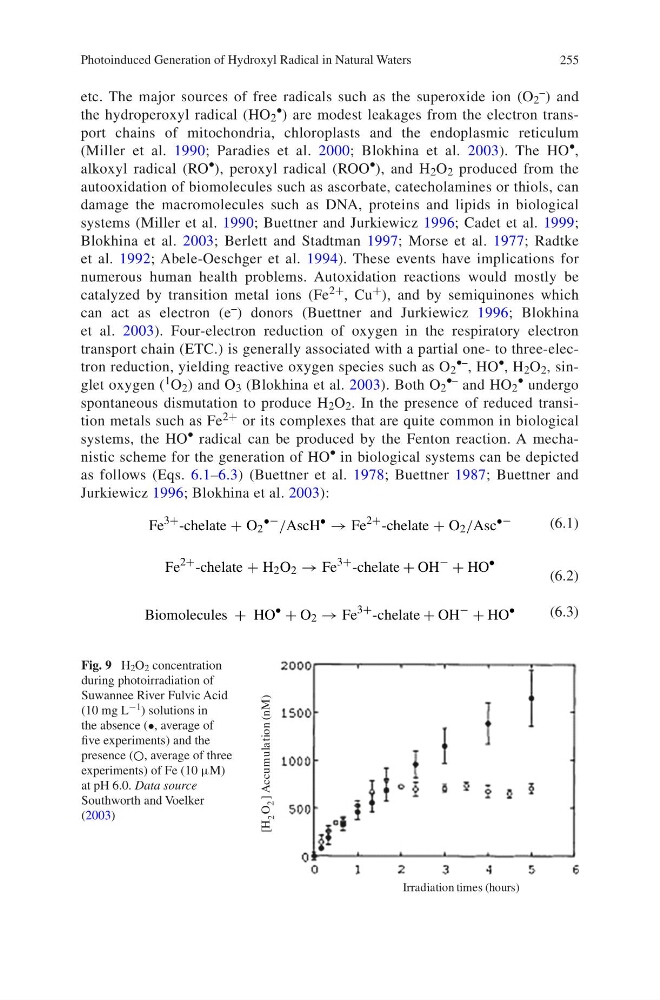
Fig. 9 H 2 O 2 concentration
during photoirradiation of
Suwannee River Fulvic Acid
(10 mg L −1 ) solutions in
the absence (•, average of
five experiments) and the
presence (○, average of three
experiments) of Fe (10 μM)
at pH 6.0. Data source
Southworth and Voelker
(2003)
Irradiation times (hours)
[H O ] Accumulation (nM)
2 2
Photoinduced Generation of Hydroxyl Radical in Natural Waters
etc. The major sources of free radicals such as the superoxide ion (O 2
– ) and
the hydroperoxyl radical (HO 2
•
) are modest leakages from the electron transport chains of mitochondria, chloroplasts and the endoplasmic reticulum
(Miller et al. 1990; Paradies et al. 2000; Blokhina et al. 2003). The HO
• ,
alkoxyl radical (RO
•
), peroxyl radical (ROO
• ), and H 2 O 2 produced from the
autooxidation of biomolecules such as ascorbate, catecholamines or thiols, can
damage the macromolecules such as DNA, proteins and lipids in biological
systems (Miller et al. 1990; Buettner and Jurkiewicz 1996; Cadet et al. 1999;
Blokhina et al. 2003; Berlett and Stadtman 1997; Morse et al. 1977; Radtke
et al. 1992; Abele-Oeschger et al. 1994). These events have implications for
numerous human health problems. Autoxidation reactions would mostly be
catalyzed by transition metal ions (Fe 2+ , Cu + ), and by semiquinones which
can act as electron (e – ) donors (Buettner and Jurkiewicz 1996; Blokhina
et al. 2003). Four-electron reduction of oxygen in the respiratory electron
transport chain (ETC.) is generally associated with a partial one- to three-electron reduction, yielding reactive oxygen species such as O 2
•– , HO
•
, H 2 O 2 , singlet oxygen ( 1 O 2 ) and O 3 (Blokhina et al. 2003). Both O 2
•– and HO 2
• undergo
spontaneous dismutation to produce H 2 O 2 . In the presence of reduced transition metals such as Fe 2+ or its complexes that are quite common in biological
systems, the HO
• radical can be produced by the Fenton reaction. A mechanistic scheme for the generation of HO
• in biological systems can be depicted
as follows (Eqs. 6.1–6.3) (Buettner et al. 1978; Buettner 1987; Buettner and
Jurkiewicz 1996; Blokhina et al. 2003):
(6.1)
Fe
3+ -chelate + O 2
•− /AscH
• → Fe
2+ -chelate + O 2 /Asc
•−
(6.2)
Fe
2+ -chelate + H 2 O 2 → Fe
3+ -chelate + OH
− + HO
•
(6.3)
Biomolecules + HO
• + O 2 → Fe
3+ -chelate + OH
− + HO
•
Fig. 9 H 2 O 2 concentration
during photoirradiation of
Suwannee River Fulvic Acid
(10 mg L −1 ) solutions in
the absence (•, average of
five experiments) and the
presence (○, average of three
experiments) of Fe (10 μM)
at pH 6.0. Data source
Southworth and Voelker
(2003)
Irradiation times (hours)
[H O ] Accumulation (nM)
2 2