

234
K. M. G. Mostofa et al.
and Haung 1991; Fox 1993; Chen et al. 2001; Han et al. 2009) (Eqs. 3.13–3.18,
see chapter “Photoinduced and Microbial Generation of Hydrogen Peroxide and
Organic Peroxides in Natural Waters”):
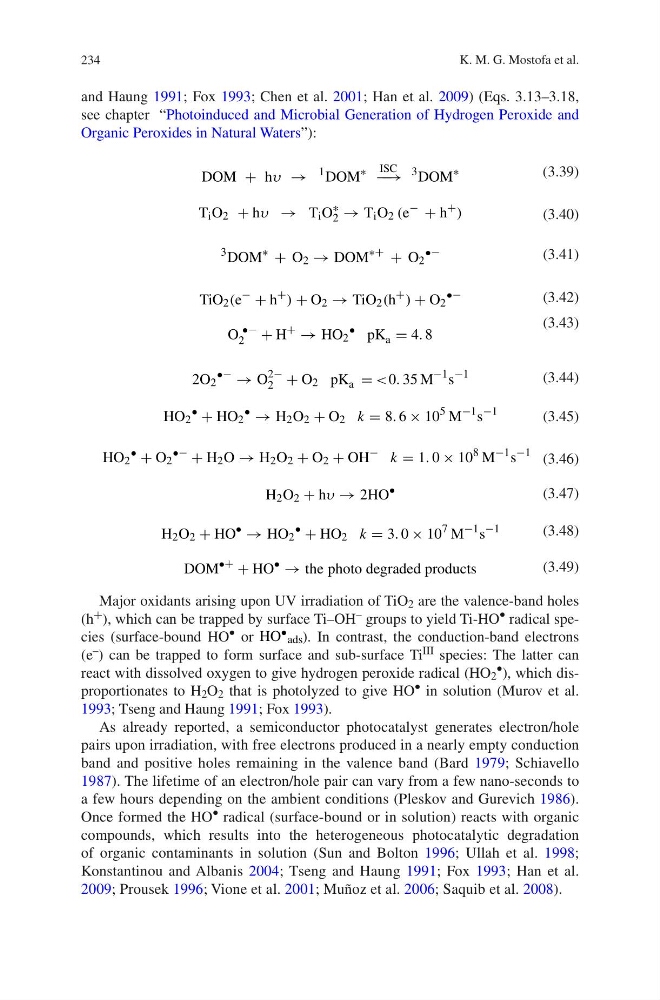
Major oxidants arising upon UV irradiation of TiO 2 are the valence-band holes
(h + ), which can be trapped by surface Ti–OH – groups to yield Ti-HO
• radical species (surface-bound HO
• or HO • ads ). In contrast, the conduction-band electrons
(e – ) can be trapped to form surface and sub-surface Ti III species: The latter can
react with dissolved oxygen to give hydrogen peroxide radical (HO 2
•
), which disproportionates to H 2 O 2 that is photolyzed to give HO
• in solution (Murov et al.
1993; Tseng and Haung 1991; Fox 1993).
As already reported, a semiconductor photocatalyst generates electron/hole
pairs upon irradiation, with free electrons produced in a nearly empty conduction
band and positive holes remaining in the valence band (Bard 1979; Schiavello
1987). The lifetime of an electron/hole pair can vary from a few nano-seconds to
a few hours depending on the ambient conditions (Pleskov and Gurevich 1986).
Once formed the HO
• radical (surface-bound or in solution) reacts with organic
compounds, which results into the heterogeneous photocatalytic degradation
of organic contaminants in solution (Sun and Bolton 1996; Ullah et al. 1998;
Konstantinou and Albanis 2004; Tseng and Haung 1991; Fox 1993; Han et al.
2009; Prousek 1996; Vione et al. 2001; Muñoz et al. 2006; Saquib et al. 2008).
(3.39)
DOM + hυ →
1 DOM
∗ ISC
− − →
3 DOM
∗
(3.40)
T i O 2 + hυ → T i O
∗
2 → T i O 2 (e
− + h
+ )
(3.41)
3 DOM
∗ + O 2 → DOM
∗+ + O 2
•−
(3.42)
TiO 2 (e
− + h
+ ) + O 2 → TiO 2 (h
+ ) + O 2
•−
(3.43)
O
•−
2 + H
+ → HO 2
• pK a = 4. 8
(3.44)
2O 2
•− → O
2−
2 + O 2 pK a = < 0. 35 M
−1 s
−1
(3.45)
HO 2
• + HO 2
• → H 2 O 2 + O 2 k = 8. 6 × 10
5 M
−1 s
−1
(3.46)
HO 2
• + O 2
•− + H 2 O → H 2 O 2 + O 2 + OH
− k = 1. 0 × 10
8 M
−1 s
−1
(3.47)
H 2 O 2 + hυ → 2HO
•
(3.48)
H 2 O 2 + HO
• → HO 2
• + HO 2 k = 3. 0 × 10
7 M
−1 s
−1
(3.49)
DOM
•+ + HO
• → the photo degraded products
K. M. G. Mostofa et al.
and Haung 1991; Fox 1993; Chen et al. 2001; Han et al. 2009) (Eqs. 3.13–3.18,
see chapter “Photoinduced and Microbial Generation of Hydrogen Peroxide and
Organic Peroxides in Natural Waters”):
Major oxidants arising upon UV irradiation of TiO 2 are the valence-band holes
(h + ), which can be trapped by surface Ti–OH – groups to yield Ti-HO
• radical species (surface-bound HO
• or HO • ads ). In contrast, the conduction-band electrons
(e – ) can be trapped to form surface and sub-surface Ti III species: The latter can
react with dissolved oxygen to give hydrogen peroxide radical (HO 2
•
), which disproportionates to H 2 O 2 that is photolyzed to give HO
• in solution (Murov et al.
1993; Tseng and Haung 1991; Fox 1993).
As already reported, a semiconductor photocatalyst generates electron/hole
pairs upon irradiation, with free electrons produced in a nearly empty conduction
band and positive holes remaining in the valence band (Bard 1979; Schiavello
1987). The lifetime of an electron/hole pair can vary from a few nano-seconds to
a few hours depending on the ambient conditions (Pleskov and Gurevich 1986).
Once formed the HO
• radical (surface-bound or in solution) reacts with organic
compounds, which results into the heterogeneous photocatalytic degradation
of organic contaminants in solution (Sun and Bolton 1996; Ullah et al. 1998;
Konstantinou and Albanis 2004; Tseng and Haung 1991; Fox 1993; Han et al.
2009; Prousek 1996; Vione et al. 2001; Muñoz et al. 2006; Saquib et al. 2008).
(3.39)
DOM + hυ →
1 DOM
∗ ISC
− − →
3 DOM
∗
(3.40)
T i O 2 + hυ → T i O
∗
2 → T i O 2 (e
− + h
+ )
(3.41)
3 DOM
∗ + O 2 → DOM
∗+ + O 2
•−
(3.42)
TiO 2 (e
− + h
+ ) + O 2 → TiO 2 (h
+ ) + O 2
•−
(3.43)
O
•−
2 + H
+ → HO 2
• pK a = 4. 8
(3.44)
2O 2
•− → O
2−
2 + O 2 pK a = < 0. 35 M
−1 s
−1
(3.45)
HO 2
• + HO 2
• → H 2 O 2 + O 2 k = 8. 6 × 10
5 M
−1 s
−1
(3.46)
HO 2
• + O 2
•− + H 2 O → H 2 O 2 + O 2 + OH
− k = 1. 0 × 10
8 M
−1 s
−1
(3.47)
H 2 O 2 + hυ → 2HO
•
(3.48)
H 2 O 2 + HO
• → HO 2
• + HO 2 k = 3. 0 × 10
7 M
−1 s
−1
(3.49)
DOM
•+ + HO
• → the photo degraded products