

215
Photoinduced Generation of Hydroxyl Radical in Natural Waters
H 2 O 2 , H 2 ) (Henglein 1987); (xiii) autooxidation of aqueous extracts of cigarette tar
(ACT), giving HO
• in air-saturated, buffered aqueous solutions. It is thought that the
process is caused by the autooxidation of hydroquinone- and catechol-related species
in ACT (Zang et al. 1995); (xiv) photoinduced HO
• production from aqueous suspensions of algae(Li et al. 2008); and (xv) photoinduced HO
• production can occur from
DOM, the reactive triplet states of which could be involved in oxidation of water and/
or OH – and in the production of lower energy hydroxylating species that simulate
DOM reactivity (Alegria et al. 1997; Pochon et al. 2002; Gan et al. 2008; Maurino
et al. 2008; Maddigapu et al. 2010; Page et al. 2011; Maddigapu et al. 2011; Brigante
et al. 2010; Sur et al. 2011).
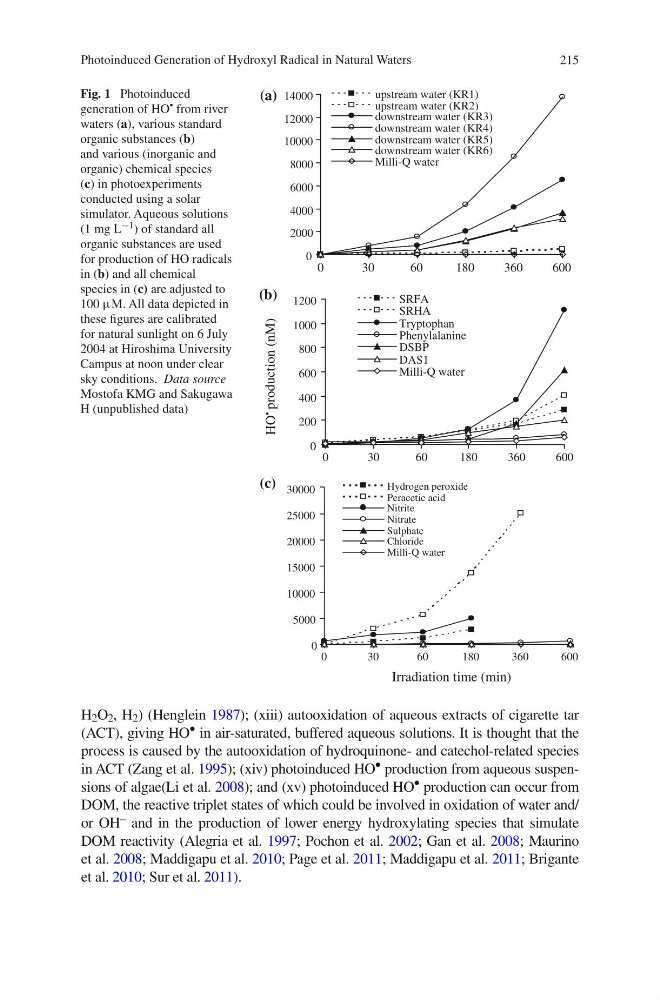
Fig. 1 Photoinduced
generation of HO • from river
waters (a), various standard
organic substances (b)
and various (inorganic and
organic) chemical species
(c) in photoexperiments
conducted using a solar
simulator. Aqueous solutions
(1 mg L −1 ) of standard all
organic substances are used
for production of HO radicals
in (b) and all chemical
species in (c) are adjusted to
100 μM. All data depicted in
these figures are calibrated
for natural sunlight on 6 July
2004 at Hiroshima University
Campus at noon under clear
sky conditions. Data source
Mostofa KMG and Sakugawa
H (unpublished data)
0
2000
4000
6000
8000
10000
12000
14000
0
3 0
6 0
180
360
600
upstream water (KR1)
upstream water (KR2)
downstream water (KR3)
downstream water (KR4)
downstream water (KR5)
downstream water (KR6)
Milli-Q water
(a)
(b)
0
200
400
600
800
1000
1200
0
3 0
6 0
180
360
600
SRFA
SRHA
Tryptophan
Phenylalanine
DSBP
DAS1
Milli-Q water
0
5000
10000
15000
20000
25000
30000
0
3 0
6 0
180
360
6 00
Hydrogen peroxide
Peracetic acid
Nitrite
Nitrate
Sulphate
Chloride
Milli-Q water
Irradiation time (min)
(c)
HO
•
production (nM)
Photoinduced Generation of Hydroxyl Radical in Natural Waters
H 2 O 2 , H 2 ) (Henglein 1987); (xiii) autooxidation of aqueous extracts of cigarette tar
(ACT), giving HO
• in air-saturated, buffered aqueous solutions. It is thought that the
process is caused by the autooxidation of hydroquinone- and catechol-related species
in ACT (Zang et al. 1995); (xiv) photoinduced HO
• production from aqueous suspensions of algae(Li et al. 2008); and (xv) photoinduced HO
• production can occur from
DOM, the reactive triplet states of which could be involved in oxidation of water and/
or OH – and in the production of lower energy hydroxylating species that simulate
DOM reactivity (Alegria et al. 1997; Pochon et al. 2002; Gan et al. 2008; Maurino
et al. 2008; Maddigapu et al. 2010; Page et al. 2011; Maddigapu et al. 2011; Brigante
et al. 2010; Sur et al. 2011).
Fig. 1 Photoinduced
generation of HO • from river
waters (a), various standard
organic substances (b)
and various (inorganic and
organic) chemical species
(c) in photoexperiments
conducted using a solar
simulator. Aqueous solutions
(1 mg L −1 ) of standard all
organic substances are used
for production of HO radicals
in (b) and all chemical
species in (c) are adjusted to
100 μM. All data depicted in
these figures are calibrated
for natural sunlight on 6 July
2004 at Hiroshima University
Campus at noon under clear
sky conditions. Data source
Mostofa KMG and Sakugawa
H (unpublished data)
0
2000
4000
6000
8000
10000
12000
14000
0
3 0
6 0
180
360
600
upstream water (KR1)
upstream water (KR2)
downstream water (KR3)
downstream water (KR4)
downstream water (KR5)
downstream water (KR6)
Milli-Q water
(a)
(b)
0
200
400
600
800
1000
1200
0
3 0
6 0
180
360
600
SRFA
SRHA
Tryptophan
Phenylalanine
DSBP
DAS1
Milli-Q water
0
5000
10000
15000
20000
25000
30000
0
3 0
6 0
180
360
6 00
Hydrogen peroxide
Peracetic acid
Nitrite
Nitrate
Sulphate
Chloride
Milli-Q water
Irradiation time (min)
(c)
HO
•
production (nM)