

194
K. M. G. Mostofa et al.
substances (Fu et al. 2010; Mostofa et al. (Manuscript In preparation); Hamanaka
et al. 2002; Hayakawa 2004; Farjalla et al. 2006).
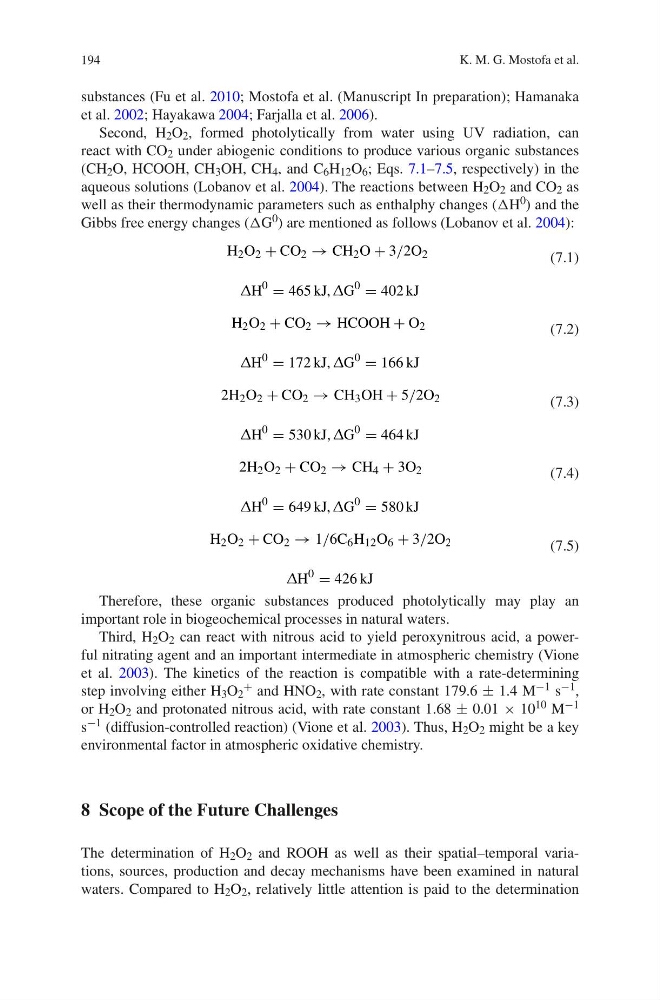
Second, H 2 O 2 , formed photolytically from water using UV radiation, can
react with CO 2 under abiogenic conditions to produce various organic substances
(CH 2 O, HCOOH, CH 3 OH, CH 4 , and C 6 H 12 O 6 ; Eqs. 7.1–7.5, respectively) in the
aqueous solutions (Lobanov et al. 2004). The reactions between H 2 O 2 and CO 2 as
well as their thermodynamic parameters such as enthalphy changes (ΔH 0 ) and the
Gibbs free energy changes (ΔG 0 ) are mentioned as follows (Lobanov et al. 2004):
Therefore, these organic substances produced photolytically may play an
important role in biogeochemical processes in natural waters.
Third, H 2 O 2 can react with nitrous acid to yield peroxynitrous acid, a powerful nitrating agent and an important intermediate in atmospheric chemistry (Vione
et al. 2003). The kinetics of the reaction is compatible with a rate-determining
step involving either H 3 O 2
+ and HNO 2 , with rate constant 179.6 ± 1.4 M −1 s −1 ,
or H 2 O 2 and protonated nitrous acid, with rate constant 1.68 ± 0.01 × 10 10 M −1
s −1 (diffusion-controlled reaction) (Vione et al. 2003). Thus, H 2 O 2 might be a key
environmental factor in atmospheric oxidative chemistry.
8 Scope of the Future Challenges
The determination of H 2 O 2 and ROOH as well as their spatial–temporal variations, sources, production and decay mechanisms have been examined in natural
waters. Compared to H 2 O 2 , relatively little attention is paid to the determination
(7.1)
H 2 O 2 + CO 2 → CH 2 O + 3/2O 2
∆H
0 = 465 kJ, ∆G
0 = 402 kJ
∆H
0 = 465 kJ, ∆G
0 = 402 kJ
(7.2)
H 2 O 2 + CO 2 → HCOOH + O 2
∆H
0 = 172 kJ, ∆G
0 = 166 kJ
∆H
0 = 172 kJ, ∆G
0 = 166 kJ
(7.3)
2H 2 O 2 + CO 2 → CH 3 OH + 5/2O 2
∆H
0 = 530 kJ, ∆G
0 = 464 kJ
∆H
0 = 530 kJ, ∆G
0 = 464 kJ
(7.4)
2H 2 O 2 + CO 2 → CH 4 + 3O 2
∆H
0 = 649 kJ, ∆G
0 = 580 kJ
∆H
0 = 649 kJ, ∆G
0 = 580 kJ
(7.5)
H 2 O 2 + CO 2 → 1/6C 6 H 12 O 6 + 3/2O 2
∆H
0 = 426 kJ
∆H
0 = 426 kJ
K. M. G. Mostofa et al.
substances (Fu et al. 2010; Mostofa et al. (Manuscript In preparation); Hamanaka
et al. 2002; Hayakawa 2004; Farjalla et al. 2006).
Second, H 2 O 2 , formed photolytically from water using UV radiation, can
react with CO 2 under abiogenic conditions to produce various organic substances
(CH 2 O, HCOOH, CH 3 OH, CH 4 , and C 6 H 12 O 6 ; Eqs. 7.1–7.5, respectively) in the
aqueous solutions (Lobanov et al. 2004). The reactions between H 2 O 2 and CO 2 as
well as their thermodynamic parameters such as enthalphy changes (ΔH 0 ) and the
Gibbs free energy changes (ΔG 0 ) are mentioned as follows (Lobanov et al. 2004):
Therefore, these organic substances produced photolytically may play an
important role in biogeochemical processes in natural waters.
Third, H 2 O 2 can react with nitrous acid to yield peroxynitrous acid, a powerful nitrating agent and an important intermediate in atmospheric chemistry (Vione
et al. 2003). The kinetics of the reaction is compatible with a rate-determining
step involving either H 3 O 2
+ and HNO 2 , with rate constant 179.6 ± 1.4 M −1 s −1 ,
or H 2 O 2 and protonated nitrous acid, with rate constant 1.68 ± 0.01 × 10 10 M −1
s −1 (diffusion-controlled reaction) (Vione et al. 2003). Thus, H 2 O 2 might be a key
environmental factor in atmospheric oxidative chemistry.
8 Scope of the Future Challenges
The determination of H 2 O 2 and ROOH as well as their spatial–temporal variations, sources, production and decay mechanisms have been examined in natural
waters. Compared to H 2 O 2 , relatively little attention is paid to the determination
(7.1)
H 2 O 2 + CO 2 → CH 2 O + 3/2O 2
∆H
0 = 465 kJ, ∆G
0 = 402 kJ
∆H
0 = 465 kJ, ∆G
0 = 402 kJ
(7.2)
H 2 O 2 + CO 2 → HCOOH + O 2
∆H
0 = 172 kJ, ∆G
0 = 166 kJ
∆H
0 = 172 kJ, ∆G
0 = 166 kJ
(7.3)
2H 2 O 2 + CO 2 → CH 3 OH + 5/2O 2
∆H
0 = 530 kJ, ∆G
0 = 464 kJ
∆H
0 = 530 kJ, ∆G
0 = 464 kJ
(7.4)
2H 2 O 2 + CO 2 → CH 4 + 3O 2
∆H
0 = 649 kJ, ∆G
0 = 580 kJ
∆H
0 = 649 kJ, ∆G
0 = 580 kJ
(7.5)
H 2 O 2 + CO 2 → 1/6C 6 H 12 O 6 + 3/2O 2
∆H
0 = 426 kJ
∆H
0 = 426 kJ