

144
K. M. G. Mostofa et al.
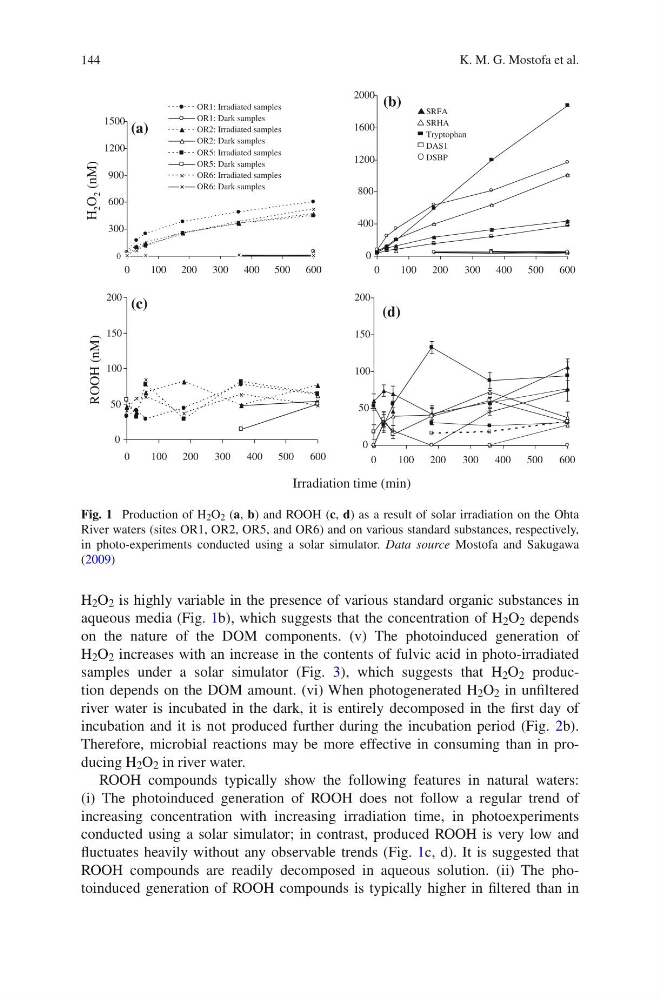
H 2 O 2 is highly variable in the presence of various standard organic substances in
aqueous media (Fig. 1b), which suggests that the concentration of H 2 O 2 depends
on the nature of the DOM components. (v) The photoinduced generation of
H 2 O 2 increases with an increase in the contents of fulvic acid in photo- irradiated
samples under a solar simulator (Fig. 3), which suggests that H 2 O 2 production depends on the DOM amount. (vi) When photogenerated H 2 O 2 in unfiltered
river water is incubated in the dark, it is entirely decomposed in the first day of
incubation and it is not produced further during the incubation period (Fig. 2b).
Therefore, microbial reactions may be more effective in consuming than in producing H 2 O 2 in river water.
ROOH compounds typically show the following features in natural waters:
(i) The photoinduced generation of ROOH does not follow a regular trend of
increasing concentration with increasing irradiation time, in photoexperiments
conducted using a solar simulator; in contrast, produced ROOH is very low and
fluctuates heavily without any observable trends (Fig. 1c, d). It is suggested that
ROOH compounds are readily decomposed in aqueous solution. (ii) The photoinduced generation of ROOH compounds is typically higher in filtered than in
0
400
800
1200
1600
2000
0
100
200
300
400
500
600
SRFA
SRHA
Tryptophan
DAS1
DSBP
0
50
100
150
200
0
100
200
300
400
500
600
0
300
600
900
1200
1500
0
100 200 300 400 500 600
OR1: Irradiated samples
OR1: Dark samples
OR2: Irradiated samples
OR2: Dark samples
OR5: Irradiated samples
OR5: Dark samples
OR6: Irradiated samples
OR6: Dark samples
0
50
100
150
200
0
100 200
300
400 500
600
H
2 O
2 (nM)
ROOH (nM)
Irradiation time (min)
(a)
(c)
(b)
(d)
Fig. 1 Production of H 2 O 2 (a, b) and ROOH (c, d) as a result of solar irradiation on the Ohta
River waters (sites OR1, OR2, OR5, and OR6) and on various standard substances, respectively,
in photo-experiments conducted using a solar simulator. Data source Mostofa and Sakugawa
(2009)
K. M. G. Mostofa et al.
H 2 O 2 is highly variable in the presence of various standard organic substances in
aqueous media (Fig. 1b), which suggests that the concentration of H 2 O 2 depends
on the nature of the DOM components. (v) The photoinduced generation of
H 2 O 2 increases with an increase in the contents of fulvic acid in photo- irradiated
samples under a solar simulator (Fig. 3), which suggests that H 2 O 2 production depends on the DOM amount. (vi) When photogenerated H 2 O 2 in unfiltered
river water is incubated in the dark, it is entirely decomposed in the first day of
incubation and it is not produced further during the incubation period (Fig. 2b).
Therefore, microbial reactions may be more effective in consuming than in producing H 2 O 2 in river water.
ROOH compounds typically show the following features in natural waters:
(i) The photoinduced generation of ROOH does not follow a regular trend of
increasing concentration with increasing irradiation time, in photoexperiments
conducted using a solar simulator; in contrast, produced ROOH is very low and
fluctuates heavily without any observable trends (Fig. 1c, d). It is suggested that
ROOH compounds are readily decomposed in aqueous solution. (ii) The photoinduced generation of ROOH compounds is typically higher in filtered than in
0
400
800
1200
1600
2000
0
100
200
300
400
500
600
SRFA
SRHA
Tryptophan
DAS1
DSBP
0
50
100
150
200
0
100
200
300
400
500
600
0
300
600
900
1200
1500
0
100 200 300 400 500 600
OR1: Irradiated samples
OR1: Dark samples
OR2: Irradiated samples
OR2: Dark samples
OR5: Irradiated samples
OR5: Dark samples
OR6: Irradiated samples
OR6: Dark samples
0
50
100
150
200
0
100 200
300
400 500
600
H
2 O
2 (nM)
ROOH (nM)
Irradiation time (min)
(a)
(c)
(b)
(d)
Fig. 1 Production of H 2 O 2 (a, b) and ROOH (c, d) as a result of solar irradiation on the Ohta
River waters (sites OR1, OR2, OR5, and OR6) and on various standard substances, respectively,
in photo-experiments conducted using a solar simulator. Data source Mostofa and Sakugawa
(2009)