

.:...
.s::.
CI
';
~
""0
CI
E
C!
§.
~
4. Lipids in Freshwater Zooplankton
77
5
o
-e- Eplllmentic algae from 3.0 m
• (). Metalimnetic algae from 6.5 m
4
0 ..
3
2
iii
CI
~
O~--~----------~--------~--------~~--June 9
June 11
June 13
June 15
."';"
iii
E
'2
III
C!
§.
~
~
....
• !::!
II)
cS
1.5
E
-e- D. slci/Is from 3.0 m
-A- D. sicl/ls from 6.5 m
1.0
0.5
0.0 +----~---~---..,......---.,.._--_..,.---_.
June 11
June 13
June 15
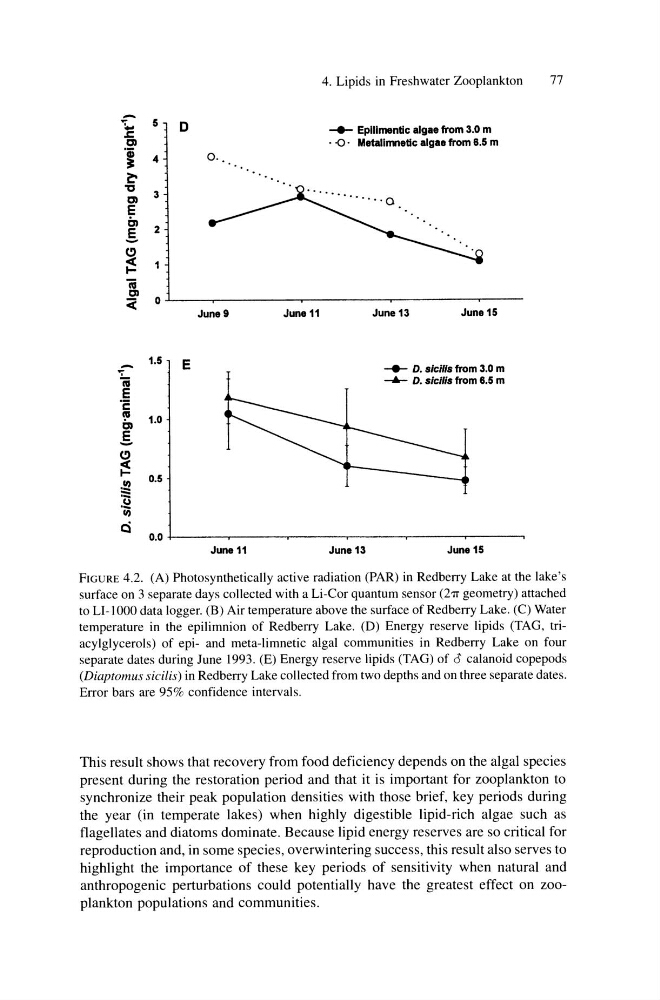
FIGURE 4.2. (A) Photosynthetically active radiation (PAR) in Redberry Lake at the lake's
surface on 3 separate days collected with a Li-Cor quantum sensor (2TI geometry) attached
to U-I 000 data logger. (B) Air temperature above the surface of Redberry Lake. (C) Water
temperature in the epilimnion of Redberry Lake. (D) Energy reserve lipids (TAG, triacylglycerols) of epi- and meta-limnetic algal communities in Redberry Lake on four
separate dates during June 1993. (E) Energy reserve lipids (TAG) of 0 calanoid copepods
(Diaptomus sicilis) in Redberry Lake collected from two depths and on three separate dates.
Error bars are 95% confidence intervals.
This result shows that recovery from food deficiency depends on the algal species
present during the restoration period and that it is important for zooplankton to
synchronize their peak population densities with those brief, key periods during
the year (in temperate lakes) when highly digestible lipid-rich algae such as
flagellates and diatoms dominate. Because lipid energy reserves are so critical for
reproduction and, in some species, overwintering success, this result also serves to
highlight the importance of these key periods of sensitivity when natural and
anthropogenic perturbations could potentially have the greatest effect on zooplankton populations and communities.
.s::.
CI
';
~
""0
CI
E
C!
§.
~
4. Lipids in Freshwater Zooplankton
77
5
o
-e- Eplllmentic algae from 3.0 m
• (). Metalimnetic algae from 6.5 m
4
0 ..
3
2
iii
CI
~
O~--~----------~--------~--------~~--June 9
June 11
June 13
June 15
."';"
iii
E
'2
III
C!
§.
~
~
....
• !::!
II)
cS
1.5
E
-e- D. slci/Is from 3.0 m
-A- D. sicl/ls from 6.5 m
1.0
0.5
0.0 +----~---~---..,......---.,.._--_..,.---_.
June 11
June 13
June 15
FIGURE 4.2. (A) Photosynthetically active radiation (PAR) in Redberry Lake at the lake's
surface on 3 separate days collected with a Li-Cor quantum sensor (2TI geometry) attached
to U-I 000 data logger. (B) Air temperature above the surface of Redberry Lake. (C) Water
temperature in the epilimnion of Redberry Lake. (D) Energy reserve lipids (TAG, triacylglycerols) of epi- and meta-limnetic algal communities in Redberry Lake on four
separate dates during June 1993. (E) Energy reserve lipids (TAG) of 0 calanoid copepods
(Diaptomus sicilis) in Redberry Lake collected from two depths and on three separate dates.
Error bars are 95% confidence intervals.
This result shows that recovery from food deficiency depends on the algal species
present during the restoration period and that it is important for zooplankton to
synchronize their peak population densities with those brief, key periods during
the year (in temperate lakes) when highly digestible lipid-rich algae such as
flagellates and diatoms dominate. Because lipid energy reserves are so critical for
reproduction and, in some species, overwintering success, this result also serves to
highlight the importance of these key periods of sensitivity when natural and
anthropogenic perturbations could potentially have the greatest effect on zooplankton populations and communities.