

I. Lipid Determination in Aquatic Samples
15
23567 9
15
' Ii I
4
12 13
11
10
8
14
17
~~JLA) 1~~A~_~_~1_
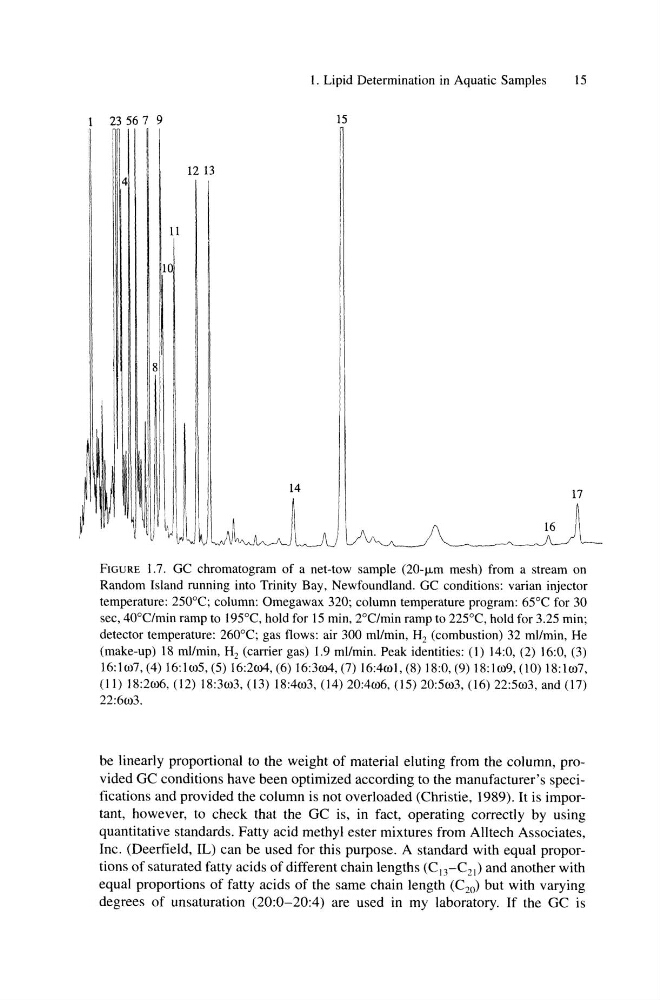
FIGURE 1.7. GC chromatogram of a net-tow sample (20-fLm mesh) from a stream on
Random Island running into Trinity Bay, Newfoundland. GC conditions: varian injector
temperature: 250°C; column: Omegawax 320; column temperature program: 65°C for 30
sec, 40°C/min ramp to 195°C, hold for 15 min, 2°C/min ramp to 225°C, hold for 3.25 min;
detector temperature: 260°C; gas flows: air 300 mllmin, H2 (combustion) 32 ml/min, He
(make-up) 18 ml/min, H2 (carrier gas) 1.9 mllmin. Peak identities: (I) 14:0, (2) 16:0, (3)
16:10)7, (4) 16:10)5, (5) 16:2w4, (6) 16:3w4, (7) 16:40)1, (8) 18:0, (9) 18:10)9, (10) 18:10)7,
(11) 18:20)6, (12) 18:30)3, (13) 18:40)3, (14) 20:40)6, (15) 20:50)3, (16) 22:50)3, and (17)
22:60)3.
be linearly proportional to the weight of material eluting from the column, provided GC conditions have been optimized according to the manufacturer's specifications and provided the column is not overloaded (Christie, 1989). It is important, however, to check that the GC is, in fact, operating correctly by using
quantitative standards. Fatty acid methyl ester mixtures from Alltech Associates,
Inc. (Deerfield, IL) can be used for this purpose. A standard with equal proportions of saturated fatty acids of different chain lengths (C 13 -C 21 ) and another with
equal proportions of fatty acids of the same chain length (C 20 ) but with varying
degrees of unsaturation (20:0-20:4) are used in my laboratory. If the GC is
15
23567 9
15
' Ii I
4
12 13
11
10
8
14
17
~~JLA) 1~~A~_~_~1_
FIGURE 1.7. GC chromatogram of a net-tow sample (20-fLm mesh) from a stream on
Random Island running into Trinity Bay, Newfoundland. GC conditions: varian injector
temperature: 250°C; column: Omegawax 320; column temperature program: 65°C for 30
sec, 40°C/min ramp to 195°C, hold for 15 min, 2°C/min ramp to 225°C, hold for 3.25 min;
detector temperature: 260°C; gas flows: air 300 mllmin, H2 (combustion) 32 ml/min, He
(make-up) 18 ml/min, H2 (carrier gas) 1.9 mllmin. Peak identities: (I) 14:0, (2) 16:0, (3)
16:10)7, (4) 16:10)5, (5) 16:2w4, (6) 16:3w4, (7) 16:40)1, (8) 18:0, (9) 18:10)9, (10) 18:10)7,
(11) 18:20)6, (12) 18:30)3, (13) 18:40)3, (14) 20:40)6, (15) 20:50)3, (16) 22:50)3, and (17)
22:60)3.
be linearly proportional to the weight of material eluting from the column, provided GC conditions have been optimized according to the manufacturer's specifications and provided the column is not overloaded (Christie, 1989). It is important, however, to check that the GC is, in fact, operating correctly by using
quantitative standards. Fatty acid methyl ester mixtures from Alltech Associates,
Inc. (Deerfield, IL) can be used for this purpose. A standard with equal proportions of saturated fatty acids of different chain lengths (C 13 -C 21 ) and another with
equal proportions of fatty acids of the same chain length (C 20 ) but with varying
degrees of unsaturation (20:0-20:4) are used in my laboratory. If the GC is