

276
KG. Ackman
Figure 11.3 assembles almost all possible fatty acids commonly identified in
fish and shellfish lipids in both marine and freshwater environments. Certain
generalities in the fatty acid percentages in oils or total lipids can be observed.
Tables 11.1 and 11.2 are designed to summarize such similarities in the three types
of fatty acids. Modem capillary GLC can easily identify 30-50 fatty acids for
marine invertebrates such as sea urchins (Takagi et aI., 1986) or fish from either
freshwater (Linko et aI., 1992) or marine (Sigurgislad6ttir and Palmad6ttir, 1993)
sources. Except in cases of exotic fatty acids used as tracers in food chains, a
minimum of 14 fatty acids usually is sufficient to describe a lipid (Table 11.2). A
few extra (e.g., 20:4(f)3, 22:5(f)6) can be included but tend to be minor components
as shown in Table 11.1. However, 16:0 (palmitic acid) invariably is the most
o
0
'"
ici ici
cD
0
o~
' "
cD
~
~
_1 ~
i
,
C
Fish Oil Fatty Acids
Brevoortia tyrannis
OJ
C
Algal Total Fatty Acids
Chaetoceros ca/citrans
"? c
'
~
I
tC
I
IJH
Time - -
"? c
LO
C:i
N
C')
C
l{)
0
N
"? c
N
C')
C
N
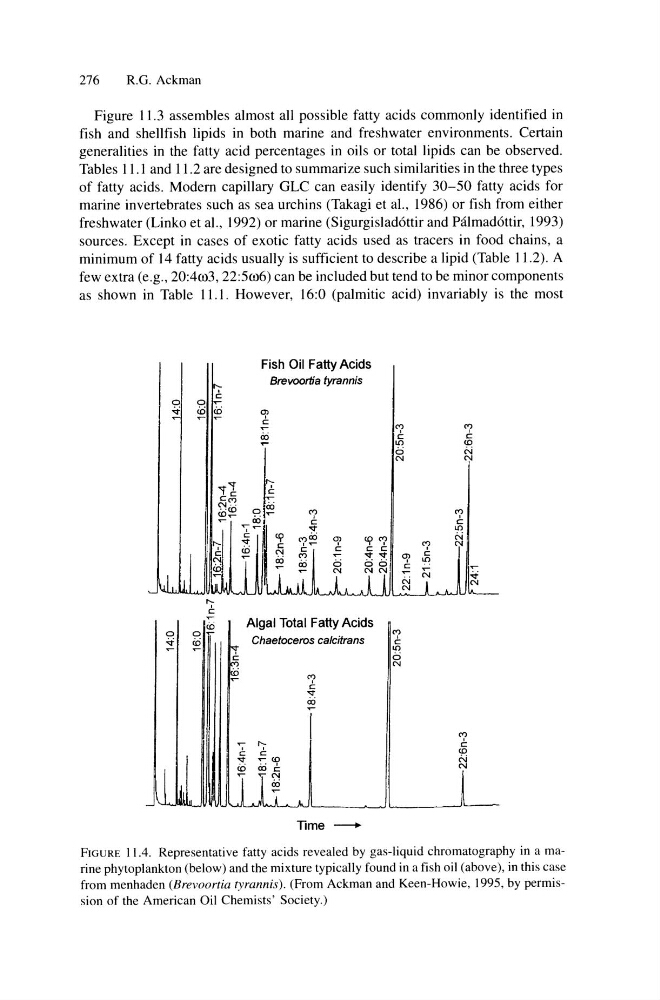
FIGURE 11.4. Representative fatty acids revealed by gas-liquid chromatography in a marine phytoplankton (below) and the mixture typically found in a fish oil (above), in this case
from menhaden (Brevoortia tyrannis). (From Ackman and Keen-Howie, 1995, by permission of the American Oil Chemists' Society.)
KG. Ackman
Figure 11.3 assembles almost all possible fatty acids commonly identified in
fish and shellfish lipids in both marine and freshwater environments. Certain
generalities in the fatty acid percentages in oils or total lipids can be observed.
Tables 11.1 and 11.2 are designed to summarize such similarities in the three types
of fatty acids. Modem capillary GLC can easily identify 30-50 fatty acids for
marine invertebrates such as sea urchins (Takagi et aI., 1986) or fish from either
freshwater (Linko et aI., 1992) or marine (Sigurgislad6ttir and Palmad6ttir, 1993)
sources. Except in cases of exotic fatty acids used as tracers in food chains, a
minimum of 14 fatty acids usually is sufficient to describe a lipid (Table 11.2). A
few extra (e.g., 20:4(f)3, 22:5(f)6) can be included but tend to be minor components
as shown in Table 11.1. However, 16:0 (palmitic acid) invariably is the most
o
0
'"
ici ici
cD
0
o~
' "
cD
~
~
_1 ~
i
,
C
Fish Oil Fatty Acids
Brevoortia tyrannis
OJ
C
Algal Total Fatty Acids
Chaetoceros ca/citrans
"? c
'
~
I
tC
I
IJH
Time - -
"? c
LO
C:i
N
C')
C
l{)
0
N
"? c
N
C')
C
N
FIGURE 11.4. Representative fatty acids revealed by gas-liquid chromatography in a marine phytoplankton (below) and the mixture typically found in a fish oil (above), in this case
from menhaden (Brevoortia tyrannis). (From Ackman and Keen-Howie, 1995, by permission of the American Oil Chemists' Society.)