

274
R.G. Ackman
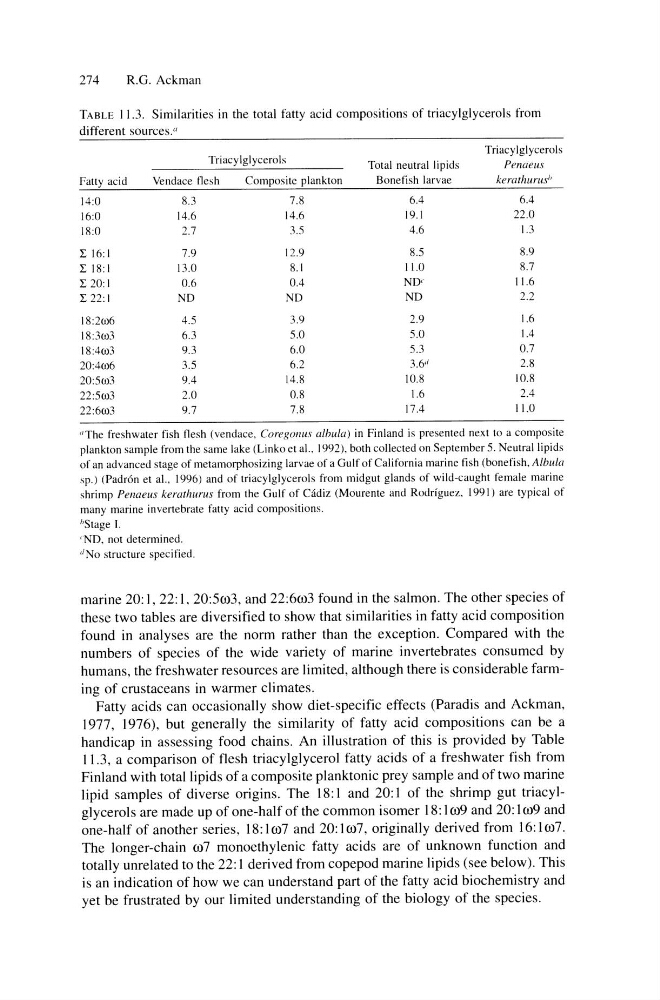
TABLE 11.3. Similarities in the total fatty acid compositions of triacylg\ycero\s from
different sources."
Triacy I gl ycerols
Triacylglycerols
Total neutral lipids
Penaeus
Fatty acid
Vendace nesh
Composite plankton
Bonefish larvae
kerathurus/;
14:0
)1.3
7.8
6.4
6.4
16:0
14.6
14.6
19.1
22.0
18:0
2.7
3.5
4.6
1.3
L 16:1
7.9
12.9
8.5
8.9
L 18:1
13.0
8.1
11.0
8.7
L 20:1
0.6
0.4
NO'
11.6
L 22:1
NO
NO
NO
2.2
18:2006
4.5
3.9
2.9
1.6
18:3003
6.3
5.0
5.0
1.4
18:4003
9.3
6.0
5.3
0.7
20:4006
3.5
6.2
3.6<1
2.8
20:5003
').4
14.8
10.8
10.8
22:5003
2.0
0.8
1.6
2.4
22:6003
').7
7.8
17.4
II.n
"The freshwater fish nesh (vendace. Coregollus albula) in Finland is presented next to a composite
plankton sample from the same lake (Linko et al.. 1992), both collected on September 5. Neutral lipids
of an advanced stage of metamorphosizing larvae of a Gulf of California marine fish (bonefish. Albula
sp.) (Padron et al.. 1996) and of triacylglycerols from midgut glands of wild-caught female marine
shrimp Penaeus kerathurus from the Gulf of Cadiz (Mourente and Rodriguez, 1991) are typical of
many marine invertebrate fatty acid compositions.
"Stage I.
'NO, not determined.
marine 20: I, 22: I. 20:5w3, and 22:6w3 found in the salmon. The other species of
these two tables are diversified to show that similarities in fatty acid composition
found in analyses are the norm rather than the exception. Compared with the
numbers of species of the wide variety of marine invertebrates consumed by
humans, the freshwater resources are limited, although there is considerable farming of crustaceans in warmer climates.
Fatty acids can occasionally show diet-specific effects (Paradis and Ackman,
1977, 1976), but generally the similarity of fatty acid compositions can be a
handicap in assessing food chains. An illustration of this is provided by Table
11.3, a comparison of flesh triacylglyceroJ fatty acids of a freshwater fish from
Finland with total lipids of a composite planktonic prey sample and of two marine
lipid samples of diverse origins. The 18: I and 20: I of the shrimp gut triacylglycerols are made up of one-half of the common isomer 18: I w9 and 20: I w9 and
one-half of another series, 18: I w7 and 20: I w7, originally derived from 16: I w7.
The longer-chain w7 monoethylenic fatty acids are of unknown function and
totally unrelated to the 22: I derived from copepod marine lipids (see below). This
is an indication of how we can understand part of the fatty acid biochemistry and
yet be frustrated by our limited understanding of the biology of the species.
R.G. Ackman
TABLE 11.3. Similarities in the total fatty acid compositions of triacylg\ycero\s from
different sources."
Triacy I gl ycerols
Triacylglycerols
Total neutral lipids
Penaeus
Fatty acid
Vendace nesh
Composite plankton
Bonefish larvae
kerathurus/;
14:0
)1.3
7.8
6.4
6.4
16:0
14.6
14.6
19.1
22.0
18:0
2.7
3.5
4.6
1.3
L 16:1
7.9
12.9
8.5
8.9
L 18:1
13.0
8.1
11.0
8.7
L 20:1
0.6
0.4
NO'
11.6
L 22:1
NO
NO
NO
2.2
18:2006
4.5
3.9
2.9
1.6
18:3003
6.3
5.0
5.0
1.4
18:4003
9.3
6.0
5.3
0.7
20:4006
3.5
6.2
3.6<1
2.8
20:5003
').4
14.8
10.8
10.8
22:5003
2.0
0.8
1.6
2.4
22:6003
').7
7.8
17.4
II.n
"The freshwater fish nesh (vendace. Coregollus albula) in Finland is presented next to a composite
plankton sample from the same lake (Linko et al.. 1992), both collected on September 5. Neutral lipids
of an advanced stage of metamorphosizing larvae of a Gulf of California marine fish (bonefish. Albula
sp.) (Padron et al.. 1996) and of triacylglycerols from midgut glands of wild-caught female marine
shrimp Penaeus kerathurus from the Gulf of Cadiz (Mourente and Rodriguez, 1991) are typical of
many marine invertebrate fatty acid compositions.
"Stage I.
'NO, not determined.
marine 20: I, 22: I. 20:5w3, and 22:6w3 found in the salmon. The other species of
these two tables are diversified to show that similarities in fatty acid composition
found in analyses are the norm rather than the exception. Compared with the
numbers of species of the wide variety of marine invertebrates consumed by
humans, the freshwater resources are limited, although there is considerable farming of crustaceans in warmer climates.
Fatty acids can occasionally show diet-specific effects (Paradis and Ackman,
1977, 1976), but generally the similarity of fatty acid compositions can be a
handicap in assessing food chains. An illustration of this is provided by Table
11.3, a comparison of flesh triacylglyceroJ fatty acids of a freshwater fish from
Finland with total lipids of a composite planktonic prey sample and of two marine
lipid samples of diverse origins. The 18: I and 20: I of the shrimp gut triacylglycerols are made up of one-half of the common isomer 18: I w9 and 20: I w9 and
one-half of another series, 18: I w7 and 20: I w7, originally derived from 16: I w7.
The longer-chain w7 monoethylenic fatty acids are of unknown function and
totally unrelated to the 22: I derived from copepod marine lipids (see below). This
is an indication of how we can understand part of the fatty acid biochemistry and
yet be frustrated by our limited understanding of the biology of the species.