

11. Lipids in Marine and Freshwater Organisms
265
the roles of triacylglycerols and wax esters are basically those of energy storage
(Albers et aI., 1996). Free fatty acids are very minor components. They can be
transported around bodies and passed through membranes into cells for catabolism but are usually generated "on site" by appropriate enzymes acting on lipids.
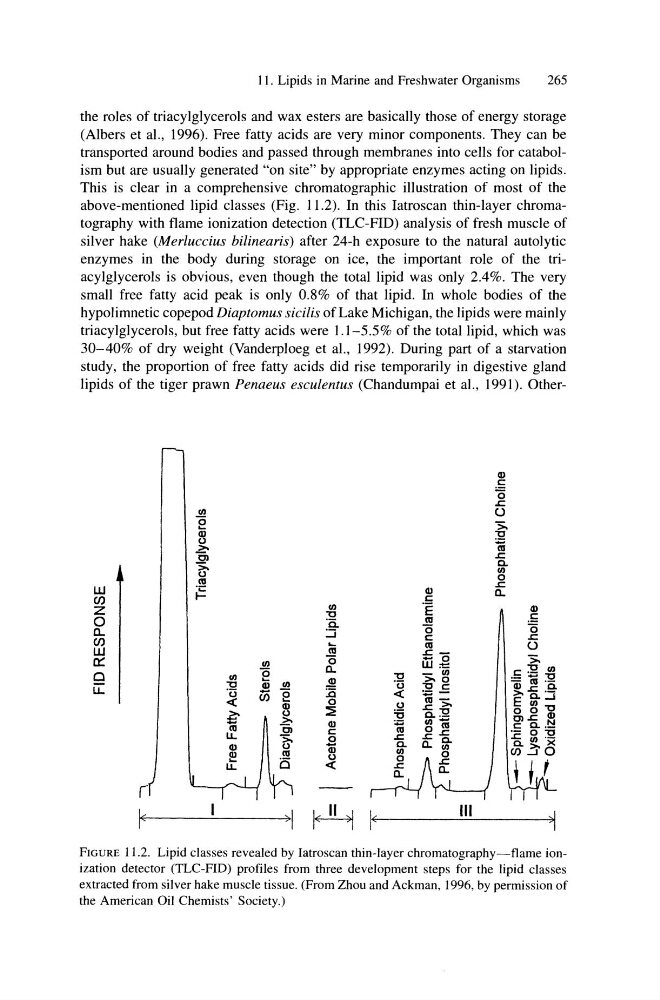
This is clear in a comprehensive chromatographic illustration of most of the
above-mentioned lipid classes (Fig. 11.2). In this Iatroscan thin-layer chromatography with flame ionization detection (TLC-FID) analysis of fresh muscle of
silver hake (Merlueeius bilinearis) after 24-h exposure to the natural autolytic
enzymes in the body during storage on ice, the important role of the triacylglycerols is obvious, even though the total lipid was only 2.4%. The very
small free fatty acid peak is only 0.8% of that lipid. In whole bodies of the
hypolimnetic copepod Diaptomus sieilis of Lake Michigan, the lipids were mainly
triacylglycerols, but free fatty acids were 1.1-5.5% of the total lipid, which was
30-40% of dry weight (Vanderploeg et aI., 1992). During part of a starvation
study, the proportion of free fatty acids did rise temporarily in digestive gland
lipids of the tiger prawn Penaeus eseulentus (Chandumpai et aI., 1991). Otherw
en
z
o
Den
UJ
a::::
Q
u::
en
"0
·Co
::J
...
(II
o 0..
~
:a o
::2
CIl
r:::
i
·u
r:::
·e
(II
o r::: (II
.s= -
-
0
w:!::: _ en
>-0
"0 r:::
1;=
.s=>a. 32
en- o (II
.s=.s=
o..~
~
0..
CIl
.5
o .s=
U
>.
32
iii .s=
a.
en
o
.s=
0..
CIl
.5
o .s=
U
>.
.5;g ~
-
(II . -
~.s:: .9E ~..J
00"0
~"§..~
.- 0 "0
"§.en ·x
(/)3'0
l t ;
~ 1<:-( -_-----'I..:.:..II _ _ ~)I
FIGURE 11.2. Lipid classes revealed by Iatroscan thin-layer chromatography-flame ionization detector (TLC-FID) profiles from three development steps for the lipid classes
extracted from silver hake muscle tissue. (From Zhou and Ackman, 1996, by permission of
the American Oil Chemists' Society.)
265
the roles of triacylglycerols and wax esters are basically those of energy storage
(Albers et aI., 1996). Free fatty acids are very minor components. They can be
transported around bodies and passed through membranes into cells for catabolism but are usually generated "on site" by appropriate enzymes acting on lipids.
This is clear in a comprehensive chromatographic illustration of most of the
above-mentioned lipid classes (Fig. 11.2). In this Iatroscan thin-layer chromatography with flame ionization detection (TLC-FID) analysis of fresh muscle of
silver hake (Merlueeius bilinearis) after 24-h exposure to the natural autolytic
enzymes in the body during storage on ice, the important role of the triacylglycerols is obvious, even though the total lipid was only 2.4%. The very
small free fatty acid peak is only 0.8% of that lipid. In whole bodies of the
hypolimnetic copepod Diaptomus sieilis of Lake Michigan, the lipids were mainly
triacylglycerols, but free fatty acids were 1.1-5.5% of the total lipid, which was
30-40% of dry weight (Vanderploeg et aI., 1992). During part of a starvation
study, the proportion of free fatty acids did rise temporarily in digestive gland
lipids of the tiger prawn Penaeus eseulentus (Chandumpai et aI., 1991). Otherw
en
z
o
Den
UJ
a::::
Q
u::
en
"0
·Co
::J
...
(II
o 0..
~
:a o
::2
CIl
r:::
i
·u
r:::
·e
(II
o r::: (II
.s= -
-
0
w:!::: _ en
>-0
"0 r:::
1;=
.s=>a. 32
en- o (II
.s=.s=
o..~
~
0..
CIl
.5
o .s=
U
>.
32
iii .s=
a.
en
o
.s=
0..
CIl
.5
o .s=
U
>.
.5;g ~
-
(II . -
~.s:: .9E ~..J
00"0
~"§..~
.- 0 "0
"§.en ·x
(/)3'0
l t ;
~ 1<:-( -_-----'I..:.:..II _ _ ~)I
FIGURE 11.2. Lipid classes revealed by Iatroscan thin-layer chromatography-flame ionization detector (TLC-FID) profiles from three development steps for the lipid classes
extracted from silver hake muscle tissue. (From Zhou and Ackman, 1996, by permission of
the American Oil Chemists' Society.)