

252
G.E. Napolitano and D.S. Cicerone
TABLE 10.4. Comparison of the fatty acid constituents (percentage of total fatty acids)
of lipids in the water-surface microlayer and foam from different environments."
Surface microlayer
Foams
Fatty acid
Fresh water
Estuary
Marine
Fresh water
Estuary
Marine
8:0
5.7
10:0
2.8
7.1
12:0
2.7
4.6
26.4
1.5
2.2
14:0
10.9
6.3
28.6
20.7
8.4
4.6
16:0
37.3
26.3
13.6
39.0
20.5
17.0
16: Iw7
7.9
11.6
2.1
11.7
7.4
9.2
18:0
18.6
11.7
2.9
10.1
13.9
7.0
18:lw9
18.1 *
10.2*
2.4*
11.7**
14.5*
25.7
18:lw7
2.1
18:2<06
4.3
1.3
4.5
9.9
18:3w3
0.5
5.1
1.0
18:4w3
0.4
20:5w3
7.3
22:6w3
2.1
Others
4.5
16.2
14.7
5.3
23.5
13.5
1:: SAFA
69.5
57.4
78.6
71.3
45.0
28.6
1:: MUFA
26.0
21.8
4.5
23.4
21.9
37.0
1:: w3
0.5
5.1
10.8
1:: w6
4.3
1.3
4.5
9.9
Referenceb
2
3
4
3
5
"-, Not reported; *, all isomers combined; **, all C-18 unsaturated combined.
bReferences: I, Meyers and Owen, 1980; 2, Gever et aI., 1996; 3, Marty and Choiniere, 1979; 4,
recalculated from Simoneit et aI., 1980; 5, Napolitano et aI., 1995.
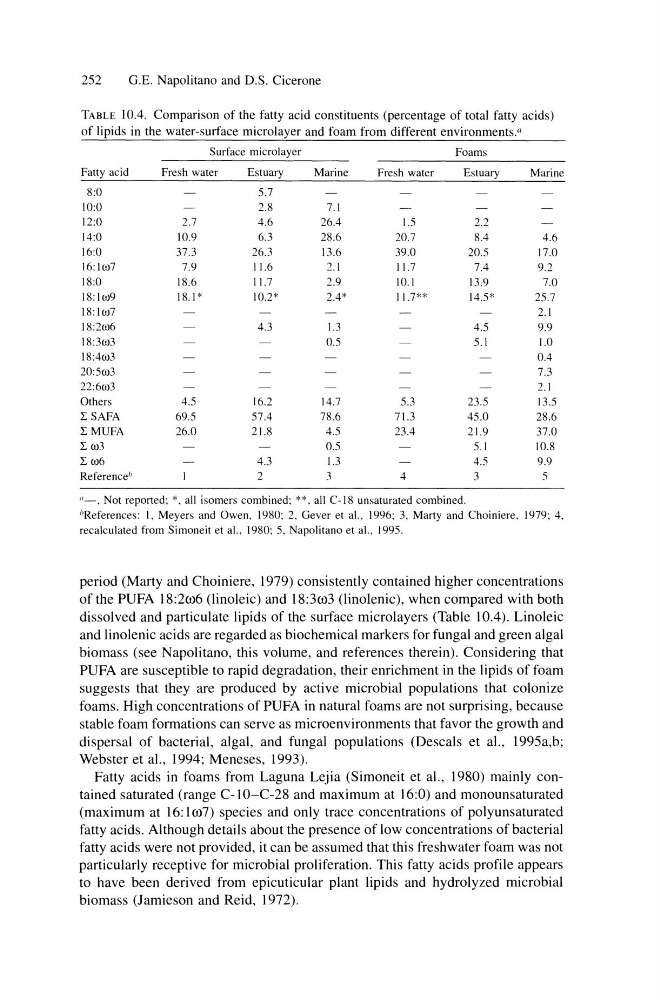
period (Marty and Choiniere, 1979) consistently contained higher concentrations
of the PUFA 18:2ro6 (linoleic) and 18:3ro3 (linolenic), when compared with both
dissolved and particulate lipids of the surface microlayers (Table 10.4). Linoleic
and linolenic acids are regarded as biochemical markers for fungal and green algal
biomass (see Napolitano, this volume, and references therein). Considering that
PUFA are susceptible to rapid degradation, their enrichment in the lipids of foam
suggests that they are produced by active microbial populations that colonize
foams. High concentrations of PUFA in natural foams are not surprising, because
stable foam formations can serve as microenvironments that favor the growth and
dispersal of bacterial, algal, and fungal populations (Descals et aI., 1995a,b;
Webster et aI., 1994; Meneses, 1993).
Fatty acids in foams from Laguna Lejia (Simoneit et aI., 1980) mainly contained saturated (range C-1O-C-28 and maximum at 16:0) and monounsaturated
(maximum at 16:1ro7) species and only trace concentrations of polyunsaturated
fatty acids. Although details about the presence of low concentrations of bacterial
fatty acids were not provided, it can be assumed that this freshwater foam was not
particularly receptive for microbial proliferation. This fatty acids profile appears
to have been derived from epicuticular plant lipids and hydrolyzed microbial
biomass (Jamieson and Reid, 1972).
G.E. Napolitano and D.S. Cicerone
TABLE 10.4. Comparison of the fatty acid constituents (percentage of total fatty acids)
of lipids in the water-surface microlayer and foam from different environments."
Surface microlayer
Foams
Fatty acid
Fresh water
Estuary
Marine
Fresh water
Estuary
Marine
8:0
5.7
10:0
2.8
7.1
12:0
2.7
4.6
26.4
1.5
2.2
14:0
10.9
6.3
28.6
20.7
8.4
4.6
16:0
37.3
26.3
13.6
39.0
20.5
17.0
16: Iw7
7.9
11.6
2.1
11.7
7.4
9.2
18:0
18.6
11.7
2.9
10.1
13.9
7.0
18:lw9
18.1 *
10.2*
2.4*
11.7**
14.5*
25.7
18:lw7
2.1
18:2<06
4.3
1.3
4.5
9.9
18:3w3
0.5
5.1
1.0
18:4w3
0.4
20:5w3
7.3
22:6w3
2.1
Others
4.5
16.2
14.7
5.3
23.5
13.5
1:: SAFA
69.5
57.4
78.6
71.3
45.0
28.6
1:: MUFA
26.0
21.8
4.5
23.4
21.9
37.0
1:: w3
0.5
5.1
10.8
1:: w6
4.3
1.3
4.5
9.9
Referenceb
2
3
4
3
5
"-, Not reported; *, all isomers combined; **, all C-18 unsaturated combined.
bReferences: I, Meyers and Owen, 1980; 2, Gever et aI., 1996; 3, Marty and Choiniere, 1979; 4,
recalculated from Simoneit et aI., 1980; 5, Napolitano et aI., 1995.
period (Marty and Choiniere, 1979) consistently contained higher concentrations
of the PUFA 18:2ro6 (linoleic) and 18:3ro3 (linolenic), when compared with both
dissolved and particulate lipids of the surface microlayers (Table 10.4). Linoleic
and linolenic acids are regarded as biochemical markers for fungal and green algal
biomass (see Napolitano, this volume, and references therein). Considering that
PUFA are susceptible to rapid degradation, their enrichment in the lipids of foam
suggests that they are produced by active microbial populations that colonize
foams. High concentrations of PUFA in natural foams are not surprising, because
stable foam formations can serve as microenvironments that favor the growth and
dispersal of bacterial, algal, and fungal populations (Descals et aI., 1995a,b;
Webster et aI., 1994; Meneses, 1993).
Fatty acids in foams from Laguna Lejia (Simoneit et aI., 1980) mainly contained saturated (range C-1O-C-28 and maximum at 16:0) and monounsaturated
(maximum at 16:1ro7) species and only trace concentrations of polyunsaturated
fatty acids. Although details about the presence of low concentrations of bacterial
fatty acids were not provided, it can be assumed that this freshwater foam was not
particularly receptive for microbial proliferation. This fatty acids profile appears
to have been derived from epicuticular plant lipids and hydrolyzed microbial
biomass (Jamieson and Reid, 1972).