

240
G.E. Napolitano and D.S. Cicerone
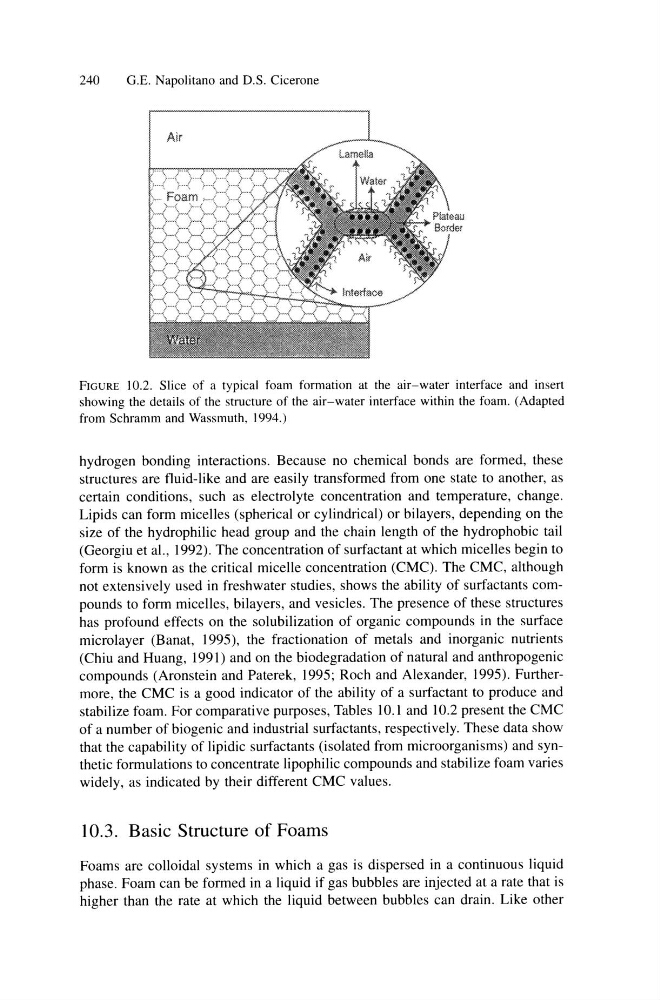
FIGURE 10.2. Slice of a typical foam formation at the air-water interface and insert
showing the details of the structure of the air-water interface within the foam. (Adapted
from Schramm and Wassmuth, 1994.)
hydrogen bonding interactions. Because no chemical bonds are formed, these
structures are fluid-like and are easily transformed from one state to another, as
certain conditions, such as electrolyte concentration and temperature, change.
Lipids can fonn micelles (spherical or cylindrical) or bilayers, depending on the
size of the hydrophilic head group and the chain length of the hydrophobic tail
(Georgiu et aI., 1992). The concentration of surfactant at which micelles begin to
form is known as the critical micelle concentration (CMC). The CMC, although
not extensively used in freshwater studies, shows the ability of surfactants compounds to fonn micelles, bilayers, and vesicles. The presence of these structures
has profound effects on the solubilization of organic compounds in the surface
microlayer (Banat, 1995), the fractionation of metals and inorganic nutrients
(Chiu and Huang, 1991) and on the biodegradation of natural and anthropogenic
compounds (Aronstein and Paterek, 1995; Roch and Alexander, 1995). Furthermore, the CMC is a good indicator of the ability of a surfactant to produce and
stabilize foam. For comparative purposes, Tables 10.1 and 10.2 present the CMC
of a number of biogenic and industrial surfactants, respectively. These data show
that the capability of lipidic surfactants (isolated from microorganisms) and synthetic formulations to concentrate lipophilic compounds and stabilize foam varies
widely, as indicated by their different CMC values.
10.3. Basic Structure of Foams
Foams are colloidal systems in which a gas is dispersed in a continuous liquid
phase. Foam can be fonned in a liquid if gas bubbles are injected at a rate that is
higher than the rate at which the liquid between bubbles can drain. Like other
G.E. Napolitano and D.S. Cicerone
FIGURE 10.2. Slice of a typical foam formation at the air-water interface and insert
showing the details of the structure of the air-water interface within the foam. (Adapted
from Schramm and Wassmuth, 1994.)
hydrogen bonding interactions. Because no chemical bonds are formed, these
structures are fluid-like and are easily transformed from one state to another, as
certain conditions, such as electrolyte concentration and temperature, change.
Lipids can fonn micelles (spherical or cylindrical) or bilayers, depending on the
size of the hydrophilic head group and the chain length of the hydrophobic tail
(Georgiu et aI., 1992). The concentration of surfactant at which micelles begin to
form is known as the critical micelle concentration (CMC). The CMC, although
not extensively used in freshwater studies, shows the ability of surfactants compounds to fonn micelles, bilayers, and vesicles. The presence of these structures
has profound effects on the solubilization of organic compounds in the surface
microlayer (Banat, 1995), the fractionation of metals and inorganic nutrients
(Chiu and Huang, 1991) and on the biodegradation of natural and anthropogenic
compounds (Aronstein and Paterek, 1995; Roch and Alexander, 1995). Furthermore, the CMC is a good indicator of the ability of a surfactant to produce and
stabilize foam. For comparative purposes, Tables 10.1 and 10.2 present the CMC
of a number of biogenic and industrial surfactants, respectively. These data show
that the capability of lipidic surfactants (isolated from microorganisms) and synthetic formulations to concentrate lipophilic compounds and stabilize foam varies
widely, as indicated by their different CMC values.
10.3. Basic Structure of Foams
Foams are colloidal systems in which a gas is dispersed in a continuous liquid
phase. Foam can be fonned in a liquid if gas bubbles are injected at a rate that is
higher than the rate at which the liquid between bubbles can drain. Like other