

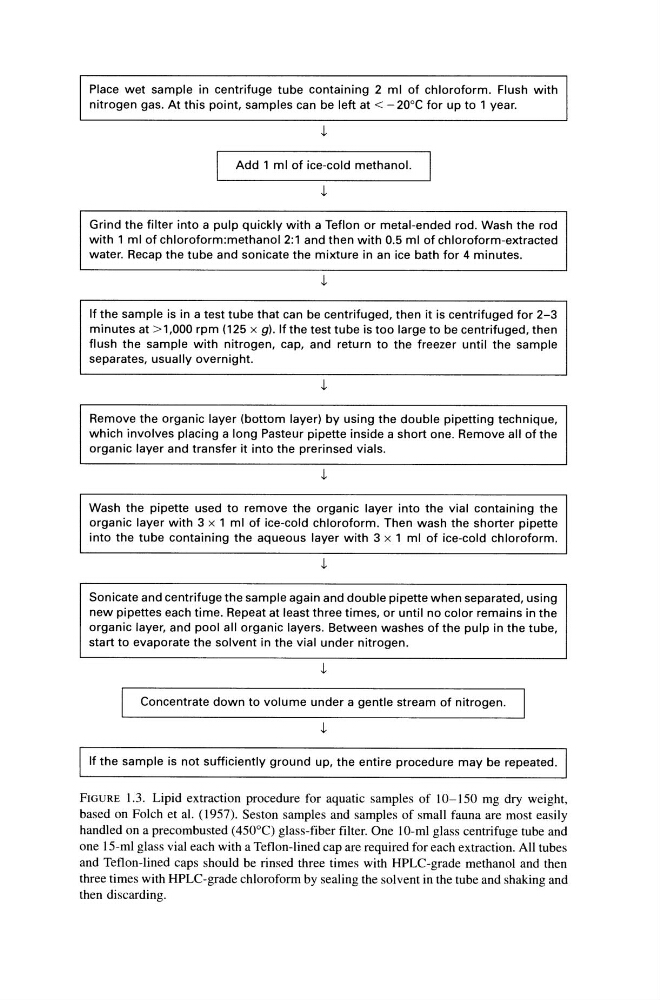
Place wet sample in centrifuge tube containing 2 ml of chloroform. Flush with
nitrogen gas. At this point, samples can be left at < - 20°C for up to 1 year.
Add 1 ml of ice-cold methanol.
Grind the filter into a pulp quickly with a Teflon or metal-ended rod. Wash the rod
with 1 ml of chloroform:methanol 2:1 and then with 0.5 ml of chloroform-extracted
water. Recap the tube and sonicate the mixture in an ice bath for 4 minutes.
If the sample is in a test tube that can be centrifuged, then it is centrifuged for 2-3
minutes at >1,000 rpm (125 x g). Ifthe test tube is too large to be centrifuged, then
flush the sample with nitrogen, cap, and return to the freezer until the sample
separates, usually overnight.
Remove the organic layer (bottom layer) by using the double pipetting technique,
which involves placing a long Pasteur pipette inside a short one. Remove all of the
organic layer and transfer it into the prerinsed vials.
Wash the pipette used to remove the organic layer into the vial containing the
organic layer with 3 x 1 ml of ice-cold chloroform. Then wash the shorter pipette
into the tube containing the aqueous layer with 3 x 1 ml of ice-cold chloroform.
Sonicate and centrifuge the sample again and double pipette when separated, using
new pipettes each time. Repeat at least three times, or until no color remains in the
organic layer, and pool all organic layers. Between washes of the pulp in the tube,
start to evaporate the solvent in the vial under nitrogen.
Concentrate down to volume under a gentle stream of nitrogen.
If the sample is not sufficiently ground up, the entire procedure may be repeated.
FIGURE 1.3. Lipid extraction procedure for aquatic samples of IO-ISO mg dry weight,
based on FoIch et al. (19S7). Seston samples and samples of small fauna are most easily
handled on a precombusted (4S0°C) glass-fiber filter. One IO-ml glass centrifuge tube and
one IS-ml glass vial each with a Teflon-lined cap are required for each extraction. All tubes
and Teflon-lined caps should be rinsed three times with HPLC-grade methanol and then
three times with HPLC-grade chloroform by sealing the solvent in the tube and shaking and
then discarding.
nitrogen gas. At this point, samples can be left at < - 20°C for up to 1 year.
Add 1 ml of ice-cold methanol.
Grind the filter into a pulp quickly with a Teflon or metal-ended rod. Wash the rod
with 1 ml of chloroform:methanol 2:1 and then with 0.5 ml of chloroform-extracted
water. Recap the tube and sonicate the mixture in an ice bath for 4 minutes.
If the sample is in a test tube that can be centrifuged, then it is centrifuged for 2-3
minutes at >1,000 rpm (125 x g). Ifthe test tube is too large to be centrifuged, then
flush the sample with nitrogen, cap, and return to the freezer until the sample
separates, usually overnight.
Remove the organic layer (bottom layer) by using the double pipetting technique,
which involves placing a long Pasteur pipette inside a short one. Remove all of the
organic layer and transfer it into the prerinsed vials.
Wash the pipette used to remove the organic layer into the vial containing the
organic layer with 3 x 1 ml of ice-cold chloroform. Then wash the shorter pipette
into the tube containing the aqueous layer with 3 x 1 ml of ice-cold chloroform.
Sonicate and centrifuge the sample again and double pipette when separated, using
new pipettes each time. Repeat at least three times, or until no color remains in the
organic layer, and pool all organic layers. Between washes of the pulp in the tube,
start to evaporate the solvent in the vial under nitrogen.
Concentrate down to volume under a gentle stream of nitrogen.
If the sample is not sufficiently ground up, the entire procedure may be repeated.
FIGURE 1.3. Lipid extraction procedure for aquatic samples of IO-ISO mg dry weight,
based on FoIch et al. (19S7). Seston samples and samples of small fauna are most easily
handled on a precombusted (4S0°C) glass-fiber filter. One IO-ml glass centrifuge tube and
one IS-ml glass vial each with a Teflon-lined cap are required for each extraction. All tubes
and Teflon-lined caps should be rinsed three times with HPLC-grade methanol and then
three times with HPLC-grade chloroform by sealing the solvent in the tube and shaking and
then discarding.