

9. Bioaccumulation and Trophic Transfer of Organic Contaminants
217
The complexity of assessing food chain accumulation calls for an organizing
principle that can cull factors of little relevance and highlight processes or factors
that are germane. The fugacity concept is particularly useful for discerning the
role of lipids in trophic transfer.
The term/ugacity was originally used to describe the thermodynamic tendency
for a gas to escape from one phase and to enter another. The term comes from the
Latin "fugal" to flee. Fugacity if) is defined in units of pressure (pascals or Pa)
and is related to chemical concentration, C (mol' m- 3 ), through the fugacity
capacity, Z (mol' m- 3 • Pa- I ) where
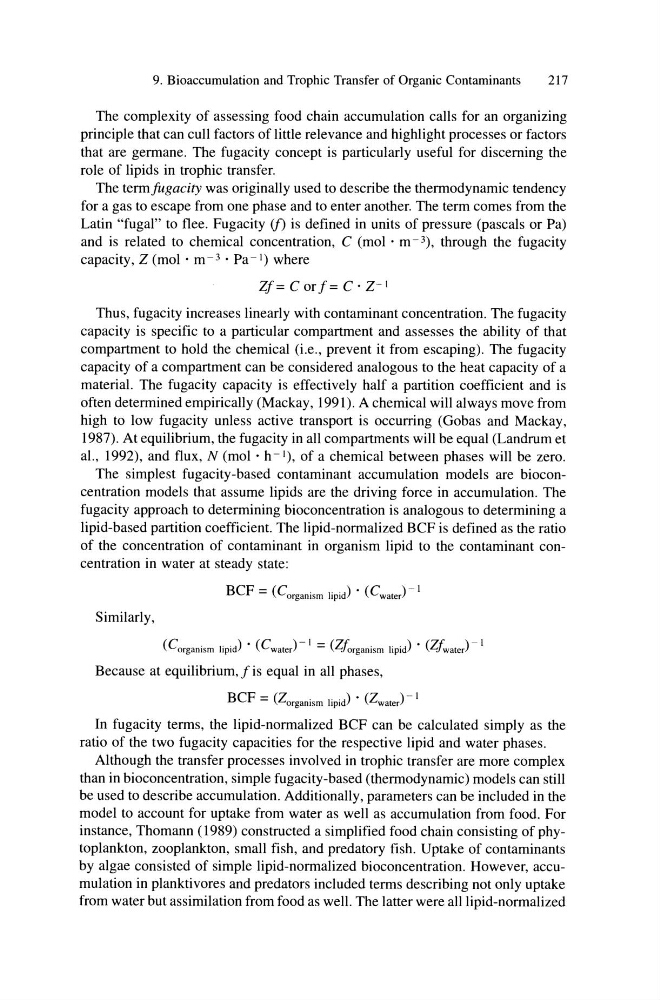
Z/= C or/= C' Z-I
Thus, fugacity increases linearly with contaminant concentration. The fugacity
capacity is specific to a particular compartment and assesses the ability of that
compartment to hold the chemical (i.e., prevent it from escaping). The fugacity
capacity of a compartment can be considered analogous to the heat capacity of a
material. The fugacity capacity is effectively half a partition coefficient and is
often determined empirically (Mackay, 1991). A chemical will always move from
high to low fugacity unless active transport is occurring (Gobas and Mackay,
1987). At equilibrium, the fugacity in all compartments will be equal (Landrum et
aI., 1992), and flux, N (mol· h- 1 ), of a chemical between phases will be zero.
The simplest fugacity-based contaminant accumulation models are bioconcentration models that assume lipids are the driving force in accumulation. The
fugacity approach to determining bioconcentration is analogous to determining a
lipid-based partition coefficient. The lipid-normalized BCF is defined as the ratio
of the concentration of contaminant in organism lipid to the contaminant concentration in water at steady state:
Similarly,
(Corganism lipid) . (Cwater) - I = (Z/organism lipid) . (Z/water) - I
Because at equilibrium, / is equal in all phases,
BCF = (Zorganism lipid) . (Zwater)-I
In fugacity terms, the lipid-normalized BCF can be calculated simply as the
ratio of the two fugacity capacities for the respective lipid and water phases.
Although the transfer processes involved in trophic transfer are more complex
than in bioconcentration, simple fugacity-based (thermodynamic) models can still
be used to describe accumulation. Additionally, parameters can be included in the
model to account for uptake from water as well as accumulation from food. For
instance, Thomann (1989) constructed a simplified food chain consisting of phytoplankton, zooplankton, small fish, and predatory fish. Uptake of contaminants
by algae consisted of simple lipid-normalized bioconcentration. However, accumulation in planktivores and predators included terms describing not only uptake
from water but assimilation from food as well. The latter were all lipid-normalized
217
The complexity of assessing food chain accumulation calls for an organizing
principle that can cull factors of little relevance and highlight processes or factors
that are germane. The fugacity concept is particularly useful for discerning the
role of lipids in trophic transfer.
The term/ugacity was originally used to describe the thermodynamic tendency
for a gas to escape from one phase and to enter another. The term comes from the
Latin "fugal" to flee. Fugacity if) is defined in units of pressure (pascals or Pa)
and is related to chemical concentration, C (mol' m- 3 ), through the fugacity
capacity, Z (mol' m- 3 • Pa- I ) where
Z/= C or/= C' Z-I
Thus, fugacity increases linearly with contaminant concentration. The fugacity
capacity is specific to a particular compartment and assesses the ability of that
compartment to hold the chemical (i.e., prevent it from escaping). The fugacity
capacity of a compartment can be considered analogous to the heat capacity of a
material. The fugacity capacity is effectively half a partition coefficient and is
often determined empirically (Mackay, 1991). A chemical will always move from
high to low fugacity unless active transport is occurring (Gobas and Mackay,
1987). At equilibrium, the fugacity in all compartments will be equal (Landrum et
aI., 1992), and flux, N (mol· h- 1 ), of a chemical between phases will be zero.
The simplest fugacity-based contaminant accumulation models are bioconcentration models that assume lipids are the driving force in accumulation. The
fugacity approach to determining bioconcentration is analogous to determining a
lipid-based partition coefficient. The lipid-normalized BCF is defined as the ratio
of the concentration of contaminant in organism lipid to the contaminant concentration in water at steady state:
Similarly,
(Corganism lipid) . (Cwater) - I = (Z/organism lipid) . (Z/water) - I
Because at equilibrium, / is equal in all phases,
BCF = (Zorganism lipid) . (Zwater)-I
In fugacity terms, the lipid-normalized BCF can be calculated simply as the
ratio of the two fugacity capacities for the respective lipid and water phases.
Although the transfer processes involved in trophic transfer are more complex
than in bioconcentration, simple fugacity-based (thermodynamic) models can still
be used to describe accumulation. Additionally, parameters can be included in the
model to account for uptake from water as well as accumulation from food. For
instance, Thomann (1989) constructed a simplified food chain consisting of phytoplankton, zooplankton, small fish, and predatory fish. Uptake of contaminants
by algae consisted of simple lipid-normalized bioconcentration. However, accumulation in planktivores and predators included terms describing not only uptake
from water but assimilation from food as well. The latter were all lipid-normalized