

204
p.F. Landrum and S.w. Fisher
Organism
I
Lipid Tissue
Water
I ... Blood ...
!
. l
I
Respiratory
Gut
Surface
iT
~r
Sediment I
[ Prey I
Fecal Egestion
~
Growth Dilution
Metamorphosis
Metabolism
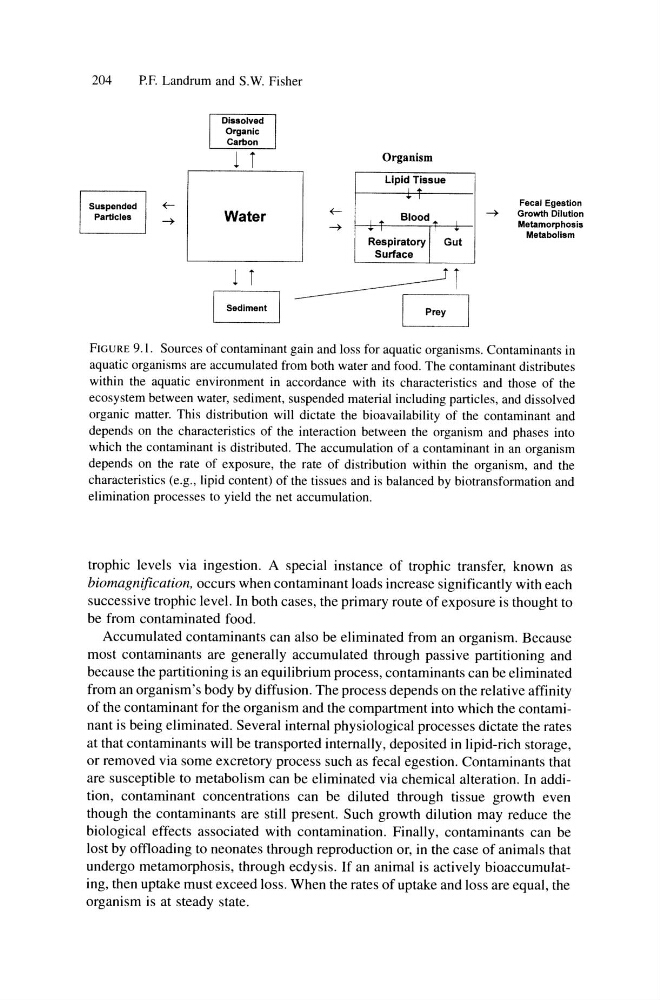
FIGURE 9.1. Sources of contaminant gain and loss for aquatic organisms. Contaminants in
aquatic organisms are accumulated from both water and food. The contaminant distributes
within the aquatic environment in accordance with its characteristics and those of the
ecosystem between water, sediment, suspended material including particles, and dissolved
organic matter. This distribution will dictate the bioavailability of the contaminant and
depends on the characteristics of the interaction between the organism and phases into
which the contaminant is distributed. The accumulation of a contaminant in an organism
depends on the rate of exposure, the rate of distribution within the organism, and the
characteristics (e.g., lipid content) of the tissues and is balanced by biotransformation and
elimination processes to yield the net accumulation.
trophic levels via ingestion. A special instance of trophic transfer, known as
biomagnification, occurs when contaminant loads increase significantly with each
successive trophic level. In both cases, the primary route of exposure is thought to
be from contaminated food.
Accumulated contaminants can also be eliminated from an organism. Because
most contaminants are generally accumulated through passive partitioning and
because the partitioning is an equilibrium process, contaminants can be eliminated
from an organism's body by diffusion. The process depends on the relative affinity
of the contaminant for the organism and the compartment into which the contaminant is being eliminated. Several internal physiological processes dictate the rates
at that contaminants will be transported internally, deposited in lipid-rich storage,
or removed via some excretory process such as fecal egestion. Contaminants that
are susceptible to metabolism can be eliminated via chemical alteration. In addition, contaminant concentrations can be diluted through tissue growth even
though the contaminants are still present. Such growth dilution may reduce the
biological effects associated with contamination. Finally, contaminants can be
lost by offloading to neonates through reproduction or, in the case of animals that
undergo metamorphosis, through ecdysis. If an animal is actively bioaccumulating, then uptake must exceed loss. When the rates of uptake and loss are equal, the
organism is at steady state.
p.F. Landrum and S.w. Fisher
Organism
I
Lipid Tissue
Water
I ... Blood ...
!
. l
I
Respiratory
Gut
Surface
iT
~r
Sediment I
[ Prey I
Fecal Egestion
~
Growth Dilution
Metamorphosis
Metabolism
FIGURE 9.1. Sources of contaminant gain and loss for aquatic organisms. Contaminants in
aquatic organisms are accumulated from both water and food. The contaminant distributes
within the aquatic environment in accordance with its characteristics and those of the
ecosystem between water, sediment, suspended material including particles, and dissolved
organic matter. This distribution will dictate the bioavailability of the contaminant and
depends on the characteristics of the interaction between the organism and phases into
which the contaminant is distributed. The accumulation of a contaminant in an organism
depends on the rate of exposure, the rate of distribution within the organism, and the
characteristics (e.g., lipid content) of the tissues and is balanced by biotransformation and
elimination processes to yield the net accumulation.
trophic levels via ingestion. A special instance of trophic transfer, known as
biomagnification, occurs when contaminant loads increase significantly with each
successive trophic level. In both cases, the primary route of exposure is thought to
be from contaminated food.
Accumulated contaminants can also be eliminated from an organism. Because
most contaminants are generally accumulated through passive partitioning and
because the partitioning is an equilibrium process, contaminants can be eliminated
from an organism's body by diffusion. The process depends on the relative affinity
of the contaminant for the organism and the compartment into which the contaminant is being eliminated. Several internal physiological processes dictate the rates
at that contaminants will be transported internally, deposited in lipid-rich storage,
or removed via some excretory process such as fecal egestion. Contaminants that
are susceptible to metabolism can be eliminated via chemical alteration. In addition, contaminant concentrations can be diluted through tissue growth even
though the contaminants are still present. Such growth dilution may reduce the
biological effects associated with contamination. Finally, contaminants can be
lost by offloading to neonates through reproduction or, in the case of animals that
undergo metamorphosis, through ecdysis. If an animal is actively bioaccumulating, then uptake must exceed loss. When the rates of uptake and loss are equal, the
organism is at steady state.