

8. Lipids and Essential Fatty Acids in Aquatic Food Webs
197
t
Absolute or percent EFA in food
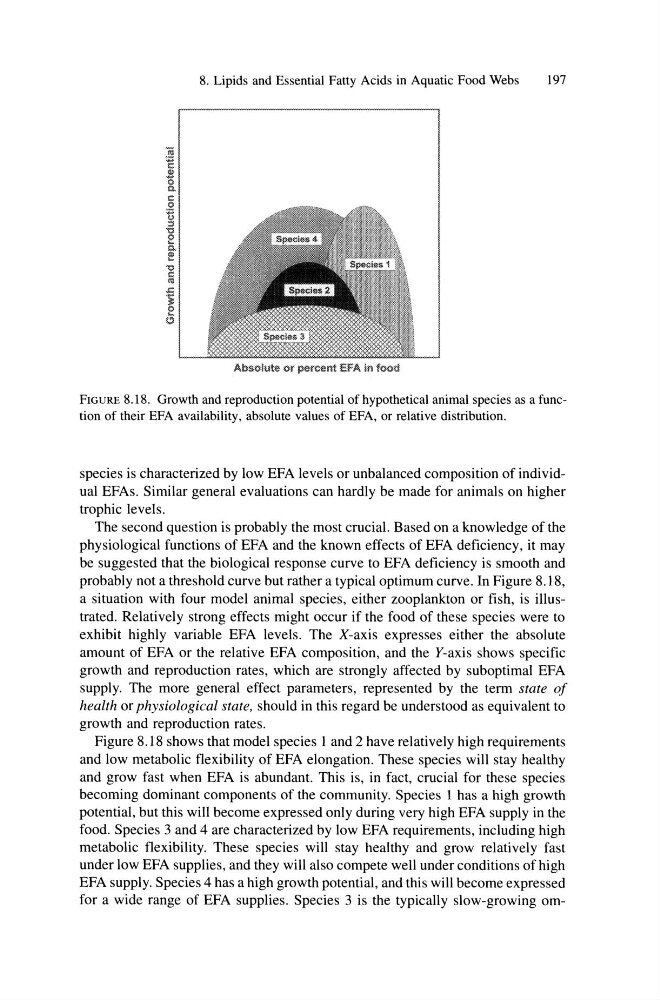
FIGURE 8.18. Growth and reproduction potential of hypothetical animal species as a function of their EFA availability, absolute values of EFA, or relative distribution.
species is characterized by low EFA levels or unbalanced composition of individual EFAs. Similar general evaluations can hardly be made for animals on higher
trophic levels.
The second question is probably the most crucial. Based on a knowledge of the
physiological functions of EFA and the known effects of EFA deficiency, it may
be suggested that the biological response curve to EFA deficiency is smooth and
probably not a threshold curve but rather a typical optimum curve. In Figure 8.18,
a situation with four model animal species, either zooplankton or fish, is illustrated. Relatively strong effects might occur if the food of these species were to
exhibit highly variable EFA levels. The X-axis expresses either the absolute
amount of EFA or the relative EFA composition, and the Y-axis shows specific
growth and reproduction rates, which are strongly affected by suboptimal EFA
supply. The more general effect parameters, represented by the term state of
health or physiological state, should in this regard be understood as equivalent to
growth and reproduction rates.
Figure 8.18 shows that model species 1 and 2 have relatively high requirements
and low metabolic flexibility of EFA elongation. These species will stay healthy
and grow fast when EFA is abundant. This is, in fact, crucial for these species
becoming dominant components of the community. Species 1 has a high growth
potential, but this will become expressed only during very high EFA supply in the
food. Species 3 and 4 are characterized by low EFA requirements, including high
metabolic flexibility. These species will stay healthy and grow relatively fast
under low EFA supplies, and they will also compete well under conditions of high
EFA supply. Species 4 has a high growth potential, and this will become expressed
for a wide range of EFA supplies. Species 3 is the typically slow-growing om-
197
t
Absolute or percent EFA in food
FIGURE 8.18. Growth and reproduction potential of hypothetical animal species as a function of their EFA availability, absolute values of EFA, or relative distribution.
species is characterized by low EFA levels or unbalanced composition of individual EFAs. Similar general evaluations can hardly be made for animals on higher
trophic levels.
The second question is probably the most crucial. Based on a knowledge of the
physiological functions of EFA and the known effects of EFA deficiency, it may
be suggested that the biological response curve to EFA deficiency is smooth and
probably not a threshold curve but rather a typical optimum curve. In Figure 8.18,
a situation with four model animal species, either zooplankton or fish, is illustrated. Relatively strong effects might occur if the food of these species were to
exhibit highly variable EFA levels. The X-axis expresses either the absolute
amount of EFA or the relative EFA composition, and the Y-axis shows specific
growth and reproduction rates, which are strongly affected by suboptimal EFA
supply. The more general effect parameters, represented by the term state of
health or physiological state, should in this regard be understood as equivalent to
growth and reproduction rates.
Figure 8.18 shows that model species 1 and 2 have relatively high requirements
and low metabolic flexibility of EFA elongation. These species will stay healthy
and grow fast when EFA is abundant. This is, in fact, crucial for these species
becoming dominant components of the community. Species 1 has a high growth
potential, but this will become expressed only during very high EFA supply in the
food. Species 3 and 4 are characterized by low EFA requirements, including high
metabolic flexibility. These species will stay healthy and grow relatively fast
under low EFA supplies, and they will also compete well under conditions of high
EFA supply. Species 4 has a high growth potential, and this will become expressed
for a wide range of EFA supplies. Species 3 is the typically slow-growing om-