

194
Y. Olsen
50,---------------------------------,,----.
40
~
f;lo; 30
S
.s
....
= 20
' :!!..
. .
10
'.
~- --- -~-- -,;; --;-! -~--. ---- __ L _. ________ • __
o~~--~~~~~----~~~~~=-~~
3
10
30
100
Lipid content (mg/g fresh weight)
%EPA
%DHA
%AA
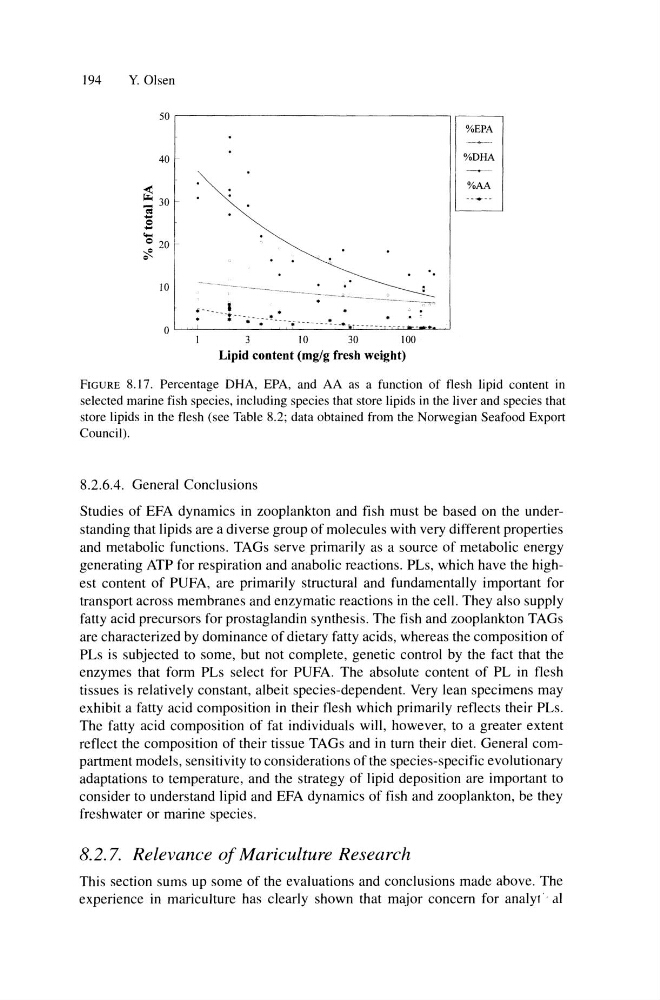
FIGURE 8.17. Percentage DHA, EPA, and AA as a function of flesh lipid content in
selected marine fish species, including species that store lipids in the liver and species that
store lipids in the flesh (see Table 8.2; data obtained from the Norwegian Seafood Export
Council).
8.2.6.4. General Conclusions
Studies of EFA dynamics in zooplankton and fish must be based on the understanding that lipids are a diverse group of molecules with very different properties
and metabolic functions. TAGs serve primarily as a source of metabolic energy
generating ATP for respiration and anabolic reactions. PLs, which have the highest content of PUFA, are primarily structural and fundamentally important for
transport across membranes and enzymatic reactions in the cell. They also supply
fatty acid precursors for prostaglandin synthesis. The fish and zooplankton TAGs
are characterized by dominance of dietary fatty acids, whereas the composition of
PLs is subjected to some, but not complete, genetic control by the fact that the
enzymes that form PLs select for PUFA. The absolute content of PL in flesh
tissues is relatively constant, albeit species-dependent. Very lean specimens may
exhibit a fatty acid composition in their flesh which primarily reflects their PLs.
The fatty acid composition of fat individuals will, however, to a greater extent
reflect the composition of their tissue TAGs and in tum their diet. General compartment models, sensitivity to considerations of the species-specific evolutionary
adaptations to temperature, and the strategy of lipid deposition are important to
consider to understand lipid and EFA dynamics of fish and zooplankton, be they
freshwater or marine species.
8.2.7. Relevance of Mariculture Research
This section sums up some of the evaluations and conclusions made above. The
experience in mariculture has clearly shown that major concern for analyt'- al
Y. Olsen
50,---------------------------------,,----.
40
~
f;lo; 30
S
.s
....
= 20
' :!!..
. .
10
'.
~- --- -~-- -,;; --;-! -~--. ---- __ L _. ________ • __
o~~--~~~~~----~~~~~=-~~
3
10
30
100
Lipid content (mg/g fresh weight)
%EPA
%DHA
%AA
FIGURE 8.17. Percentage DHA, EPA, and AA as a function of flesh lipid content in
selected marine fish species, including species that store lipids in the liver and species that
store lipids in the flesh (see Table 8.2; data obtained from the Norwegian Seafood Export
Council).
8.2.6.4. General Conclusions
Studies of EFA dynamics in zooplankton and fish must be based on the understanding that lipids are a diverse group of molecules with very different properties
and metabolic functions. TAGs serve primarily as a source of metabolic energy
generating ATP for respiration and anabolic reactions. PLs, which have the highest content of PUFA, are primarily structural and fundamentally important for
transport across membranes and enzymatic reactions in the cell. They also supply
fatty acid precursors for prostaglandin synthesis. The fish and zooplankton TAGs
are characterized by dominance of dietary fatty acids, whereas the composition of
PLs is subjected to some, but not complete, genetic control by the fact that the
enzymes that form PLs select for PUFA. The absolute content of PL in flesh
tissues is relatively constant, albeit species-dependent. Very lean specimens may
exhibit a fatty acid composition in their flesh which primarily reflects their PLs.
The fatty acid composition of fat individuals will, however, to a greater extent
reflect the composition of their tissue TAGs and in tum their diet. General compartment models, sensitivity to considerations of the species-specific evolutionary
adaptations to temperature, and the strategy of lipid deposition are important to
consider to understand lipid and EFA dynamics of fish and zooplankton, be they
freshwater or marine species.
8.2.7. Relevance of Mariculture Research
This section sums up some of the evaluations and conclusions made above. The
experience in mariculture has clearly shown that major concern for analyt'- al