

170
Y. Olsen
The ability of marine animals to synthesize AA from shorter 006 precursors is
not known, but this trait is presumably not very important because AA seems to be
present in low, although significant, amounts in most biological material and
therefore also in all types of food (see below).
It is commonly believed that carnivorous fish show less ability to modify EFAs
through anabolic reactions than planktivorous and omnivorous species (Sargent et
aI., 1993a). Such differences can be understood from an evolutionary point of
view. It has not been very important for carnivorous fish to retain the ability of
fatty acid elongation and desaturation during their evolution as compared with
groups feeding on more suboptimal diets; this is simply because carnivorous fish
to a large extent feed on an overall well-balanced diet relative to their own
requirements, with respect to both EFA and other essential compounds. Most of
the marine species of interest for aquaculture, except for the salmonids, which are
not strictly marine, are carnivorous species with high EFA requirements.
8.2.3.3. Membrane Transport and Metabolism
The physiological justification for the relatively high EFA requirements of aquatic
animals in general, and for marine fish larvae in particular, is their high need for
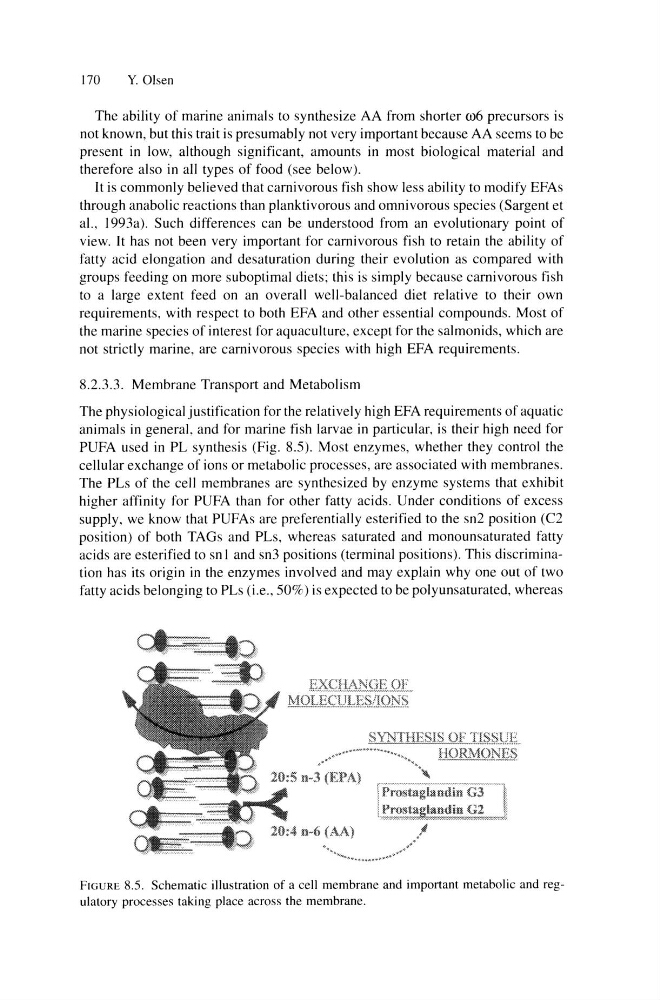
PUFA used in PL synthesis (Fig. 8.5). Most enzymes, whether they control the
cellular exchange of ions or metabolic processes, are associated with membranes.
The PLs of the cell membranes are synthesized by enzyme systems that exhibit
higher affinity for PUFA than for other fatty acids. Under conditions of excess
supply, we know that PUFAs are preferentially esterified to the sn2 position (e2
position) of both TAGs and PLs, whereas saturated and monounsaturated fatty
acids are esterified to sn I and sn3 positions (terminal positions). This discrimination has its origin in the enzymes involved and may explain why one out of two
fatty acids belonging to PLs (i.e., 50%) is expected to be polyunsaturated, whereas
EXCHANGE OF
MOLE.c1JLE.~apN~
SYNTHESIS OF TISSUE ..
/ ••.•. _..............
HOR1v10NE~
.'
"'"
~~ta~g7Ia~n"c;d7in~=-.
.. l
.
"
"'"",-o..,,,.,..,."' .. ,,,.. .. .,."' ...... ~AFIGURE 8.5. Schematic illustration of a cell membrane and important metabolic and regulatory processes taking place across the membrane.
Y. Olsen
The ability of marine animals to synthesize AA from shorter 006 precursors is
not known, but this trait is presumably not very important because AA seems to be
present in low, although significant, amounts in most biological material and
therefore also in all types of food (see below).
It is commonly believed that carnivorous fish show less ability to modify EFAs
through anabolic reactions than planktivorous and omnivorous species (Sargent et
aI., 1993a). Such differences can be understood from an evolutionary point of
view. It has not been very important for carnivorous fish to retain the ability of
fatty acid elongation and desaturation during their evolution as compared with
groups feeding on more suboptimal diets; this is simply because carnivorous fish
to a large extent feed on an overall well-balanced diet relative to their own
requirements, with respect to both EFA and other essential compounds. Most of
the marine species of interest for aquaculture, except for the salmonids, which are
not strictly marine, are carnivorous species with high EFA requirements.
8.2.3.3. Membrane Transport and Metabolism
The physiological justification for the relatively high EFA requirements of aquatic
animals in general, and for marine fish larvae in particular, is their high need for
PUFA used in PL synthesis (Fig. 8.5). Most enzymes, whether they control the
cellular exchange of ions or metabolic processes, are associated with membranes.
The PLs of the cell membranes are synthesized by enzyme systems that exhibit
higher affinity for PUFA than for other fatty acids. Under conditions of excess
supply, we know that PUFAs are preferentially esterified to the sn2 position (e2
position) of both TAGs and PLs, whereas saturated and monounsaturated fatty
acids are esterified to sn I and sn3 positions (terminal positions). This discrimination has its origin in the enzymes involved and may explain why one out of two
fatty acids belonging to PLs (i.e., 50%) is expected to be polyunsaturated, whereas
EXCHANGE OF
MOLE.c1JLE.~apN~
SYNTHESIS OF TISSUE ..
/ ••.•. _..............
HOR1v10NE~
.'
"'"
~~ta~g7Ia~n"c;d7in~=-.
.. l
.
"
"'"",-o..,,,.,..,."' .. ,,,.. .. .,."' ...... ~AFIGURE 8.5. Schematic illustration of a cell membrane and important metabolic and regulatory processes taking place across the membrane.