

80.8
~
;g.
] 0.6
~
~
:s! 0.4
i!
£
~ 0.2
8. Lipids and Essential Fatty Acids in Aquatic Food Webs
167
III: '
. .. ..
. ... .
' " ' " "'. '" ; .. ~.~-;." .
•
• ."'. '."'
"' •• '" '" • f'-I'--~:-,. : '''' :--:
.. ' " '" • ' " '" f -.' • "'"., • '" • :. •• ~ ' " III. ' " ' "
: ·o
' "
",' r
••••
' "
• • O ~ "'. <) ~ ~: '" •••• :
: '"
"", '"
"'.
'" '" '"
8 '))
' "
... ' "
'" $0 ~~ <> 0 0 (> '" '" '" '"
00~ "'"
8
..
"
10
20
50
100
200
Totailipids (mglg fresh weight)
Salmosalar
B. plicatilis
o
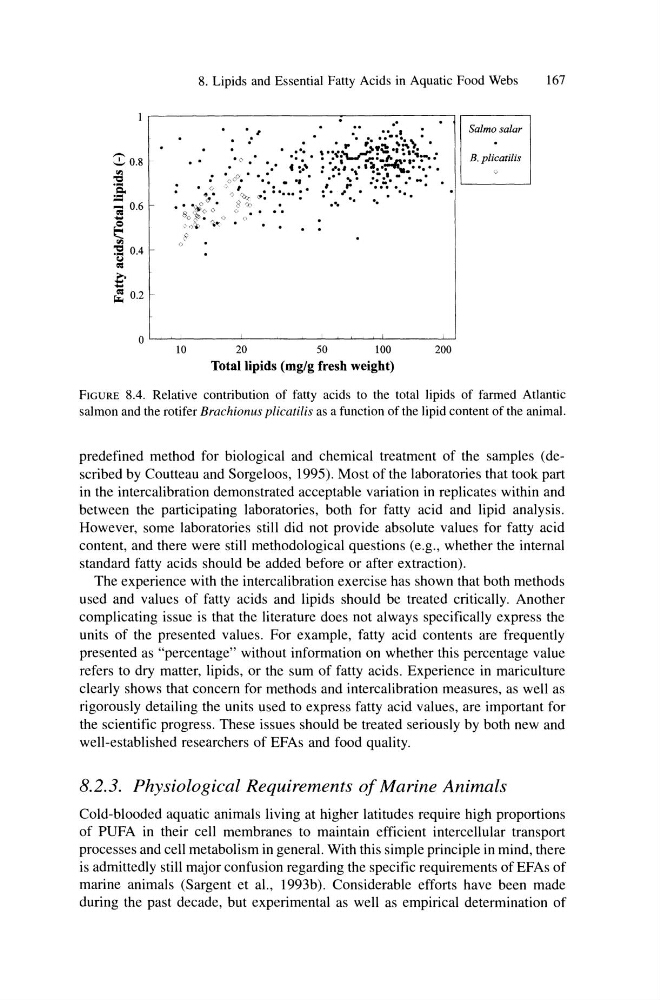
FIGURE 8.4. Relative contribution of fatty acids to the total lipids of farmed Atlantic
salmon and the rotifer Brachionus plicatilis as a function of the lipid content of the animal.
predefined method for biological and chemical treatment of the samples (described by Coutteau and Sorgeloos, 1995). Most of the laboratories that took part
in the intercalibration demonstrated acceptable variation in replicates within and
between the participating laboratories, both for fatty acid and lipid analysis.
However, some laboratories still did not provide absolute values for fatty acid
content, and there were still methodological questions (e.g., whether the internal
standard fatty acids should be added before or after extraction).
The experience with the intercalibration exercise has shown that both methods
used and values of fatty acids and lipids should be treated critically. Another
complicating issue is that the literature does not always specifically express the
units of the presented values. For example, fatty acid contents are frequently
presented as "percentage" without information on whether this percentage value
refers to dry matter, lipids, or the sum of fatty acids. Experience in mariculture
clearly shows that concern for methods and intercalibration measures, as well as
rigorously detailing the units used to express fatty acid values, are important for
the scientific progress. These issues should be treated seriously by both new and
well-established researchers of EFAs and food quality.
8.2.3. Physiological Requirements of Marine Animals
Cold-blooded aquatic animals living at higher latitudes require high proportions
of PUFA in their cell membranes to maintain efficient intercellular transport
processes and cell metabolism in general. With this simple principle in mind, there
is admittedly still major confusion regarding the specific requirements ofEFAs of
marine animals (Sargent et aI., 1993b). Considerable efforts have been made
during the past decade, but experimental as well as empirical determination of
~
;g.
] 0.6
~
~
:s! 0.4
i!
£
~ 0.2
8. Lipids and Essential Fatty Acids in Aquatic Food Webs
167
III: '
. .. ..
. ... .
' " ' " "'. '" ; .. ~.~-;." .
•
• ."'. '."'
"' •• '" '" • f'-I'--~:-,. : '''' :--:
.. ' " '" • ' " '" f -.' • "'"., • '" • :. •• ~ ' " III. ' " ' "
: ·o
' "
",' r
••••
' "
• • O ~ "'. <) ~ ~: '" •••• :
: '"
"", '"
"'.
'" '" '"
8 '))
' "
... ' "
'" $0 ~~ <> 0 0 (> '" '" '" '"
00~ "'"
8
..
"
10
20
50
100
200
Totailipids (mglg fresh weight)
Salmosalar
B. plicatilis
o
FIGURE 8.4. Relative contribution of fatty acids to the total lipids of farmed Atlantic
salmon and the rotifer Brachionus plicatilis as a function of the lipid content of the animal.
predefined method for biological and chemical treatment of the samples (described by Coutteau and Sorgeloos, 1995). Most of the laboratories that took part
in the intercalibration demonstrated acceptable variation in replicates within and
between the participating laboratories, both for fatty acid and lipid analysis.
However, some laboratories still did not provide absolute values for fatty acid
content, and there were still methodological questions (e.g., whether the internal
standard fatty acids should be added before or after extraction).
The experience with the intercalibration exercise has shown that both methods
used and values of fatty acids and lipids should be treated critically. Another
complicating issue is that the literature does not always specifically express the
units of the presented values. For example, fatty acid contents are frequently
presented as "percentage" without information on whether this percentage value
refers to dry matter, lipids, or the sum of fatty acids. Experience in mariculture
clearly shows that concern for methods and intercalibration measures, as well as
rigorously detailing the units used to express fatty acid values, are important for
the scientific progress. These issues should be treated seriously by both new and
well-established researchers of EFAs and food quality.
8.2.3. Physiological Requirements of Marine Animals
Cold-blooded aquatic animals living at higher latitudes require high proportions
of PUFA in their cell membranes to maintain efficient intercellular transport
processes and cell metabolism in general. With this simple principle in mind, there
is admittedly still major confusion regarding the specific requirements ofEFAs of
marine animals (Sargent et aI., 1993b). Considerable efforts have been made
during the past decade, but experimental as well as empirical determination of