

7. Role of Lipids in Fish Populations
133
7.2. Results and Discussion
7.2.1. Overwinter Starvation and Survival
The energetic demands of fish are met primarily by lipid oxidation (Cowey and
Sargent, 1979). Depending on the species, TAG, or the energy-based lipids, are
stored in various tissues including muscle, liver, subdermal tissue, and the mesenteries. During starvation, TAG is mobilized preferentially to the structural (mostly
phospholipids) lipids, but these membrane lipids can also be mobilized if starvation is prolonged (Henderson and Tocher, 1987; Love, 1980). At temperate and
north- temperate latitudes, many fish species display seasonal cycles in energy
storage (Dygert, 1990; Sheridan et a!., 1983; Adams et a!., 1982; Medford and
Mackay, 1978; Foltz and Nordon, 1977; Newsome and Leduc, 1975; MacKinnon,
1972). During the winter nonfeeding periods, fish use these lipid stores for basic
maintenance and other metabolic needs. Beyond these maintenance needs, however, substantial quantities of both energetic lipids (i.e., TAG) and phospholipids
for cell membranes must be supplied to the gonads, especially the ovaries, during
reproductive development. Because energy for both metabolic and reproductive
needs are drawn from stored lipids (Fig. 7.1) and depots are not usually re8UB-ORGANISMAL
INDIVIDUAL
POPULATION
\oNAt1ENTAl
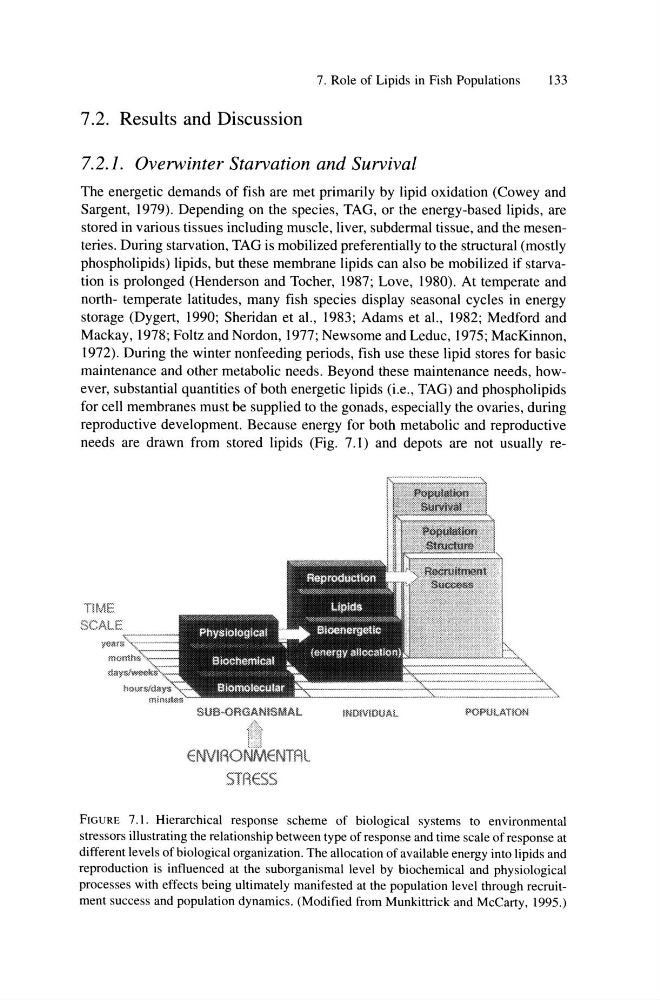
FIG URE 7.1. Hierarchical response scheme of biological systems to environmental
stressors illustrating the relationship between type of response and time scale of response at
different levels of biological organization. The allocation of available energy into lipids and
reproduction is influenced at the suborganismal level by biochemical and physiological
processes with effects being ultimately manifested at the population level through recruitment success and population dynamics. (Modified from Munkittrick and McCarty, 1995.)
133
7.2. Results and Discussion
7.2.1. Overwinter Starvation and Survival
The energetic demands of fish are met primarily by lipid oxidation (Cowey and
Sargent, 1979). Depending on the species, TAG, or the energy-based lipids, are
stored in various tissues including muscle, liver, subdermal tissue, and the mesenteries. During starvation, TAG is mobilized preferentially to the structural (mostly
phospholipids) lipids, but these membrane lipids can also be mobilized if starvation is prolonged (Henderson and Tocher, 1987; Love, 1980). At temperate and
north- temperate latitudes, many fish species display seasonal cycles in energy
storage (Dygert, 1990; Sheridan et a!., 1983; Adams et a!., 1982; Medford and
Mackay, 1978; Foltz and Nordon, 1977; Newsome and Leduc, 1975; MacKinnon,
1972). During the winter nonfeeding periods, fish use these lipid stores for basic
maintenance and other metabolic needs. Beyond these maintenance needs, however, substantial quantities of both energetic lipids (i.e., TAG) and phospholipids
for cell membranes must be supplied to the gonads, especially the ovaries, during
reproductive development. Because energy for both metabolic and reproductive
needs are drawn from stored lipids (Fig. 7.1) and depots are not usually re8UB-ORGANISMAL
INDIVIDUAL
POPULATION
\oNAt1ENTAl
FIG URE 7.1. Hierarchical response scheme of biological systems to environmental
stressors illustrating the relationship between type of response and time scale of response at
different levels of biological organization. The allocation of available energy into lipids and
reproduction is influenced at the suborganismal level by biochemical and physiological
processes with effects being ultimately manifested at the population level through recruitment success and population dynamics. (Modified from Munkittrick and McCarty, 1995.)