

6. Seasonal Dynamics of Lipids
121
20+-~~-L-L-L~~--r4-~-L-L-L-L-L~-+
18
Station 3
16
~ 14
~ 12
~ 10
~ 8
6
4
2
° A M J J A S O N
Time (months)
A M J J A SON
Time (months)
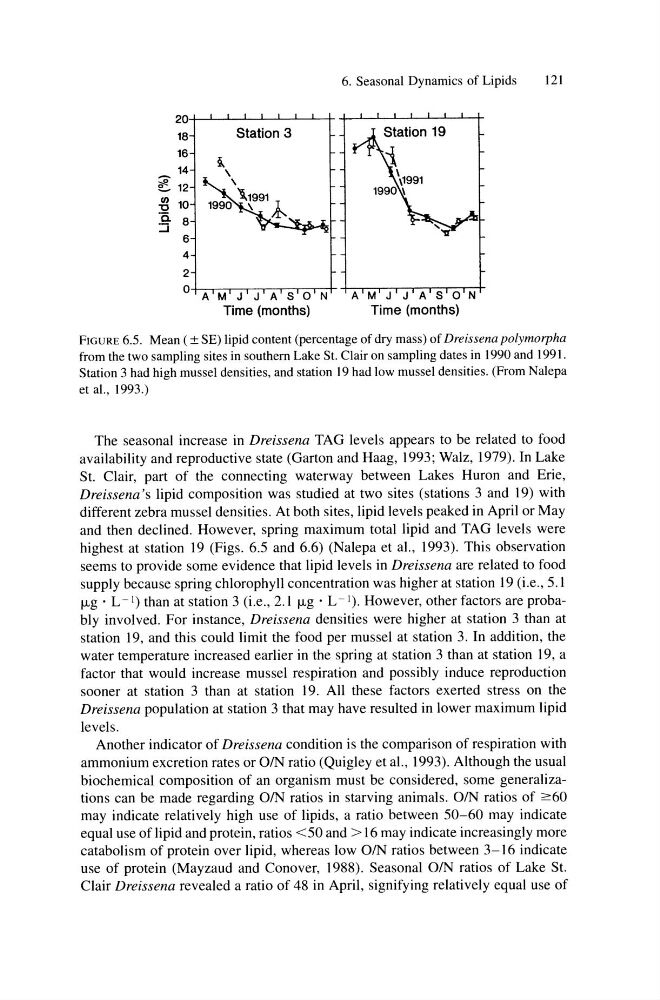
FIGURE 6.5. Mean (± SE) lipid content (percentage of dry mass) of Dreissena polymorpha
from the two sampling sites in southern Lake St. Clair on sampling dates in 1990 and 1991.
Station 3 had high mussel densities, and station 19 had low mussel densities. (From Nalepa
eta!.,1993.)
The seasonal increase in Dreissena TAG levels appears to be related to food
availability and reproductive state (Garton and Haag, 1993; Walz, 1979). In Lake
St. Clair, part of the connecting waterway between Lakes Huron and Erie,
Dreissena's lipid composition was studied at two sites (stations 3 and 19) with
different zebra mussel densities. At both sites, lipid levels peaked in April or May
and then declined. However, spring maximum total lipid and TAG levels were
highest at station 19 (Figs. 6.5 and 6.6) (Nalepa et aI., 1993). This observation
seems to provide some evidence that lipid levels in Dreissena are related to food
supply because spring chlorophyll concentration was higher at station 19 (i.e., 5.1
I-Lg . L -1) than at station 3 (i.e., 2.1 I-Lg . L -1). However, other factors are probably involved. For instance, Dreissena densities were higher at station 3 than at
station 19, and this could limit the food per mussel at station 3. In addition, the
water temperature increased earlier in the spring at station 3 than at station 19, a
factor that would increase mussel respiration and possibly induce reproduction
sooner at station 3 than at station 19. All these factors exerted stress on the
Dreissena population at station 3 that may have resulted in lower maximum lipid
levels.
Another indicator of Dreissena condition is the comparison of respiration with
ammonium excretion rates or OIN ratio (Quigley et aI., 1993). Although the usual
biochemical composition of an organism must be considered, some generalizations can be made regarding OIN ratios in starving animals. OIN ratios of 2:60
may indicate relatively high use of lipids, a ratio between 50-60 may indicate
equal use of lipid and protein, ratios <50 and> 16 may indicate increasingly more
catabolism of protein over lipid, whereas low OIN ratios between 3-16 indicate
use of protein (Mayzaud and Conover, 1988). Seasonal OIN ratios of Lake St.
Clair Dreissena revealed a ratio of 48 in April, signifying relatively equal use of
121
20+-~~-L-L-L~~--r4-~-L-L-L-L-L~-+
18
Station 3
16
~ 14
~ 12
~ 10
~ 8
6
4
2
° A M J J A S O N
Time (months)
A M J J A SON
Time (months)
FIGURE 6.5. Mean (± SE) lipid content (percentage of dry mass) of Dreissena polymorpha
from the two sampling sites in southern Lake St. Clair on sampling dates in 1990 and 1991.
Station 3 had high mussel densities, and station 19 had low mussel densities. (From Nalepa
eta!.,1993.)
The seasonal increase in Dreissena TAG levels appears to be related to food
availability and reproductive state (Garton and Haag, 1993; Walz, 1979). In Lake
St. Clair, part of the connecting waterway between Lakes Huron and Erie,
Dreissena's lipid composition was studied at two sites (stations 3 and 19) with
different zebra mussel densities. At both sites, lipid levels peaked in April or May
and then declined. However, spring maximum total lipid and TAG levels were
highest at station 19 (Figs. 6.5 and 6.6) (Nalepa et aI., 1993). This observation
seems to provide some evidence that lipid levels in Dreissena are related to food
supply because spring chlorophyll concentration was higher at station 19 (i.e., 5.1
I-Lg . L -1) than at station 3 (i.e., 2.1 I-Lg . L -1). However, other factors are probably involved. For instance, Dreissena densities were higher at station 3 than at
station 19, and this could limit the food per mussel at station 3. In addition, the
water temperature increased earlier in the spring at station 3 than at station 19, a
factor that would increase mussel respiration and possibly induce reproduction
sooner at station 3 than at station 19. All these factors exerted stress on the
Dreissena population at station 3 that may have resulted in lower maximum lipid
levels.
Another indicator of Dreissena condition is the comparison of respiration with
ammonium excretion rates or OIN ratio (Quigley et aI., 1993). Although the usual
biochemical composition of an organism must be considered, some generalizations can be made regarding OIN ratios in starving animals. OIN ratios of 2:60
may indicate relatively high use of lipids, a ratio between 50-60 may indicate
equal use of lipid and protein, ratios <50 and> 16 may indicate increasingly more
catabolism of protein over lipid, whereas low OIN ratios between 3-16 indicate
use of protein (Mayzaud and Conover, 1988). Seasonal OIN ratios of Lake St.
Clair Dreissena revealed a ratio of 48 in April, signifying relatively equal use of