

96
C.E. Goulden et al.
TABLE 5.1. Detail of supplement experiments."
Date/lake/species
May 24.1988
Lake Lacawac
Daphnia catawba
June 30.1989
Lake Lacawac
D. catawba
July 13, 1989
Lake Lacawac
D. catawba
July 29, 1989
Lake Wayne wood
Daphnia pulicaria
October 14, 1989
Lake Waynewood
Daphnia laevis
D. pulicaria
Treatment supplementsh
TAG fL-capsules (100 . 103 • ml- I)
Ankistrodesmus (5 . 103 cells' ml" I)
EFA fL-capsules (50 . 10' . ml" I)
Non-EFA microcapsules (50' 103 • ml" I)
Casein fL-particles (1.25 fLg protein' ml- I)
Ankistrodesmus (5 . 101 cells' ml- ' )
EFA fL-capsules (50 . 103 • ml- I ),
Casein fL-particles (1.0 fLg protein' ml- I)
EFA + Casein
Ankistrodesmus (5' 103 cells' ml I)
EFA fL-capsules (50' 103 • ml- I)
Casein fL-particles (1.0 fLg and 1.5 fLg protein' ml 1)
Ankistrodesmus (5 . 10' cells' ml -1)
EFA fL-capsules (50 . 103 • ml - I)
Casein fL-particles (1.4 fLg protein' ml- I)
EFA + Casein
Ankistrodesmus (10 . 103 cells' mIl)
"EFA, essential fatty acids; TAG, triacylglycerol.
hLipid microcapsules average 1 pg lipid per microcapsule.
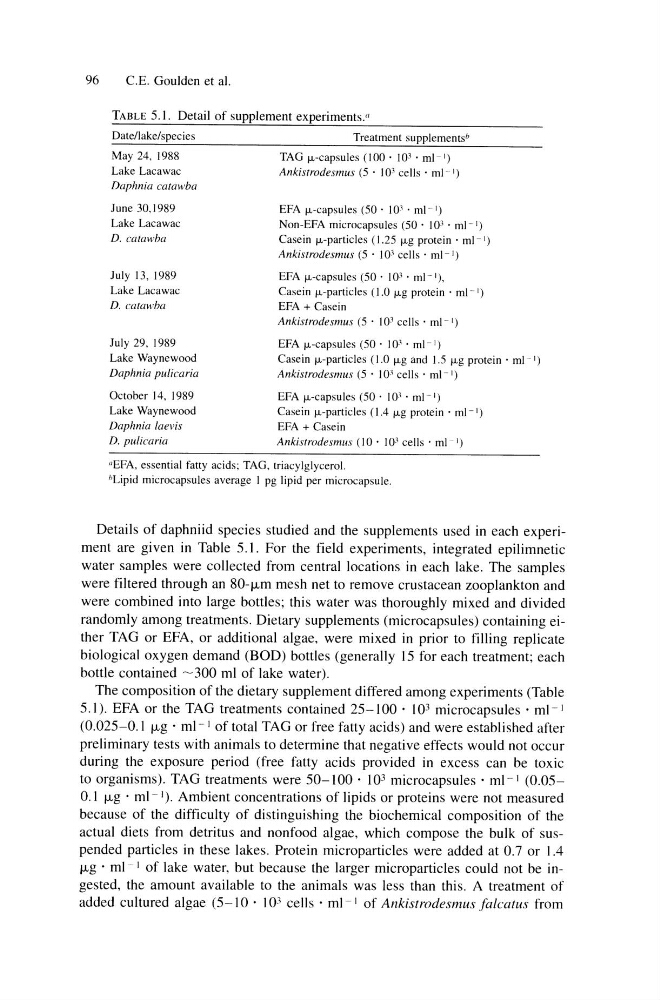
Details of daphniid species studied and the supplements used in each experiment are given in Table 5.1. For the field experiments, integrated epilimnetic
water samples were collected from central locations in each lake. The samples
were filtered through an 80-/km mesh net to remove crustacean zooplankton and
were combined into large bottles; this water was thoroughly mixed and divided
randomly among treatments. Dietary supplements (microcapsules) containing either TAG or EFA, or additional algae, were mixed in prior to filling replicate
biological oxygen demand (BOD) bottles (generally 15 for each treatment; each
bottle contained ~300 ml of lake water).
The composition of the dietary supplement differed among experiments (Table
5.1). EFA or the TAG treatments contained 25-100 . 10" microcapsules' ml- 1
(0.025-0.1 /kg . ml- 1 of total TAG or free fatty acids) and were established after
preliminary tests with animals to determine that negative effects would not occur
during the exposure period (free fatty acids provided in excess can be toxic
to organisms). TAG treatments were 50-100' 10 3 microcapsules' ml- 1 (0.050.1 /kg . ml-l). Ambient concentrations of lipids or proteins were not measured
because of the difficulty of distinguishing the biochemical composition of the
actual diets from detritus and nonfood algae, which compose the bulk of suspended particles in these lakes. Protein microparticles were added at 0.7 or 1.4
/kg . ml- 1 of lake water, but because the larger microparticles could not be ingested, the amount available to the animals was less than this. A treatment of
added cultured algae (5-10 . 10" cells' ml- 1 of Ankistrodesmus Jalcatus from
C.E. Goulden et al.
TABLE 5.1. Detail of supplement experiments."
Date/lake/species
May 24.1988
Lake Lacawac
Daphnia catawba
June 30.1989
Lake Lacawac
D. catawba
July 13, 1989
Lake Lacawac
D. catawba
July 29, 1989
Lake Wayne wood
Daphnia pulicaria
October 14, 1989
Lake Waynewood
Daphnia laevis
D. pulicaria
Treatment supplementsh
TAG fL-capsules (100 . 103 • ml- I)
Ankistrodesmus (5 . 103 cells' ml" I)
EFA fL-capsules (50 . 10' . ml" I)
Non-EFA microcapsules (50' 103 • ml" I)
Casein fL-particles (1.25 fLg protein' ml- I)
Ankistrodesmus (5 . 101 cells' ml- ' )
EFA fL-capsules (50 . 103 • ml- I ),
Casein fL-particles (1.0 fLg protein' ml- I)
EFA + Casein
Ankistrodesmus (5' 103 cells' ml I)
EFA fL-capsules (50' 103 • ml- I)
Casein fL-particles (1.0 fLg and 1.5 fLg protein' ml 1)
Ankistrodesmus (5 . 10' cells' ml -1)
EFA fL-capsules (50 . 103 • ml - I)
Casein fL-particles (1.4 fLg protein' ml- I)
EFA + Casein
Ankistrodesmus (10 . 103 cells' mIl)
"EFA, essential fatty acids; TAG, triacylglycerol.
hLipid microcapsules average 1 pg lipid per microcapsule.
Details of daphniid species studied and the supplements used in each experiment are given in Table 5.1. For the field experiments, integrated epilimnetic
water samples were collected from central locations in each lake. The samples
were filtered through an 80-/km mesh net to remove crustacean zooplankton and
were combined into large bottles; this water was thoroughly mixed and divided
randomly among treatments. Dietary supplements (microcapsules) containing either TAG or EFA, or additional algae, were mixed in prior to filling replicate
biological oxygen demand (BOD) bottles (generally 15 for each treatment; each
bottle contained ~300 ml of lake water).
The composition of the dietary supplement differed among experiments (Table
5.1). EFA or the TAG treatments contained 25-100 . 10" microcapsules' ml- 1
(0.025-0.1 /kg . ml- 1 of total TAG or free fatty acids) and were established after
preliminary tests with animals to determine that negative effects would not occur
during the exposure period (free fatty acids provided in excess can be toxic
to organisms). TAG treatments were 50-100' 10 3 microcapsules' ml- 1 (0.050.1 /kg . ml-l). Ambient concentrations of lipids or proteins were not measured
because of the difficulty of distinguishing the biochemical composition of the
actual diets from detritus and nonfood algae, which compose the bulk of suspended particles in these lakes. Protein microparticles were added at 0.7 or 1.4
/kg . ml- 1 of lake water, but because the larger microparticles could not be ingested, the amount available to the animals was less than this. A treatment of
added cultured algae (5-10 . 10" cells' ml- 1 of Ankistrodesmus Jalcatus from