

x
Contents
7.2.4.2. Thermal Effects ........................... 149
7.2.4.3. Other Stressors . . . . . . . . . . . . . . . . . . . . . . . . . . .. 151
References . . . . . . . . . . . . . . . . . . . . . . . . . . . . . . . . . . . . . . . . . . .. 153
8. Lipids and Essential Fatty Acids in Aquatic Food Webs: What Can
Freshwater Ecologists Learn from Mariculture? .................. 161
Yngvar Olsen
8.1. Introduction . . . . . . . . . . . . . . . . . . . . . . . . . . . . . . . . . . . . . . . . . .. 161
8.2. Results and Discussion .................................. 162
8.2.1. Some Important Lipids and Fatty Acids ............... 162
8.2.1.1. Essential Fatty Acids ....................... 162
8.2.1.2. Lipid Classes ............................. 164
8.2.2. Methodological Considerations ...................... 165
8.2.3. Physiological Requirements of Marine Animals. . . . . . . .. 167
8.2.3.1. General Evaluation of EFA Requirements ...... 168
8.2.3.2. Anabolic Processes and Growth .............. 168
8.2.3.3. Membrane Transport and Metabolism. . . . . . . . .. 170
8.2.3.4. Regulation of Metabolism ................... 171
8.2.3.5. General Considerations and
Concluding Remarks ....................... 172
8.2.4. Methods for Evaluation of EFA Requirements . . . . . . . . .. 173
8.2.5. Symptoms of EFA Deficiency. . . . . . . . . . . . . . . . . . . . . .. 175
8.2.6. Fatty Acid Transport and Metabolism in Food Webs . . . .. 177
8.2.6.1. Algae ................................... 177
8.2.6.1.1. Lipids of Algae ................... 177
8.2.6.1.2. Essential Fatty Acids of Algae . . . . . .. 177
8.2.6.1.3. Conclusion. . . . . . . . . . . . . . . . . . . . . .. 179
8.2.6.2. Zooplankton .............................. 180
8.2.6.2.1. Lipid Content and Lipid Composition
180
8.2.6.2.2. Fatty Acids of TAG-Zooplankton. . . .. 181
8.2.6.3. Fish . . . . . . . . . . . . . . . . . . . . . . . . . . . . . . . . . . . .. 186
8.2.6.3.1. Lipid ........................... 187
8.2.6.3.2. Fatty Acid Composition ............ 189
8.2.6.4. General Conclusions ....................... 194
8.2.7. Relevance of Mariculture Research. . . . . . . . . . . . . . . . . .. 194
8.2.8. Evaluation of Ecological Effects of Essential
Fatty Acids . . . . . . . . . . . . . . . . . . . . . . . . . . . . . . . . . . . . .. 196
8.3. Concluding Remarks. . . . . . . . . . . . . . . . . . . . . . . . . . . . . . . . . . .. 198
References . . . . . . . . . . . . . . . . . . . . . . . . . . . . . . . . . . . . . . . . . . .. I 99
9. Influence of Lipids on the Bioaccumulation and Trophic Transfer of
Organic Contaminants in Aquatic Organisms .................... 203
Peter F Landrum and Susan W Fisher
9.1. Introduction . . . . . . . . . . . . . . . . . . . . . . . . . . . . . . . . . . . . . . . . . .. 203
9.1.1. Sources of Contaminant Gain and Loss in
Aquatic Systems. . . . . . . . . . . . . . . . . . . . . . . . . . . . . . . . .. 203
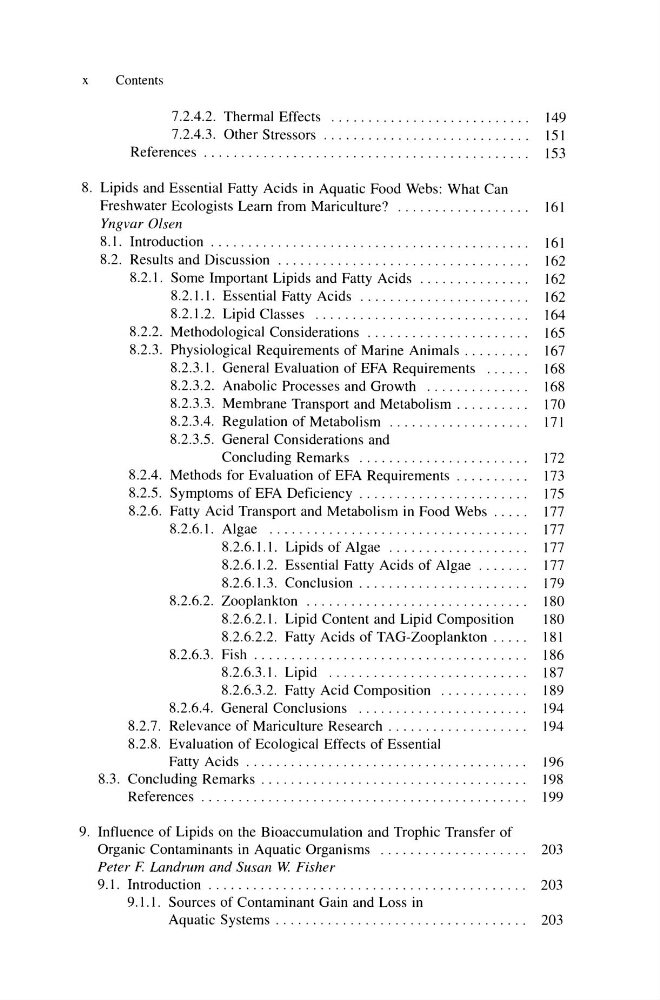
Contents
7.2.4.2. Thermal Effects ........................... 149
7.2.4.3. Other Stressors . . . . . . . . . . . . . . . . . . . . . . . . . . .. 151
References . . . . . . . . . . . . . . . . . . . . . . . . . . . . . . . . . . . . . . . . . . .. 153
8. Lipids and Essential Fatty Acids in Aquatic Food Webs: What Can
Freshwater Ecologists Learn from Mariculture? .................. 161
Yngvar Olsen
8.1. Introduction . . . . . . . . . . . . . . . . . . . . . . . . . . . . . . . . . . . . . . . . . .. 161
8.2. Results and Discussion .................................. 162
8.2.1. Some Important Lipids and Fatty Acids ............... 162
8.2.1.1. Essential Fatty Acids ....................... 162
8.2.1.2. Lipid Classes ............................. 164
8.2.2. Methodological Considerations ...................... 165
8.2.3. Physiological Requirements of Marine Animals. . . . . . . .. 167
8.2.3.1. General Evaluation of EFA Requirements ...... 168
8.2.3.2. Anabolic Processes and Growth .............. 168
8.2.3.3. Membrane Transport and Metabolism. . . . . . . . .. 170
8.2.3.4. Regulation of Metabolism ................... 171
8.2.3.5. General Considerations and
Concluding Remarks ....................... 172
8.2.4. Methods for Evaluation of EFA Requirements . . . . . . . . .. 173
8.2.5. Symptoms of EFA Deficiency. . . . . . . . . . . . . . . . . . . . . .. 175
8.2.6. Fatty Acid Transport and Metabolism in Food Webs . . . .. 177
8.2.6.1. Algae ................................... 177
8.2.6.1.1. Lipids of Algae ................... 177
8.2.6.1.2. Essential Fatty Acids of Algae . . . . . .. 177
8.2.6.1.3. Conclusion. . . . . . . . . . . . . . . . . . . . . .. 179
8.2.6.2. Zooplankton .............................. 180
8.2.6.2.1. Lipid Content and Lipid Composition
180
8.2.6.2.2. Fatty Acids of TAG-Zooplankton. . . .. 181
8.2.6.3. Fish . . . . . . . . . . . . . . . . . . . . . . . . . . . . . . . . . . . .. 186
8.2.6.3.1. Lipid ........................... 187
8.2.6.3.2. Fatty Acid Composition ............ 189
8.2.6.4. General Conclusions ....................... 194
8.2.7. Relevance of Mariculture Research. . . . . . . . . . . . . . . . . .. 194
8.2.8. Evaluation of Ecological Effects of Essential
Fatty Acids . . . . . . . . . . . . . . . . . . . . . . . . . . . . . . . . . . . . .. 196
8.3. Concluding Remarks. . . . . . . . . . . . . . . . . . . . . . . . . . . . . . . . . . .. 198
References . . . . . . . . . . . . . . . . . . . . . . . . . . . . . . . . . . . . . . . . . . .. I 99
9. Influence of Lipids on the Bioaccumulation and Trophic Transfer of
Organic Contaminants in Aquatic Organisms .................... 203
Peter F Landrum and Susan W Fisher
9.1. Introduction . . . . . . . . . . . . . . . . . . . . . . . . . . . . . . . . . . . . . . . . . .. 203
9.1.1. Sources of Contaminant Gain and Loss in
Aquatic Systems. . . . . . . . . . . . . . . . . . . . . . . . . . . . . . . . .. 203