

87
been reported from fungi, bacteria, actinomycetes, algae, molluscs and higher plants
(Pitson et al. 1993) and many of these organisms are being exploited as efficient
biocontrol agents. Depending upon the mode of hydrolysis the β-1,3-glucanases can
be classified as exo-β-1,3-glucanase (EC3.2.1.58) and endo-β-1,3-glucanase (EC
3.2.1.39). Endohydrolases act randomly on β-1,3-D-glucan generating small oligosaccharides (Reese and Mandels 1959) whereas exo-β-1,3-glucanases remove glucose units from terminal β-1,3-D linkages generating D-glucose as the sole product
(Pitson et al. 1993). Along with this, based on the folding properties, amino acid
sequences and structural properties of glucanases can be further classified into many
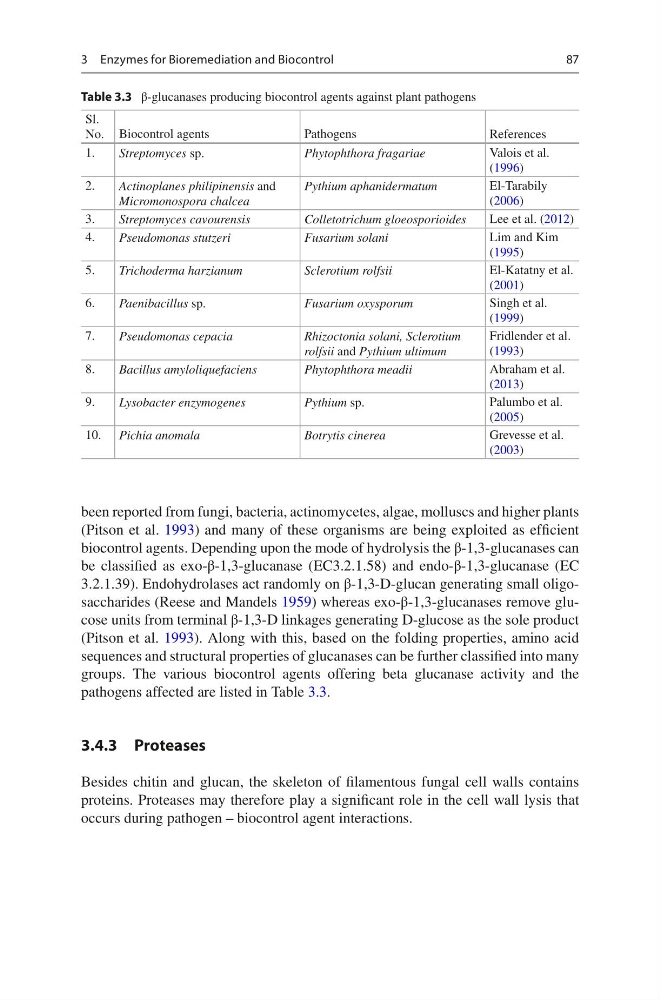
groups. The various biocontrol agents offering beta glucanase activity and the
pathogens affected are listed in Table 3.3.
3.4.3 Proteases
Besides chitin and glucan, the skeleton of filamentous fungal cell walls contains
proteins. Proteases may therefore play a significant role in the cell wall lysis that
occurs during pathogen – biocontrol agent interactions.
Table 3.3 β-glucanases producing biocontrol agents against plant pathogens
Sl.
No. Biocontrol agents
Pathogens
References
1.
Streptomyces sp.
Phytophthora fragariae
Valois et al.
(1996)
2.
Actinoplanes philipinensis and
Micromonospora chalcea
Pythium aphanidermatum
El-Tarabily
(2006)
3.
Streptomyces cavourensis
Colletotrichum gloeosporioides
Lee et al. (2012)
4.
Pseudomonas stutzeri
Fusarium solani
Lim and Kim
(1995)
5.
Trichoderma harzianum
Sclerotium rolfsii
El-Katatny et al.
(2001)
6.
Paenibacillus sp.
Fusarium oxysporum
Singh et al.
(1999)
7.
Pseudomonas cepacia
Rhizoctonia solani, Sclerotium
rolfsii and Pythium ultimum
Fridlender et al.
(1993)
8.
Bacillus amyloliquefaciens
Phytophthora meadii
Abraham et al.
(2013)
9.
Lysobacter enzymogenes
Pythium sp.
Palumbo et al.
(2005)
10. Pichia anomala
Botrytis cinerea
Grevesse et al.
(2003)
3 Enzymes for Bioremediation and Biocontrol
been reported from fungi, bacteria, actinomycetes, algae, molluscs and higher plants
(Pitson et al. 1993) and many of these organisms are being exploited as efficient
biocontrol agents. Depending upon the mode of hydrolysis the β-1,3-glucanases can
be classified as exo-β-1,3-glucanase (EC3.2.1.58) and endo-β-1,3-glucanase (EC
3.2.1.39). Endohydrolases act randomly on β-1,3-D-glucan generating small oligosaccharides (Reese and Mandels 1959) whereas exo-β-1,3-glucanases remove glucose units from terminal β-1,3-D linkages generating D-glucose as the sole product
(Pitson et al. 1993). Along with this, based on the folding properties, amino acid
sequences and structural properties of glucanases can be further classified into many
groups. The various biocontrol agents offering beta glucanase activity and the
pathogens affected are listed in Table 3.3.
3.4.3 Proteases
Besides chitin and glucan, the skeleton of filamentous fungal cell walls contains
proteins. Proteases may therefore play a significant role in the cell wall lysis that
occurs during pathogen – biocontrol agent interactions.
Table 3.3 β-glucanases producing biocontrol agents against plant pathogens
Sl.
No. Biocontrol agents
Pathogens
References
1.
Streptomyces sp.
Phytophthora fragariae
Valois et al.
(1996)
2.
Actinoplanes philipinensis and
Micromonospora chalcea
Pythium aphanidermatum
El-Tarabily
(2006)
3.
Streptomyces cavourensis
Colletotrichum gloeosporioides
Lee et al. (2012)
4.
Pseudomonas stutzeri
Fusarium solani
Lim and Kim
(1995)
5.
Trichoderma harzianum
Sclerotium rolfsii
El-Katatny et al.
(2001)
6.
Paenibacillus sp.
Fusarium oxysporum
Singh et al.
(1999)
7.
Pseudomonas cepacia
Rhizoctonia solani, Sclerotium
rolfsii and Pythium ultimum
Fridlender et al.
(1993)
8.
Bacillus amyloliquefaciens
Phytophthora meadii
Abraham et al.
(2013)
9.
Lysobacter enzymogenes
Pythium sp.
Palumbo et al.
(2005)
10. Pichia anomala
Botrytis cinerea
Grevesse et al.
(2003)
3 Enzymes for Bioremediation and Biocontrol