

63
enzyme replacement therapy using recombinant human GAA (rhGAA) produced
either in Chinese hamster ovary (CHO) cells or in transgenic rabbit milk (Bijvoet
et al. 1999; Van Hove et al. 1996). Myozyme
®
(alglucosidase alfa) was approved in
2006 for enzyme replacement therapy (ERT) of IOPD and Lumizyme
®
was approved
in 2010 for enzyme replacement therapy (ERT) of LOPD by FDA. Though ERT for
Pompe disease has certain limitations such as lifelong administration of enzyme,
cost of therapy and loss of administered enzyme prior to reaching target muscles, it
has certainly improved the quality of life led by patients with Pompe disease.
2.6.4 Mucopolysacchariodoses (MPSs)
Mucopolysaccharidoses (MPSs) are a group of disorders characterized by deficiency of lysosomal enzymes for degradation of glycosaminoglycans (GAGs) or
mucopolysaccharides. There are seven types of MPSs based on enzyme affected,
namely Types I, II, III, IV, VI, VII and IX. MPSs are associated with lysosomal
progressive accumulation of undigested glycosaminoglycan (GAG) leading to cellular and multiple organ damage. MPSs are multivisceral diseases affecting musculoskeletal, gastrointestinal, neurological, cardiovascular and pulmonary systems
leading to death in severe forms. All MPSs except MPS II show autosomal recessive inheritance whereas MPS II shows an X-linked recessive inheritance. Enzyme
replacement therapy (ERT) is now available for MPS I, MPS II and MPS VI.
MPS I is a disorder characterized by the deficiency of the enzyme α-L-iduronidase
leading to progressive accumulation of glycosaminoglycans (GAGs) in lysosomes,
namely heparan sulphate and dermatan sulphate. Based on severity of disease, MPS
I is classified into three sub-types: severe (Hurler syndrome), intermediate (Hurler–
Scheie syndrome) and mild (Scheie syndrome). The first of its kind to be approved
for ERT against MPS was Laronidase (recombinant human α-L-iduronidase) and it
has been available in Europe and the USA since 2003. MPS II (Hunter syndrome)
is an X-linked recessive disorder which appears mostly in males and very rarely in
females. Hunter syndrome is due to absence of the enzyme iduronate-2-sulphatase
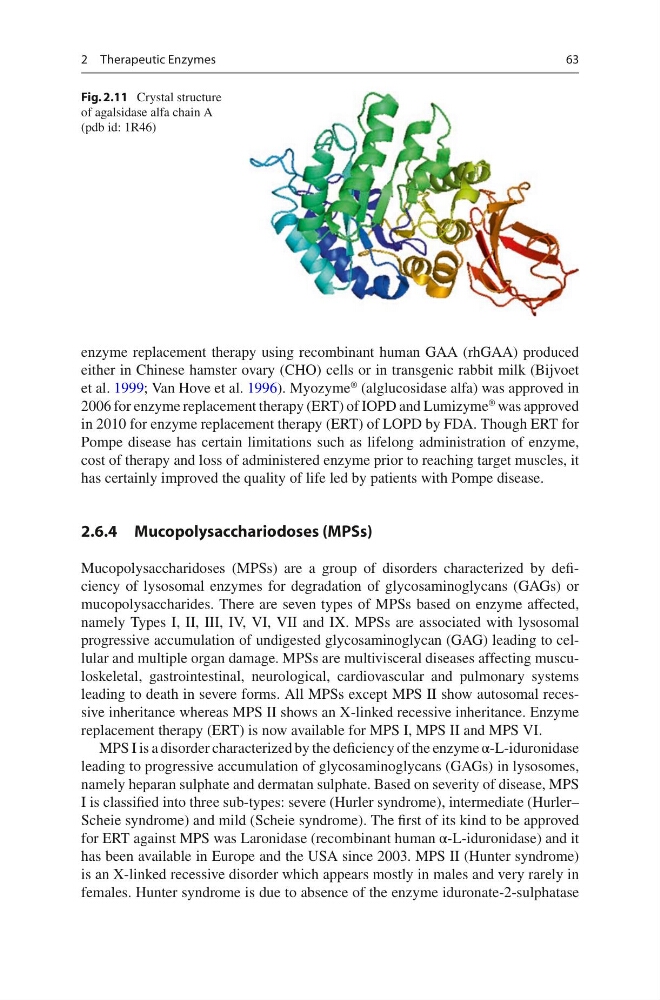
Fig. 2.11 Crystal structure
of agalsidase alfa chain A
(pdb id: 1R46)
2 Therapeutic Enzymes
enzyme replacement therapy using recombinant human GAA (rhGAA) produced
either in Chinese hamster ovary (CHO) cells or in transgenic rabbit milk (Bijvoet
et al. 1999; Van Hove et al. 1996). Myozyme
®
(alglucosidase alfa) was approved in
2006 for enzyme replacement therapy (ERT) of IOPD and Lumizyme
®
was approved
in 2010 for enzyme replacement therapy (ERT) of LOPD by FDA. Though ERT for
Pompe disease has certain limitations such as lifelong administration of enzyme,
cost of therapy and loss of administered enzyme prior to reaching target muscles, it
has certainly improved the quality of life led by patients with Pompe disease.
2.6.4 Mucopolysacchariodoses (MPSs)
Mucopolysaccharidoses (MPSs) are a group of disorders characterized by deficiency of lysosomal enzymes for degradation of glycosaminoglycans (GAGs) or
mucopolysaccharides. There are seven types of MPSs based on enzyme affected,
namely Types I, II, III, IV, VI, VII and IX. MPSs are associated with lysosomal
progressive accumulation of undigested glycosaminoglycan (GAG) leading to cellular and multiple organ damage. MPSs are multivisceral diseases affecting musculoskeletal, gastrointestinal, neurological, cardiovascular and pulmonary systems
leading to death in severe forms. All MPSs except MPS II show autosomal recessive inheritance whereas MPS II shows an X-linked recessive inheritance. Enzyme
replacement therapy (ERT) is now available for MPS I, MPS II and MPS VI.
MPS I is a disorder characterized by the deficiency of the enzyme α-L-iduronidase
leading to progressive accumulation of glycosaminoglycans (GAGs) in lysosomes,
namely heparan sulphate and dermatan sulphate. Based on severity of disease, MPS
I is classified into three sub-types: severe (Hurler syndrome), intermediate (Hurler–
Scheie syndrome) and mild (Scheie syndrome). The first of its kind to be approved
for ERT against MPS was Laronidase (recombinant human α-L-iduronidase) and it
has been available in Europe and the USA since 2003. MPS II (Hunter syndrome)
is an X-linked recessive disorder which appears mostly in males and very rarely in
females. Hunter syndrome is due to absence of the enzyme iduronate-2-sulphatase
Fig. 2.11 Crystal structure
of agalsidase alfa chain A
(pdb id: 1R46)
2 Therapeutic Enzymes