

48
therapeutic administration of plasminogen activator enzymes can overcome the
effect, thus leading to thrombolysis.
Intravenous administration of tPA was approved by the FDA in 1996 and since
then it has been in practice for acute stroke therapy. Therapeutic practice of tissue
plasminogen activator (tPA) was initially for acute coronary artery occlusion.
Recombinant tissue plasminogen activator (rtPA) production was achieved in 1981
by molecular cloning of the human tPA gene (Pennica et al. 1983). Recombinant
tissue plasminogen activators (rtPAs) are available for therapeutic usage such as
alteplase, reteplase and tenecteplase. Currently available PAs differ in their source,
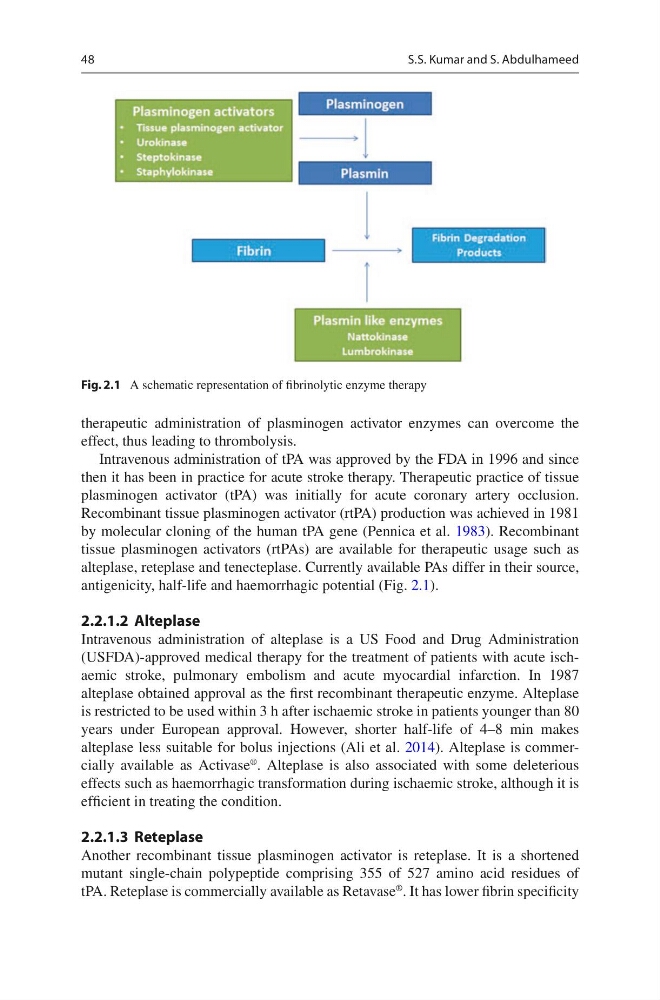
antigenicity, half-life and haemorrhagic potential (Fig. 2.1).
2.2.1.2 Alteplase
Intravenous administration of alteplase is a US Food and Drug Administration
(USFDA)-approved medical therapy for the treatment of patients with acute ischaemic stroke, pulmonary embolism and acute myocardial infarction. In 1987
alteplase obtained approval as the first recombinant therapeutic enzyme. Alteplase
is restricted to be used within 3 h after ischaemic stroke in patients younger than 80
years under European approval. However, shorter half-life of 4–8 min makes
alteplase less suitable for bolus injections (Ali et al. 2014). Alteplase is commercially available as Activase
®
. Alteplase is also associated with some deleterious
effects such as haemorrhagic transformation during ischaemic stroke, although it is
efficient in treating the condition.
2.2.1.3 Reteplase
Another recombinant tissue plasminogen activator is reteplase. It is a shortened
mutant single-chain polypeptide comprising 355 of 527 amino acid residues of
tPA. Reteplase is commercially available as Retavase
®
. It has lower fibrin specificity
Fig. 2.1 A schematic representation of fibrinolytic enzyme therapy
S.S. Kumar and S. Abdulhameed
therapeutic administration of plasminogen activator enzymes can overcome the
effect, thus leading to thrombolysis.
Intravenous administration of tPA was approved by the FDA in 1996 and since
then it has been in practice for acute stroke therapy. Therapeutic practice of tissue
plasminogen activator (tPA) was initially for acute coronary artery occlusion.
Recombinant tissue plasminogen activator (rtPA) production was achieved in 1981
by molecular cloning of the human tPA gene (Pennica et al. 1983). Recombinant
tissue plasminogen activators (rtPAs) are available for therapeutic usage such as
alteplase, reteplase and tenecteplase. Currently available PAs differ in their source,
antigenicity, half-life and haemorrhagic potential (Fig. 2.1).
2.2.1.2 Alteplase
Intravenous administration of alteplase is a US Food and Drug Administration
(USFDA)-approved medical therapy for the treatment of patients with acute ischaemic stroke, pulmonary embolism and acute myocardial infarction. In 1987
alteplase obtained approval as the first recombinant therapeutic enzyme. Alteplase
is restricted to be used within 3 h after ischaemic stroke in patients younger than 80
years under European approval. However, shorter half-life of 4–8 min makes
alteplase less suitable for bolus injections (Ali et al. 2014). Alteplase is commercially available as Activase
®
. Alteplase is also associated with some deleterious
effects such as haemorrhagic transformation during ischaemic stroke, although it is
efficient in treating the condition.
2.2.1.3 Reteplase
Another recombinant tissue plasminogen activator is reteplase. It is a shortened
mutant single-chain polypeptide comprising 355 of 527 amino acid residues of
tPA. Reteplase is commercially available as Retavase
®
. It has lower fibrin specificity
Fig. 2.1 A schematic representation of fibrinolytic enzyme therapy
S.S. Kumar and S. Abdulhameed