

429
targets of viral entry inhibition and are collectively known as entry inhibitors. The
attachment of virus is believed to be facilitated by electrostatic interactions (nonspecific) between the positively charged domains of gp120 and negatively charged
domains of proteoglycans of the host cell surface. However, certain specific interactions such as those between gp120 and integrin α4β7 are also known to mediate this
process. Once attachment to the CD4 receptor is achieved, gp120 undergoes conformational changes. At this stage, chemokine receptors CCR5/CXCR4 help in gp120
binding, which is followed by further conformational changes in gp120.These
events lead to conformational changes in the transmembrane glycoprotein gp41,
which anchors fusion of viral and host cell membrane. Therefore, all these three
stages serve as targets of therapeutic intervention at the entry stage.
Some of the earliest small molecule gp120-CD4 interaction inhibitors included
BMS 378806 and BMS 448043, which were soon replaced by BMS 626529 and its
prodrug BMS 663068. A line of small molecule inhibitors targeting coreceptor
CCR5 were developed such as Aplaviroc, Vicriviroc, Cenicriviroc and Maraviroc.
Of these, Maraviroc was granted FDA approval in 2007. Another set of small molecules aimed at blocking gp41-mediated membrane fusion were developed, of
which Enfuvirtide (initially known as T-20, a 36-amino acid synthetic peptide based
upon the heptad repeat sequence 2 of gp41) was granted FDA approval in 2003, and
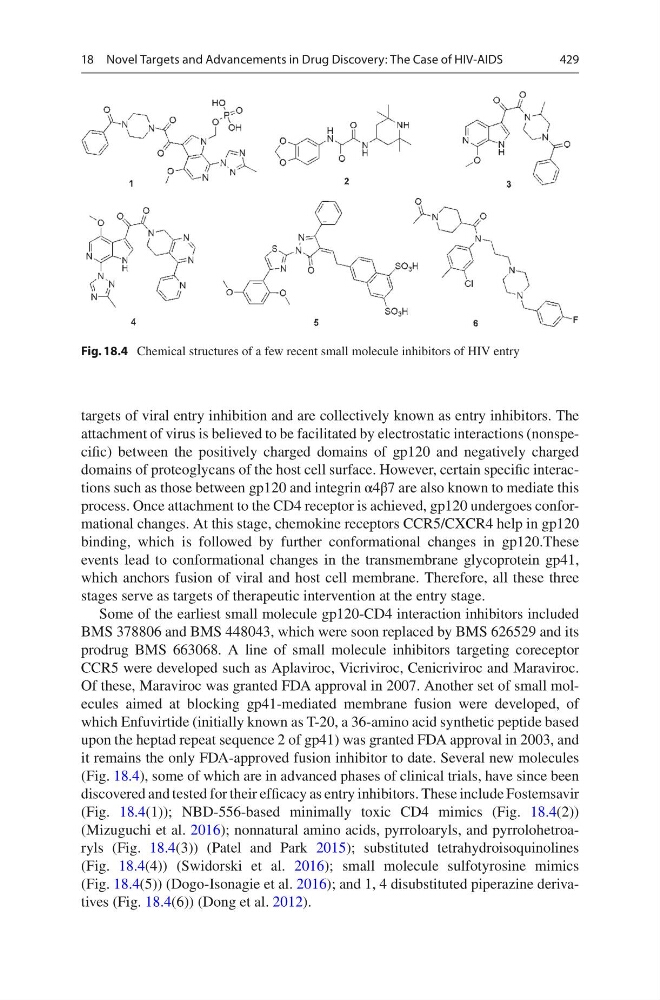
it remains the only FDA-approved fusion inhibitor to date. Several new molecules
(Fig. 18.4), some of which are in advanced phases of clinical trials, have since been
discovered and tested for their efficacy as entry inhibitors. These include Fostemsavir
(Fig. 18.4(1)); NBD-556-based minimally toxic CD4 mimics (Fig. 18.4(2))
(Mizuguchi et al. 2016); nonnatural amino acids, pyrroloaryls, and pyrrolohetroaryls (Fig. 18.4(3)) (Patel and Park 2015); substituted tetrahydroisoquinolines
(Fig. 18.4(4)) (Swidorski et al. 2016); small molecule sulfotyrosine mimics
(Fig. 18.4(5)) (Dogo-Isonagie et al. 2016); and 1, 4 disubstituted piperazine derivatives (Fig. 18.4(6)) (Dong et al. 2012).
Fig. 18.4 Chemical structures of a few recent small molecule inhibitors of HIV entry
18 Novel Targets and Advancements in Drug Discovery: The Case of HIV-AIDS
targets of viral entry inhibition and are collectively known as entry inhibitors. The
attachment of virus is believed to be facilitated by electrostatic interactions (nonspecific) between the positively charged domains of gp120 and negatively charged
domains of proteoglycans of the host cell surface. However, certain specific interactions such as those between gp120 and integrin α4β7 are also known to mediate this
process. Once attachment to the CD4 receptor is achieved, gp120 undergoes conformational changes. At this stage, chemokine receptors CCR5/CXCR4 help in gp120
binding, which is followed by further conformational changes in gp120.These
events lead to conformational changes in the transmembrane glycoprotein gp41,
which anchors fusion of viral and host cell membrane. Therefore, all these three
stages serve as targets of therapeutic intervention at the entry stage.
Some of the earliest small molecule gp120-CD4 interaction inhibitors included
BMS 378806 and BMS 448043, which were soon replaced by BMS 626529 and its
prodrug BMS 663068. A line of small molecule inhibitors targeting coreceptor
CCR5 were developed such as Aplaviroc, Vicriviroc, Cenicriviroc and Maraviroc.
Of these, Maraviroc was granted FDA approval in 2007. Another set of small molecules aimed at blocking gp41-mediated membrane fusion were developed, of
which Enfuvirtide (initially known as T-20, a 36-amino acid synthetic peptide based
upon the heptad repeat sequence 2 of gp41) was granted FDA approval in 2003, and
it remains the only FDA-approved fusion inhibitor to date. Several new molecules
(Fig. 18.4), some of which are in advanced phases of clinical trials, have since been
discovered and tested for their efficacy as entry inhibitors. These include Fostemsavir
(Fig. 18.4(1)); NBD-556-based minimally toxic CD4 mimics (Fig. 18.4(2))
(Mizuguchi et al. 2016); nonnatural amino acids, pyrroloaryls, and pyrrolohetroaryls (Fig. 18.4(3)) (Patel and Park 2015); substituted tetrahydroisoquinolines
(Fig. 18.4(4)) (Swidorski et al. 2016); small molecule sulfotyrosine mimics
(Fig. 18.4(5)) (Dogo-Isonagie et al. 2016); and 1, 4 disubstituted piperazine derivatives (Fig. 18.4(6)) (Dong et al. 2012).
Fig. 18.4 Chemical structures of a few recent small molecule inhibitors of HIV entry
18 Novel Targets and Advancements in Drug Discovery: The Case of HIV-AIDS