

20
1.4
Regulation of Cellulase Production
While cellulases are produced by a large number of bacteria and actinomycetes,
fungi have remained the commercial sources of cellulases, since they are capable of
secreting copious amounts of highly efficient enzymes. In several cases, it is also
possible to mix and match different enzymes from different fungi and still obtain the
synergies, and this has been especially true with the cellulases from Trichoderma
reesei and the beta glucosidases from Aspergillus niger. T. reesei has remained the
gold standard for industrial cellulase production, with the fungus capable of secreting more than 100 g/L of cellulase and the extracellular titers of protein reaching 30
g/L on the cellulose-inducing substrate – lactose (Durand et al. 1988; Bischof et al.
2016). The organism continues to amaze the scientific fraternity with its newly discovered capabilities, though it contains a remarkably lower number of carbohydrateactive enzymes (CAZymes) compared to several other cellulolytic fungi (Martinez
et al. 2008). Because of these and several other advantages offered by this fungus
most of the studies on cellulase gene regulation have been made in this organism.
The presence of lignocellulose or the polymers derived from it can cause the induction of cellulase and hemicellulase genes in the fungus, and this is probably an
adaptation to economize on energy and resources – synthesizing the enzymes only
when needed. In the presence of an easily utilizable carbon source like glucose, the
genes encoding cellulases and hemicellulases can be switched off – a phenomenon
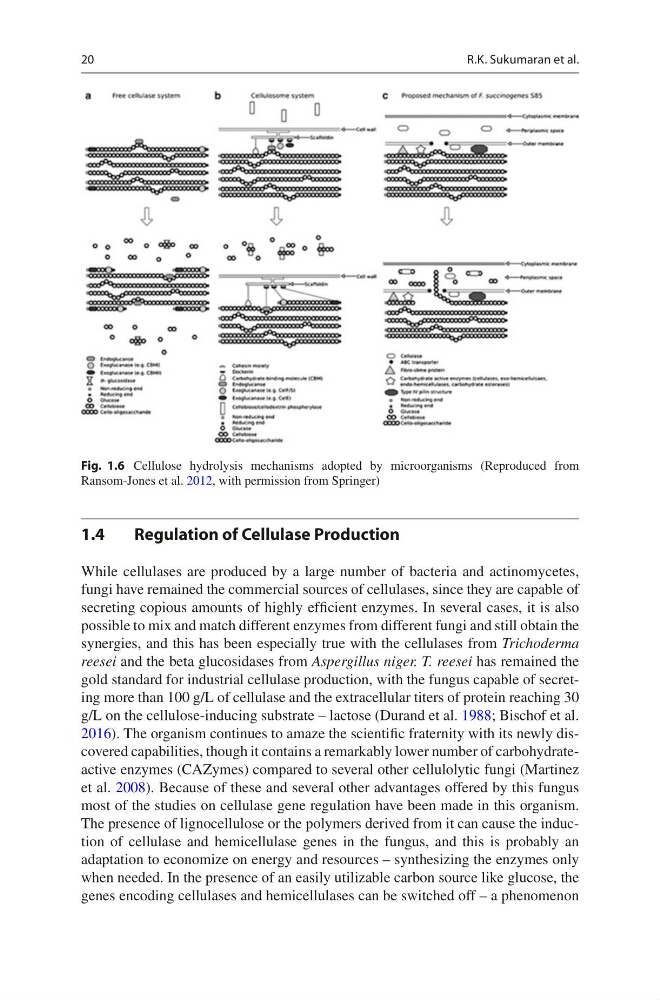
Fig. 1.6 Cellulose hydrolysis mechanisms adopted by microorganisms (Reproduced from
Ransom-Jones et al. 2012, with permission from Springer)
R.K. Sukumaran et al.
1.4
Regulation of Cellulase Production
While cellulases are produced by a large number of bacteria and actinomycetes,
fungi have remained the commercial sources of cellulases, since they are capable of
secreting copious amounts of highly efficient enzymes. In several cases, it is also
possible to mix and match different enzymes from different fungi and still obtain the
synergies, and this has been especially true with the cellulases from Trichoderma
reesei and the beta glucosidases from Aspergillus niger. T. reesei has remained the
gold standard for industrial cellulase production, with the fungus capable of secreting more than 100 g/L of cellulase and the extracellular titers of protein reaching 30
g/L on the cellulose-inducing substrate – lactose (Durand et al. 1988; Bischof et al.
2016). The organism continues to amaze the scientific fraternity with its newly discovered capabilities, though it contains a remarkably lower number of carbohydrateactive enzymes (CAZymes) compared to several other cellulolytic fungi (Martinez
et al. 2008). Because of these and several other advantages offered by this fungus
most of the studies on cellulase gene regulation have been made in this organism.
The presence of lignocellulose or the polymers derived from it can cause the induction of cellulase and hemicellulase genes in the fungus, and this is probably an
adaptation to economize on energy and resources – synthesizing the enzymes only
when needed. In the presence of an easily utilizable carbon source like glucose, the
genes encoding cellulases and hemicellulases can be switched off – a phenomenon
Fig. 1.6 Cellulose hydrolysis mechanisms adopted by microorganisms (Reproduced from
Ransom-Jones et al. 2012, with permission from Springer)
R.K. Sukumaran et al.