

324
Eleftheria terrae, was identified using a multichannel device called the ichip that
enables the growth of bacteria in their natural environment.
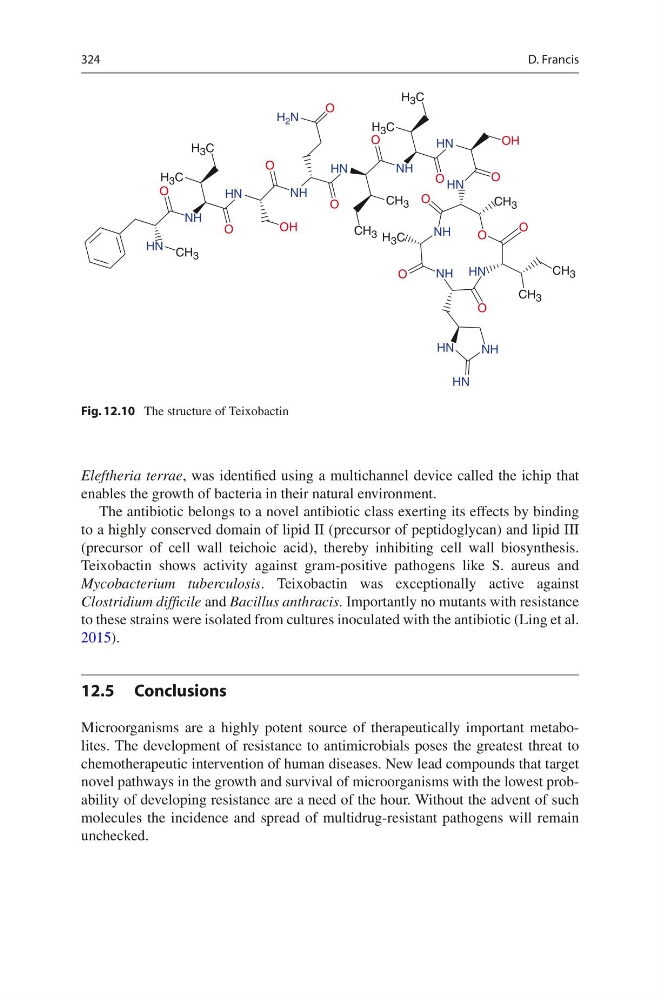
The antibiotic belongs to a novel antibiotic class exerting its effects by binding
to a highly conserved domain of lipid II (precursor of peptidoglycan) and lipid III
(precursor of cell wall teichoic acid), thereby inhibiting cell wall biosynthesis.
Teixobactin shows activity against gram-positive pathogens like S. aureus and
Mycobacterium tuberculosis. Teixobactin was exceptionally active against
Clostridium difficile and Bacillus anthracis. Importantly no mutants with resistance
to these strains were isolated from cultures inoculated with the antibiotic (Ling et al.
2015).
12.5 Conclusions
Microorganisms are a highly potent source of therapeutically important metabolites. The development of resistance to antimicrobials poses the greatest threat to
chemotherapeutic intervention of human diseases. New lead compounds that target
novel pathways in the growth and survival of microorganisms with the lowest probability of developing resistance are a need of the hour. Without the advent of such
molecules the incidence and spread of multidrug-resistant pathogens will remain
unchecked.
HN
NH
NH
HN
HN
HN
HN
HN
HN
HN
NH
NH
NH
NH
H 2 N
O
O
O
O
O
O
O
O
O
O
O
OH
O
O
OH
CH 3
CH 3
CH 3
CH 3
CH 3
CH 3
H 3 C
H 3 C
H 3 C
H 3 C
H 3 C
Fig. 12.10 The structure of Teixobactin
D. Francis
Eleftheria terrae, was identified using a multichannel device called the ichip that
enables the growth of bacteria in their natural environment.
The antibiotic belongs to a novel antibiotic class exerting its effects by binding
to a highly conserved domain of lipid II (precursor of peptidoglycan) and lipid III
(precursor of cell wall teichoic acid), thereby inhibiting cell wall biosynthesis.
Teixobactin shows activity against gram-positive pathogens like S. aureus and
Mycobacterium tuberculosis. Teixobactin was exceptionally active against
Clostridium difficile and Bacillus anthracis. Importantly no mutants with resistance
to these strains were isolated from cultures inoculated with the antibiotic (Ling et al.
2015).
12.5 Conclusions
Microorganisms are a highly potent source of therapeutically important metabolites. The development of resistance to antimicrobials poses the greatest threat to
chemotherapeutic intervention of human diseases. New lead compounds that target
novel pathways in the growth and survival of microorganisms with the lowest probability of developing resistance are a need of the hour. Without the advent of such
molecules the incidence and spread of multidrug-resistant pathogens will remain
unchecked.
HN
NH
NH
HN
HN
HN
HN
HN
HN
HN
NH
NH
NH
NH
H 2 N
O
O
O
O
O
O
O
O
O
O
O
OH
O
O
OH
CH 3
CH 3
CH 3
CH 3
CH 3
CH 3
H 3 C
H 3 C
H 3 C
H 3 C
H 3 C
Fig. 12.10 The structure of Teixobactin
D. Francis