

309
Other Antibiotics Amicoumacin is an antibiotic complex isolated from the culture
broth of B. pumilus BN-103. The antibiotic complex is composed of Amicoumacin
A (423 Da), Amicoumacin B (424 Da) and Amicoumacin C (406 Da). Amicoumacin
A shows activity against gram-positive bacteria, Salmonella spp. and Shigella spp.
Amicoumacin C and D do not exhibit significant antibacterial activity compared to
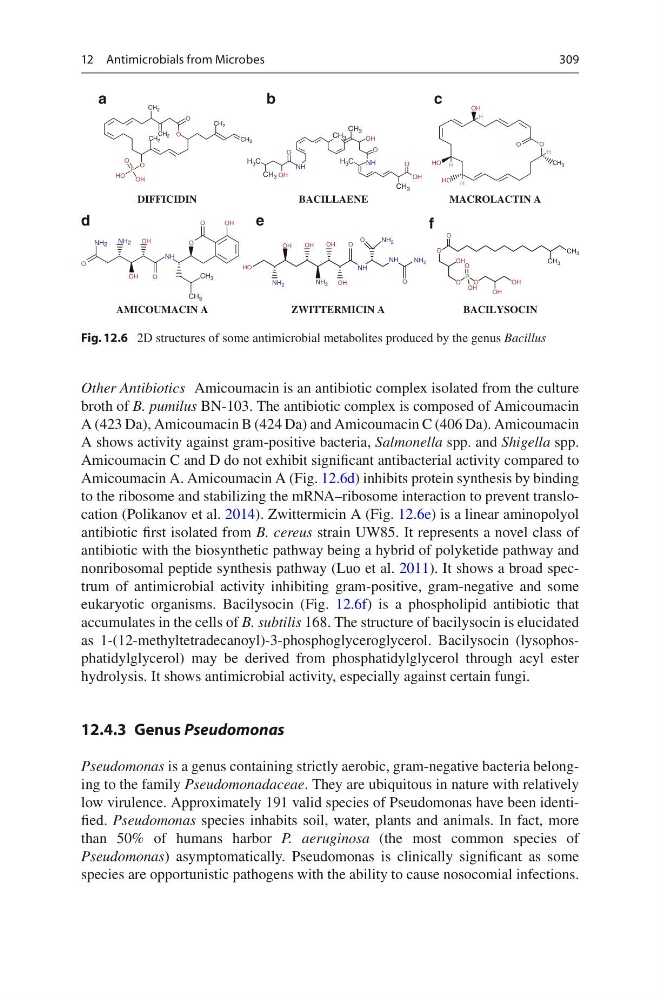
Amicoumacin A. Amicoumacin A (Fig. 12.6d) inhibits protein synthesis by binding
to the ribosome and stabilizing the mRNA–ribosome interaction to prevent translocation (Polikanov et al. 2014). Zwittermicin A (Fig. 12.6e) is a linear aminopolyol
antibiotic first isolated from B. cereus strain UW85. It represents a novel class of
antibiotic with the biosynthetic pathway being a hybrid of polyketide pathway and
nonribosomal peptide synthesis pathway (Luo et al. 2011). It shows a broad spectrum of antimicrobial activity inhibiting gram-positive, gram-negative and some
eukaryotic organisms. Bacilysocin (Fig. 12.6f) is a phospholipid antibiotic that
accumulates in the cells of B. subtilis 168. The structure of bacilysocin is elucidated
as 1-(12-methyltetradecanoyl)-3-phosphoglyceroglycerol. Bacilysocin (lysophosphatidylglycerol) may be derived from phosphatidylglycerol through acyl ester
hydrolysis. It shows antimicrobial activity, especially against certain fungi.
12.4.3 Genus Pseudomonas
Pseudomonas is a genus containing strictly aerobic, gram-negative bacteria belonging to the family Pseudomonadaceae. They are ubiquitous in nature with relatively
low virulence. Approximately 191 valid species of Pseudomonas have been identified. Pseudomonas species inhabits soil, water, plants and animals. In fact, more
than 50% of humans harbor P. aeruginosa (the most common species of
Pseudomonas) asymptomatically. Pseudomonas is clinically significant as some
species are opportunistic pathogens with the ability to cause nosocomial infections.
O
O
O
O
NH 2
NH 2
NH 2
NH 2
NH2
NH2
CH 3
CH 3
CH 2
CH 2
CH 2
CH 2
CH 2
NH
NH
NH
O
P
O
O
O
O
OH
OH
OH
OH
OH
HO
OH
OH
O
O
O
O
P
O
O
O
O
HO
OH
O
OH
OH
OH
CH 3
CH 3
CH 3
CH 3
OH
HO
HO
OH
NH
NH
OH
H
H
H
H
O
O
O
OH
CH 3
CH 3
CH 3
H 3 C
H 3 C
OH
DIFFICIDIN
BACILLAENE
MACROLACTIN A
ZWITTERMICIN A
AMICOUMACIN A
BACILYSOCIN
a
b
c
d
e
f
Fig. 12.6 2D structures of some antimicrobial metabolites produced by the genus Bacillus
12 Antimicrobials from Microbes
Other Antibiotics Amicoumacin is an antibiotic complex isolated from the culture
broth of B. pumilus BN-103. The antibiotic complex is composed of Amicoumacin
A (423 Da), Amicoumacin B (424 Da) and Amicoumacin C (406 Da). Amicoumacin
A shows activity against gram-positive bacteria, Salmonella spp. and Shigella spp.
Amicoumacin C and D do not exhibit significant antibacterial activity compared to
Amicoumacin A. Amicoumacin A (Fig. 12.6d) inhibits protein synthesis by binding
to the ribosome and stabilizing the mRNA–ribosome interaction to prevent translocation (Polikanov et al. 2014). Zwittermicin A (Fig. 12.6e) is a linear aminopolyol
antibiotic first isolated from B. cereus strain UW85. It represents a novel class of
antibiotic with the biosynthetic pathway being a hybrid of polyketide pathway and
nonribosomal peptide synthesis pathway (Luo et al. 2011). It shows a broad spectrum of antimicrobial activity inhibiting gram-positive, gram-negative and some
eukaryotic organisms. Bacilysocin (Fig. 12.6f) is a phospholipid antibiotic that
accumulates in the cells of B. subtilis 168. The structure of bacilysocin is elucidated
as 1-(12-methyltetradecanoyl)-3-phosphoglyceroglycerol. Bacilysocin (lysophosphatidylglycerol) may be derived from phosphatidylglycerol through acyl ester
hydrolysis. It shows antimicrobial activity, especially against certain fungi.
12.4.3 Genus Pseudomonas
Pseudomonas is a genus containing strictly aerobic, gram-negative bacteria belonging to the family Pseudomonadaceae. They are ubiquitous in nature with relatively
low virulence. Approximately 191 valid species of Pseudomonas have been identified. Pseudomonas species inhabits soil, water, plants and animals. In fact, more
than 50% of humans harbor P. aeruginosa (the most common species of
Pseudomonas) asymptomatically. Pseudomonas is clinically significant as some
species are opportunistic pathogens with the ability to cause nosocomial infections.
O
O
O
O
NH 2
NH 2
NH 2
NH 2
NH2
NH2
CH 3
CH 3
CH 2
CH 2
CH 2
CH 2
CH 2
NH
NH
NH
O
P
O
O
O
O
OH
OH
OH
OH
OH
HO
OH
OH
O
O
O
O
P
O
O
O
O
HO
OH
O
OH
OH
OH
CH 3
CH 3
CH 3
CH 3
OH
HO
HO
OH
NH
NH
OH
H
H
H
H
O
O
O
OH
CH 3
CH 3
CH 3
H 3 C
H 3 C
OH
DIFFICIDIN
BACILLAENE
MACROLACTIN A
ZWITTERMICIN A
AMICOUMACIN A
BACILYSOCIN
a
b
c
d
e
f
Fig. 12.6 2D structures of some antimicrobial metabolites produced by the genus Bacillus
12 Antimicrobials from Microbes