

307
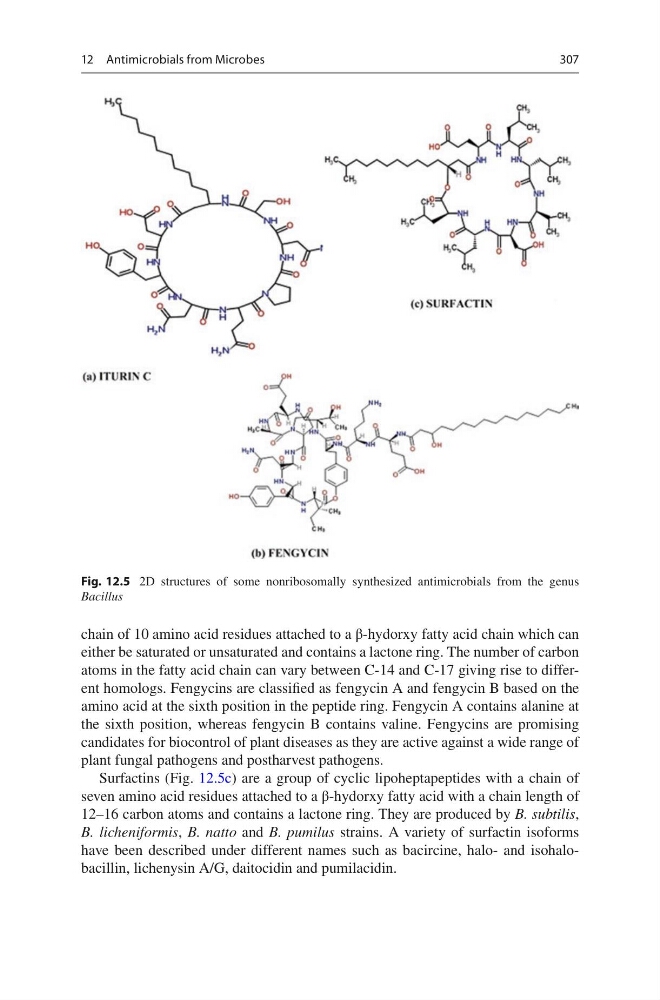
chain of 10 amino acid residues attached to a β-hydorxy fatty acid chain which can
either be saturated or unsaturated and contains a lactone ring. The number of carbon
atoms in the fatty acid chain can vary between C-14 and C-17 giving rise to different homologs. Fengycins are classified as fengycin A and fengycin B based on the
amino acid at the sixth position in the peptide ring. Fengycin A contains alanine at
the sixth position, whereas fengycin B contains valine. Fengycins are promising
candidates for biocontrol of plant diseases as they are active against a wide range of
plant fungal pathogens and postharvest pathogens.
Surfactins (Fig. 12.5c) are a group of cyclic lipoheptapeptides with a chain of
seven amino acid residues attached to a β-hydorxy fatty acid with a chain length of
12–16 carbon atoms and contains a lactone ring. They are produced by B. subtilis,
B. licheniformis, B. natto and B. pumilus strains. A variety of surfactin isoforms
have been described under different names such as bacircine, halo- and isohalobacillin, lichenysin A/G, daitocidin and pumilacidin.
Fig. 12.5 2D structures of some nonribosomally synthesized antimicrobials from the genus
Bacillus
12 Antimicrobials from Microbes
chain of 10 amino acid residues attached to a β-hydorxy fatty acid chain which can
either be saturated or unsaturated and contains a lactone ring. The number of carbon
atoms in the fatty acid chain can vary between C-14 and C-17 giving rise to different homologs. Fengycins are classified as fengycin A and fengycin B based on the
amino acid at the sixth position in the peptide ring. Fengycin A contains alanine at
the sixth position, whereas fengycin B contains valine. Fengycins are promising
candidates for biocontrol of plant diseases as they are active against a wide range of
plant fungal pathogens and postharvest pathogens.
Surfactins (Fig. 12.5c) are a group of cyclic lipoheptapeptides with a chain of
seven amino acid residues attached to a β-hydorxy fatty acid with a chain length of
12–16 carbon atoms and contains a lactone ring. They are produced by B. subtilis,
B. licheniformis, B. natto and B. pumilus strains. A variety of surfactin isoforms
have been described under different names such as bacircine, halo- and isohalobacillin, lichenysin A/G, daitocidin and pumilacidin.
Fig. 12.5 2D structures of some nonribosomally synthesized antimicrobials from the genus
Bacillus
12 Antimicrobials from Microbes