

17
hydrolysis employed by such fungi includes secreted complexes of enzymes in
addition to the cell wall-bound cellulosomal complexes. The implications of cellulose hydrolysis by anaerobic fungi are presumably high because of the unique features displayed by these organisms by virtue of the unique ecosystem in which they
survive. Anaerobic fungi are mostly residents of the rumen and alimentary tract of
herbivores, and their growth and survival is dependent on their ability to metabolize
plant biomass in a highly efficient and fast manner (Gruninger et al. 2014). This
would also imply that their enzyme systems are capable of rapid turnovers within
the shortest span of time and would make excellent candidates as components in
biomass-hydrolyzing enzyme cocktails for biorefineries. In fact, this approach has
been tried recently using a defined enzyme cocktail from Orpinomyces sp. strain
C1A, which indicated that the enzyme cocktail from anaerobic fungus performed
better than the commercial biomass-hydrolyzing enzymes at least in certain cases
(Morrison et al. 2016). Apparently, the cellulosome paradigm for cellulose hydrolysis may provide newer and efficient means for biomass conversion either alone or in
synergy with the free enzyme systems and warrants more focused studies.
CBM
Catalytic domain
Dockerin
Cohesin
Family 3
CBM
C Terminal
Divergent
Dockerin
Bacterial Cell wall
Enzymes
Scaffoldin
Cellulosome
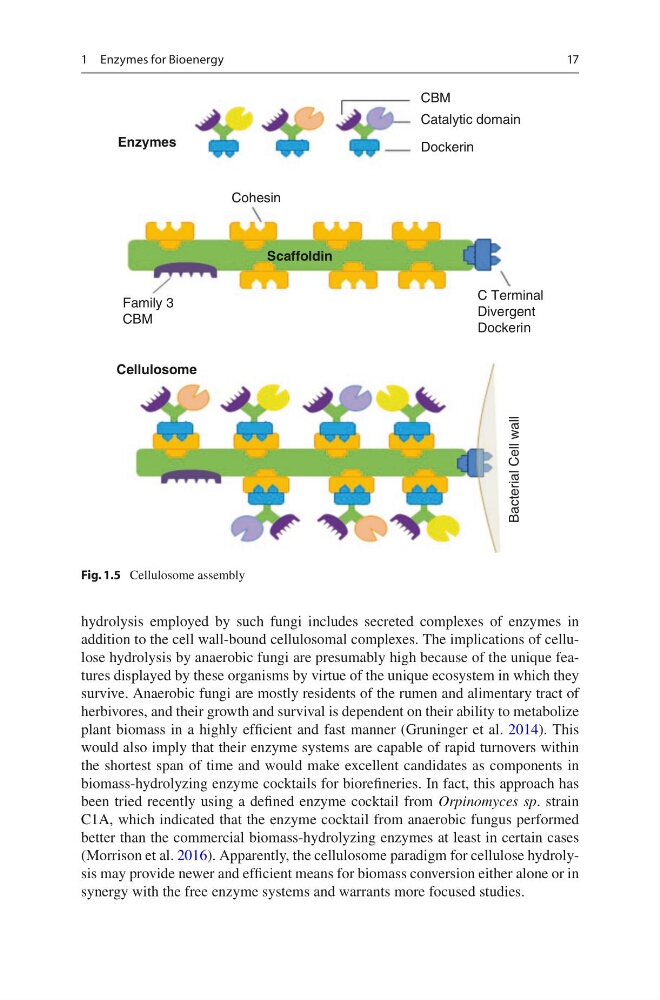
Fig. 1.5 Cellulosome assembly
1 Enzymes for Bioenergy
hydrolysis employed by such fungi includes secreted complexes of enzymes in
addition to the cell wall-bound cellulosomal complexes. The implications of cellulose hydrolysis by anaerobic fungi are presumably high because of the unique features displayed by these organisms by virtue of the unique ecosystem in which they
survive. Anaerobic fungi are mostly residents of the rumen and alimentary tract of
herbivores, and their growth and survival is dependent on their ability to metabolize
plant biomass in a highly efficient and fast manner (Gruninger et al. 2014). This
would also imply that their enzyme systems are capable of rapid turnovers within
the shortest span of time and would make excellent candidates as components in
biomass-hydrolyzing enzyme cocktails for biorefineries. In fact, this approach has
been tried recently using a defined enzyme cocktail from Orpinomyces sp. strain
C1A, which indicated that the enzyme cocktail from anaerobic fungus performed
better than the commercial biomass-hydrolyzing enzymes at least in certain cases
(Morrison et al. 2016). Apparently, the cellulosome paradigm for cellulose hydrolysis may provide newer and efficient means for biomass conversion either alone or in
synergy with the free enzyme systems and warrants more focused studies.
CBM
Catalytic domain
Dockerin
Cohesin
Family 3
CBM
C Terminal
Divergent
Dockerin
Bacterial Cell wall
Enzymes
Scaffoldin
Cellulosome
Fig. 1.5 Cellulosome assembly
1 Enzymes for Bioenergy