

284
dried under reduced pressure and redissolved in the alcohol to a specific concentration. Soxhlet apparatus can be used for the extraction process.
A variety of solvents were examined by Eloff (1998) for their ability to solubilize
antimicrobials from plants. The focus of the study was to provide a more standardized extraction method for the various researchers working in diverse areas.
Although it is not one of the more frequently used extracts in studies published to
date, acetone received the highest overall rating. Generally, most of the studies
avoid the use of aqueous fractionation altogether. Some exceptional water-soluble
compounds, such as polysaccharides (e.g. starch) and polypeptides, including fabatin and various lectins, are commonly more effective as inhibitors of pathogens and
would not be detected in the screening techniques commonly used. Occasionally,
terpenoids and tannins will be found in the aqueous phase, but they are more often
obtained by treatment with less polar solvents (Cowan 1999).
The active chemicals can be purified from the crude extracts using different
methods of separation and purification developed by natural products chemists who
mainly include chromatography techniques. Successive extractions of the dried
plant parts using different solvent systems like hexane, chloroform and methanol
are also performed in certain cases.
Chemical analysis of the purified material can be done using techniques like
chromatography, bioautography, radioimmunoassay, mass spectrometry, highperformance liquid chromatography, capillary zone electrophoresis, nuclear magnetic resonance spectroscopy and X-ray crystallography (Borris 1996). The products
obtained can then be used for testing antimicrobial studies using disc diffusion and
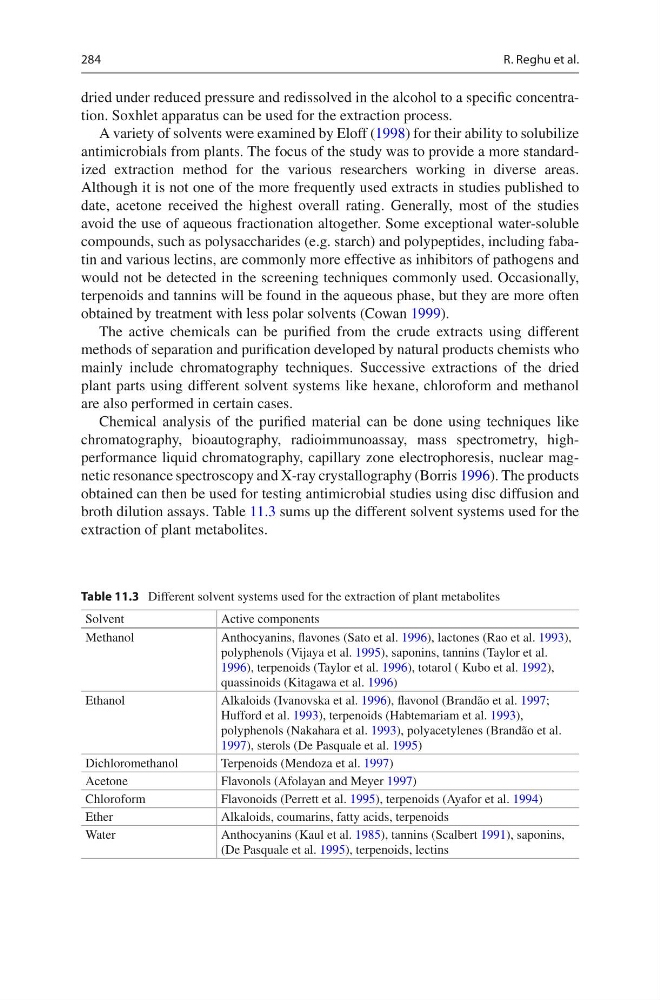
broth dilution assays. Table 11.3 sums up the different solvent systems used for the
extraction of plant metabolites.
Table 11.3 Different solvent systems used for the extraction of plant metabolites
Solvent
Active components
Methanol
Anthocyanins, flavones (Sato et al. 1996), lactones (Rao et al. 1993),
polyphenols (Vijaya et al. 1995), saponins, tannins (Taylor et al.
1996), terpenoids (Taylor et al. 1996), totarol ( Kubo et al. 1992),
quassinoids (Kitagawa et al. 1996)
Ethanol
Alkaloids (Ivanovska et al. 1996), flavonol (Brandão et al. 1997;
Hufford et al. 1993), terpenoids (Habtemariam et al. 1993),
polyphenols (Nakahara et al. 1993), polyacetylenes (Brandão et al.
1997), sterols (De Pasquale et al. 1995)
Dichloromethanol
Terpenoids (Mendoza et al. 1997)
Acetone
Flavonols (Afolayan and Meyer 1997)
Chloroform
Flavonoids (Perrett et al. 1995), terpenoids (Ayafor et al. 1994)
Ether
Alkaloids, coumarins, fatty acids, terpenoids
Water
Anthocyanins (Kaul et al. 1985), tannins (Scalbert 1991), saponins,
(De Pasquale et al. 1995), terpenoids, lectins
R. Reghu et al.
dried under reduced pressure and redissolved in the alcohol to a specific concentration. Soxhlet apparatus can be used for the extraction process.
A variety of solvents were examined by Eloff (1998) for their ability to solubilize
antimicrobials from plants. The focus of the study was to provide a more standardized extraction method for the various researchers working in diverse areas.
Although it is not one of the more frequently used extracts in studies published to
date, acetone received the highest overall rating. Generally, most of the studies
avoid the use of aqueous fractionation altogether. Some exceptional water-soluble
compounds, such as polysaccharides (e.g. starch) and polypeptides, including fabatin and various lectins, are commonly more effective as inhibitors of pathogens and
would not be detected in the screening techniques commonly used. Occasionally,
terpenoids and tannins will be found in the aqueous phase, but they are more often
obtained by treatment with less polar solvents (Cowan 1999).
The active chemicals can be purified from the crude extracts using different
methods of separation and purification developed by natural products chemists who
mainly include chromatography techniques. Successive extractions of the dried
plant parts using different solvent systems like hexane, chloroform and methanol
are also performed in certain cases.
Chemical analysis of the purified material can be done using techniques like
chromatography, bioautography, radioimmunoassay, mass spectrometry, highperformance liquid chromatography, capillary zone electrophoresis, nuclear magnetic resonance spectroscopy and X-ray crystallography (Borris 1996). The products
obtained can then be used for testing antimicrobial studies using disc diffusion and
broth dilution assays. Table 11.3 sums up the different solvent systems used for the
extraction of plant metabolites.
Table 11.3 Different solvent systems used for the extraction of plant metabolites
Solvent
Active components
Methanol
Anthocyanins, flavones (Sato et al. 1996), lactones (Rao et al. 1993),
polyphenols (Vijaya et al. 1995), saponins, tannins (Taylor et al.
1996), terpenoids (Taylor et al. 1996), totarol ( Kubo et al. 1992),
quassinoids (Kitagawa et al. 1996)
Ethanol
Alkaloids (Ivanovska et al. 1996), flavonol (Brandão et al. 1997;
Hufford et al. 1993), terpenoids (Habtemariam et al. 1993),
polyphenols (Nakahara et al. 1993), polyacetylenes (Brandão et al.
1997), sterols (De Pasquale et al. 1995)
Dichloromethanol
Terpenoids (Mendoza et al. 1997)
Acetone
Flavonols (Afolayan and Meyer 1997)
Chloroform
Flavonoids (Perrett et al. 1995), terpenoids (Ayafor et al. 1994)
Ether
Alkaloids, coumarins, fatty acids, terpenoids
Water
Anthocyanins (Kaul et al. 1985), tannins (Scalbert 1991), saponins,
(De Pasquale et al. 1995), terpenoids, lectins
R. Reghu et al.