

213
transfer from heme to Tyr385) generate tyrosyl radical in the enzyme active site.
Process of pro-S hydrogen abstraction from arachidonic acid takes place with the
help of these radicals and initiates cyclooxygenase reaction. At last, PGG2 formed
by the reduction of peroxyl radical to hydroperoxide regenerate tyrosyl radical.
Activated COX can carry out multiple turnovers without the activation step.
9.2.2.3 Inhibitors of Cyclooxygenase
Aspirin, the world’s most favourable drug, was discovered in 1898 but its therapeutic mechanism of prostaglandin inhibition was invented only in the late 1970s. A
series of cyclooxygenase inhibitor drugs were developed from 1940 to 1980 which
include phenylbutazone, fenamatesin, indomethacin, proprionates and oxicams. But
the discovery of COX isozyme in 1990 lead to a great breakthrough in the development of new drugs better than the older drugs evolved. Isozyme of COX was defined
in 1991 and a new class of inhibitors were developed by several researchers and
industrialists. The most extensively represented class of cyclooxygenase inhibitors
includes acidic sulphonamides, diarylheterocycles, zomepirac analogues, indomethacin analogues and di-tertiary-butylphenols. All these compounds are slow and
mediate tight binding inhibition.
NSAIDs show three different modes of binding. (i) low affinity fast reversible
binding followed by, higher affinity, slow reversible binding (fluorbiprofen), (ii)
reversible binding (ibuprofen) and (iii) fast reversible binding followed by a covalent modification of the enzyme (aspirin). A protein conformational change occurs
when the enzyme inhibitor is formed. Aspirin, the golden drug, covalently modifies
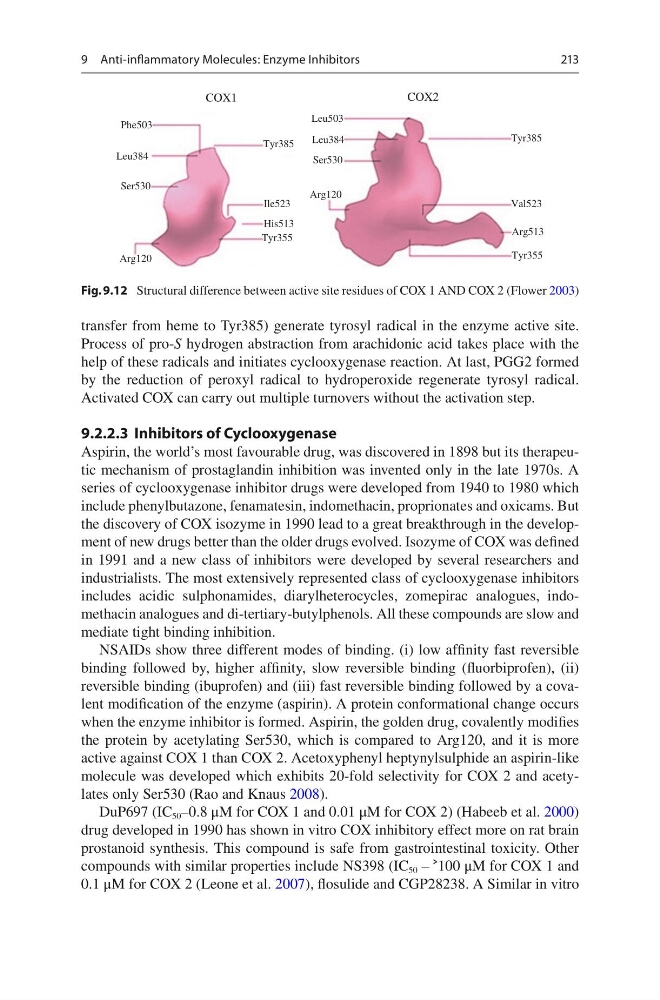
the protein by acetylating Ser530, which is compared to Arg120, and it is more
active against COX 1 than COX 2. Acetoxyphenyl heptynylsulphide an aspirin-like
molecule was developed which exhibits 20-fold selectivity for COX 2 and acetylates only Ser530 (Rao and Knaus 2008).
DuP697 (IC 50 –0.8 μM for COX 1 and 0.01 μM for COX 2) (Habeeb et al. 2000)
drug developed in 1990 has shown in vitro COX inhibitory effect more on rat brain
prostanoid synthesis. This compound is safe from gastrointestinal toxicity. Other
compounds with similar properties include NS398 (IC 50 – ˃100 μM for COX 1 and
0.1 μM for COX 2 (Leone et al. 2007), flosulide and CGP28238. A Similar in vitro
COX1
COX2
Phe503
Leu384
Ser530
Arg120
Tyr355
His513
Ile523
Tyr385
Leu503
Leu384
Ser530
Arg120
Tyr385
Val523
Arg513
Tyr355
Fig. 9.12 Structural difference between active site residues of COX 1 AND COX 2 (Flower 2003)
9 Anti-inflammatory Molecules: Enzyme Inhibitors
transfer from heme to Tyr385) generate tyrosyl radical in the enzyme active site.
Process of pro-S hydrogen abstraction from arachidonic acid takes place with the
help of these radicals and initiates cyclooxygenase reaction. At last, PGG2 formed
by the reduction of peroxyl radical to hydroperoxide regenerate tyrosyl radical.
Activated COX can carry out multiple turnovers without the activation step.
9.2.2.3 Inhibitors of Cyclooxygenase
Aspirin, the world’s most favourable drug, was discovered in 1898 but its therapeutic mechanism of prostaglandin inhibition was invented only in the late 1970s. A
series of cyclooxygenase inhibitor drugs were developed from 1940 to 1980 which
include phenylbutazone, fenamatesin, indomethacin, proprionates and oxicams. But
the discovery of COX isozyme in 1990 lead to a great breakthrough in the development of new drugs better than the older drugs evolved. Isozyme of COX was defined
in 1991 and a new class of inhibitors were developed by several researchers and
industrialists. The most extensively represented class of cyclooxygenase inhibitors
includes acidic sulphonamides, diarylheterocycles, zomepirac analogues, indomethacin analogues and di-tertiary-butylphenols. All these compounds are slow and
mediate tight binding inhibition.
NSAIDs show three different modes of binding. (i) low affinity fast reversible
binding followed by, higher affinity, slow reversible binding (fluorbiprofen), (ii)
reversible binding (ibuprofen) and (iii) fast reversible binding followed by a covalent modification of the enzyme (aspirin). A protein conformational change occurs
when the enzyme inhibitor is formed. Aspirin, the golden drug, covalently modifies
the protein by acetylating Ser530, which is compared to Arg120, and it is more
active against COX 1 than COX 2. Acetoxyphenyl heptynylsulphide an aspirin-like
molecule was developed which exhibits 20-fold selectivity for COX 2 and acetylates only Ser530 (Rao and Knaus 2008).
DuP697 (IC 50 –0.8 μM for COX 1 and 0.01 μM for COX 2) (Habeeb et al. 2000)
drug developed in 1990 has shown in vitro COX inhibitory effect more on rat brain
prostanoid synthesis. This compound is safe from gastrointestinal toxicity. Other
compounds with similar properties include NS398 (IC 50 – ˃100 μM for COX 1 and
0.1 μM for COX 2 (Leone et al. 2007), flosulide and CGP28238. A Similar in vitro
COX1
COX2
Phe503
Leu384
Ser530
Arg120
Tyr355
His513
Ile523
Tyr385
Leu503
Leu384
Ser530
Arg120
Tyr385
Val523
Arg513
Tyr355
Fig. 9.12 Structural difference between active site residues of COX 1 AND COX 2 (Flower 2003)
9 Anti-inflammatory Molecules: Enzyme Inhibitors