

207
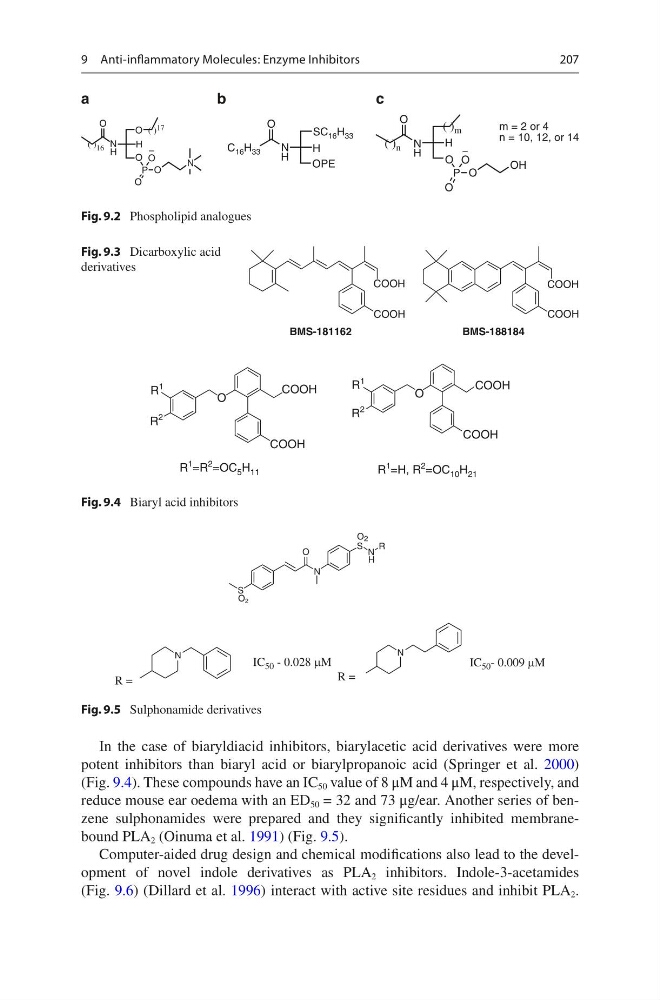
In the case of biaryldiacid inhibitors, biarylacetic acid derivatives were more
potent inhibitors than biaryl acid or biarylpropanoic acid (Springer et al. 2000)
(Fig. 9.4). These compounds have an IC 50 value of 8 μM and 4 μM, respectively, and
reduce mouse ear oedema with an ED 50 = 32 and 73 μg/ear. Another series of benzene sulphonamides were prepared and they significantly inhibited membranebound PLA 2 (Oinuma et al. 1991) (Fig. 9.5).
Computer-aided drug design and chemical modifications also lead to the development of novel indole derivatives as PLA 2 inhibitors. Indole-3-acetamides
(Fig. 9.6) (Dillard et al. 1996) interact with active site residues and inhibit PLA 2 .
O
O
–
–
O
O
O O
O
O
P
OH
m = 2 or 4
( ) m
( ) n
( ) 16
( ) 17
n = 10, 12, or 14
OPE
O O
O
O
P
N
N
N
N
H
H
H
H
C 16 H 33
SC 16 H 33
H
H
a
b
c
Fig. 9.2 Phospholipid analogues
COOH
COOH
COOH
BMS-188184
BMS-181162
COOH
Fig. 9.3 Dicarboxylic acid
derivatives
R
1
R
1
R
2
R
2
O
O
COOH
COOH
COOH
COOH
R
1 =R
2
=OC 5 H 11
R
1 =H, R
2 =OC 10 H 21
Fig. 9.4 Biaryl acid inhibitors
S
O
S N
H
R
O 2
N
N
N
R =
R =
IC 50 - 0.028 mM
IC 50 - 0.009 mM
O 2
Fig. 9.5 Sulphonamide derivatives
9 Anti-inflammatory Molecules: Enzyme Inhibitors
In the case of biaryldiacid inhibitors, biarylacetic acid derivatives were more
potent inhibitors than biaryl acid or biarylpropanoic acid (Springer et al. 2000)
(Fig. 9.4). These compounds have an IC 50 value of 8 μM and 4 μM, respectively, and
reduce mouse ear oedema with an ED 50 = 32 and 73 μg/ear. Another series of benzene sulphonamides were prepared and they significantly inhibited membranebound PLA 2 (Oinuma et al. 1991) (Fig. 9.5).
Computer-aided drug design and chemical modifications also lead to the development of novel indole derivatives as PLA 2 inhibitors. Indole-3-acetamides
(Fig. 9.6) (Dillard et al. 1996) interact with active site residues and inhibit PLA 2 .
O
O
–
–
O
O
O O
O
O
P
OH
m = 2 or 4
( ) m
( ) n
( ) 16
( ) 17
n = 10, 12, or 14
OPE
O O
O
O
P
N
N
N
N
H
H
H
H
C 16 H 33
SC 16 H 33
H
H
a
b
c
Fig. 9.2 Phospholipid analogues
COOH
COOH
COOH
BMS-188184
BMS-181162
COOH
Fig. 9.3 Dicarboxylic acid
derivatives
R
1
R
1
R
2
R
2
O
O
COOH
COOH
COOH
COOH
R
1 =R
2
=OC 5 H 11
R
1 =H, R
2 =OC 10 H 21
Fig. 9.4 Biaryl acid inhibitors
S
O
S N
H
R
O 2
N
N
N
R =
R =
IC 50 - 0.028 mM
IC 50 - 0.009 mM
O 2
Fig. 9.5 Sulphonamide derivatives
9 Anti-inflammatory Molecules: Enzyme Inhibitors