

156
computational protein design algorithms were developed to predict optimal mutations at specific residue positions in the protein, only limited success has been demonstrated, whereas only the knowledge of protein sequence is required in the case of
directed evolution approach. This approach involves repeated cycles of random
mutagenesis and/or gene recombination followed by screening or selection for positive mutants (Zhao and Tan 2015). The method of directed evolution mimics natural
evolution and normally produces better results to rational design. The directed evolution has been widely applied with the aim of developing highly efficient biocatalysts (Adamczak and Krishna 2004; Bloom and Arnold 2009; Rubin-Pitel and Zhao
2006; Turner 2009). The methodology or the approach that permits one to attain the
goal with least effort can be considered as the best protein engineering strategy. This
criterion makes it improbable that a purely rational design or purely random mutagenesis approach will be best.
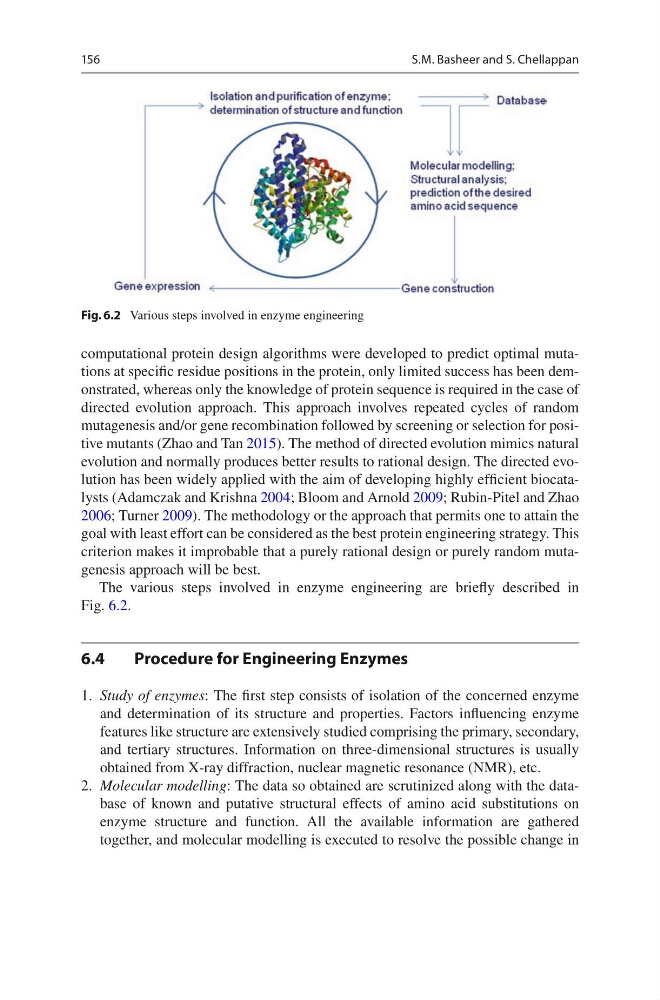
The various steps involved in enzyme engineering are briefly described in
Fig. 6.2.
6.4
Procedure for Engineering Enzymes
1. Study of enzymes: The first step consists of isolation of the concerned enzyme
and determination of its structure and properties. Factors influencing enzyme
features like structure are extensively studied comprising the primary, secondary,
and tertiary structures. Information on three-dimensional structures is usually
obtained from X-ray diffraction, nuclear magnetic resonance (NMR), etc.
2. Molecular modelling: The data so obtained are scrutinized along with the database of known and putative structural effects of amino acid substitutions on
enzyme structure and function. All the available information are gathered
together, and molecular modelling is executed to resolve the possible change in
Fig. 6.2 Various steps involved in enzyme engineering
S.M. Basheer and S. Chellappan
computational protein design algorithms were developed to predict optimal mutations at specific residue positions in the protein, only limited success has been demonstrated, whereas only the knowledge of protein sequence is required in the case of
directed evolution approach. This approach involves repeated cycles of random
mutagenesis and/or gene recombination followed by screening or selection for positive mutants (Zhao and Tan 2015). The method of directed evolution mimics natural
evolution and normally produces better results to rational design. The directed evolution has been widely applied with the aim of developing highly efficient biocatalysts (Adamczak and Krishna 2004; Bloom and Arnold 2009; Rubin-Pitel and Zhao
2006; Turner 2009). The methodology or the approach that permits one to attain the
goal with least effort can be considered as the best protein engineering strategy. This
criterion makes it improbable that a purely rational design or purely random mutagenesis approach will be best.
The various steps involved in enzyme engineering are briefly described in
Fig. 6.2.
6.4
Procedure for Engineering Enzymes
1. Study of enzymes: The first step consists of isolation of the concerned enzyme
and determination of its structure and properties. Factors influencing enzyme
features like structure are extensively studied comprising the primary, secondary,
and tertiary structures. Information on three-dimensional structures is usually
obtained from X-ray diffraction, nuclear magnetic resonance (NMR), etc.
2. Molecular modelling: The data so obtained are scrutinized along with the database of known and putative structural effects of amino acid substitutions on
enzyme structure and function. All the available information are gathered
together, and molecular modelling is executed to resolve the possible change in
Fig. 6.2 Various steps involved in enzyme engineering
S.M. Basheer and S. Chellappan