

152
6.1
Introduction
Enzymes are widely used in novel and diverse applications in the food, feed, agriculture, paper, leather, and textile industries producing significant decline in their
manufacturing cost. Currently, rapid technological advancements are stimulating
the chemistry and pharma industries to adopt enzyme technology, a trend that is
strengthened by the concerns occurring in the areas of health, energy, raw materials,
and the environment. In the case of industrial enzymes, the global market approached
nearly $4.9 billion in 2015 and is anticipated to reach $6.3 billion by 2021 (BCC
Research 2017). Novo Nordisk is one of the biggest enzyme producers, which manufactures genetically engineered (GE) and non-GE enzymes. Enzymes are abundantly used in the large-scale production of chemicals and pharmaceuticals, and
more than 300 processes have been already established (Schmid et al. 2001;
Schoemaker et al. 2003). The microbial kingdom represents an enormous and still
underexplored reservoir for enzymes with specific properties, and hence biocatalysts of microbial origin are used in a majority of industrial processes.
6.2
Major Classification of Enzymes
According to the International Enzyme Commission constituted by the International
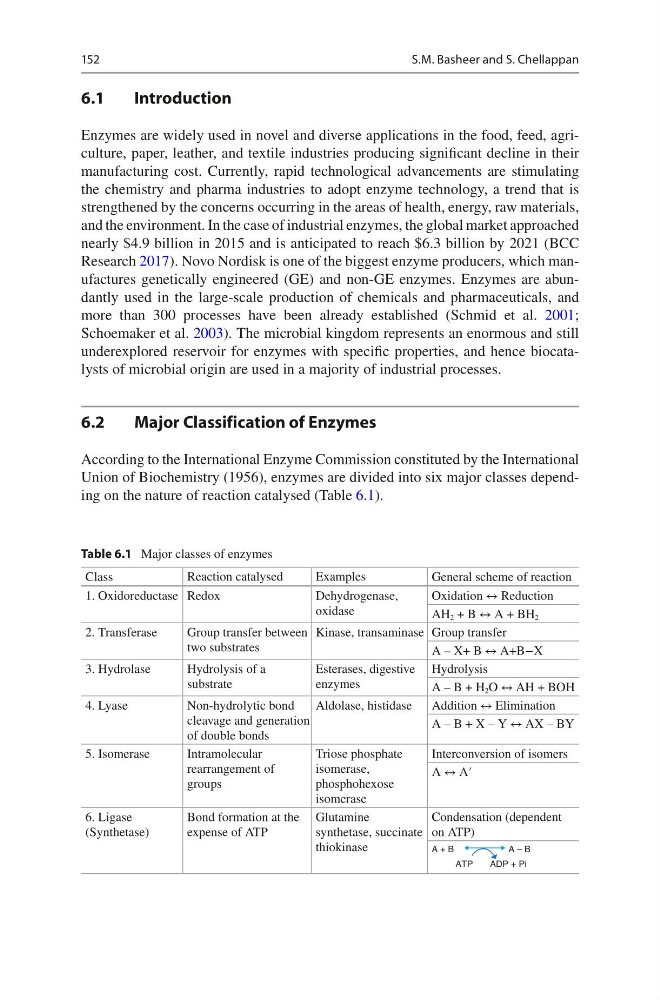
Union of Biochemistry (1956), enzymes are divided into six major classes depending on the nature of reaction catalysed (Table 6.1).
Table 6.1 Major classes of enzymes
Class
Reaction catalysed
Examples
General scheme of reaction
1. Oxidoreductase Redox
Dehydrogenase,
oxidase
Oxidation ↔ Reduction
AH 2 + B ↔ A + BH 2
2. Transferase
Group transfer between
two substrates
Kinase, transaminase Group transfer
A – X+ B ↔ A+B−X
3. Hydrolase
Hydrolysis of a
substrate
Esterases, digestive
enzymes
Hydrolysis
A – B + H 2 O ↔ AH + BOH
4. Lyase
Non-hydrolytic bond
cleavage and generation
of double bonds
Aldolase, histidase
Addition ↔ Elimination
A – B + X – Y ↔ AX – BY
5. Isomerase
Intramolecular
rearrangement of
groups
Triose phosphate
isomerase,
phosphohexose
isomerase
Interconversion of isomers
A ↔ A′
6. Ligase
(Synthetase)
Bond formation at the
expense of ATP
Glutamine
synthetase, succinate
thiokinase
Condensation (dependent
on ATP)
A + B
A – B
ATP
ADP + Pi
S.M. Basheer and S. Chellappan
6.1
Introduction
Enzymes are widely used in novel and diverse applications in the food, feed, agriculture, paper, leather, and textile industries producing significant decline in their
manufacturing cost. Currently, rapid technological advancements are stimulating
the chemistry and pharma industries to adopt enzyme technology, a trend that is
strengthened by the concerns occurring in the areas of health, energy, raw materials,
and the environment. In the case of industrial enzymes, the global market approached
nearly $4.9 billion in 2015 and is anticipated to reach $6.3 billion by 2021 (BCC
Research 2017). Novo Nordisk is one of the biggest enzyme producers, which manufactures genetically engineered (GE) and non-GE enzymes. Enzymes are abundantly used in the large-scale production of chemicals and pharmaceuticals, and
more than 300 processes have been already established (Schmid et al. 2001;
Schoemaker et al. 2003). The microbial kingdom represents an enormous and still
underexplored reservoir for enzymes with specific properties, and hence biocatalysts of microbial origin are used in a majority of industrial processes.
6.2
Major Classification of Enzymes
According to the International Enzyme Commission constituted by the International
Union of Biochemistry (1956), enzymes are divided into six major classes depending on the nature of reaction catalysed (Table 6.1).
Table 6.1 Major classes of enzymes
Class
Reaction catalysed
Examples
General scheme of reaction
1. Oxidoreductase Redox
Dehydrogenase,
oxidase
Oxidation ↔ Reduction
AH 2 + B ↔ A + BH 2
2. Transferase
Group transfer between
two substrates
Kinase, transaminase Group transfer
A – X+ B ↔ A+B−X
3. Hydrolase
Hydrolysis of a
substrate
Esterases, digestive
enzymes
Hydrolysis
A – B + H 2 O ↔ AH + BOH
4. Lyase
Non-hydrolytic bond
cleavage and generation
of double bonds
Aldolase, histidase
Addition ↔ Elimination
A – B + X – Y ↔ AX – BY
5. Isomerase
Intramolecular
rearrangement of
groups
Triose phosphate
isomerase,
phosphohexose
isomerase
Interconversion of isomers
A ↔ A′
6. Ligase
(Synthetase)
Bond formation at the
expense of ATP
Glutamine
synthetase, succinate
thiokinase
Condensation (dependent
on ATP)
A + B
A – B
ATP
ADP + Pi
S.M. Basheer and S. Chellappan