

145
gation of tripeptide glutathione with xenobiotic compounds forming thioether conjugates. To a larger extent, a number of endogenous compounds such as
prostaglandins and steroids are also metabolized via glutathione conjugation
(Parkinson et al. 2013).
5.3
Biotransforming Enzymes in Plants
Plants are permanently exposed to various xenobiotics and pose potential danger.
Like other living beings, plants also include a variety of xenobiotic-metabolizing
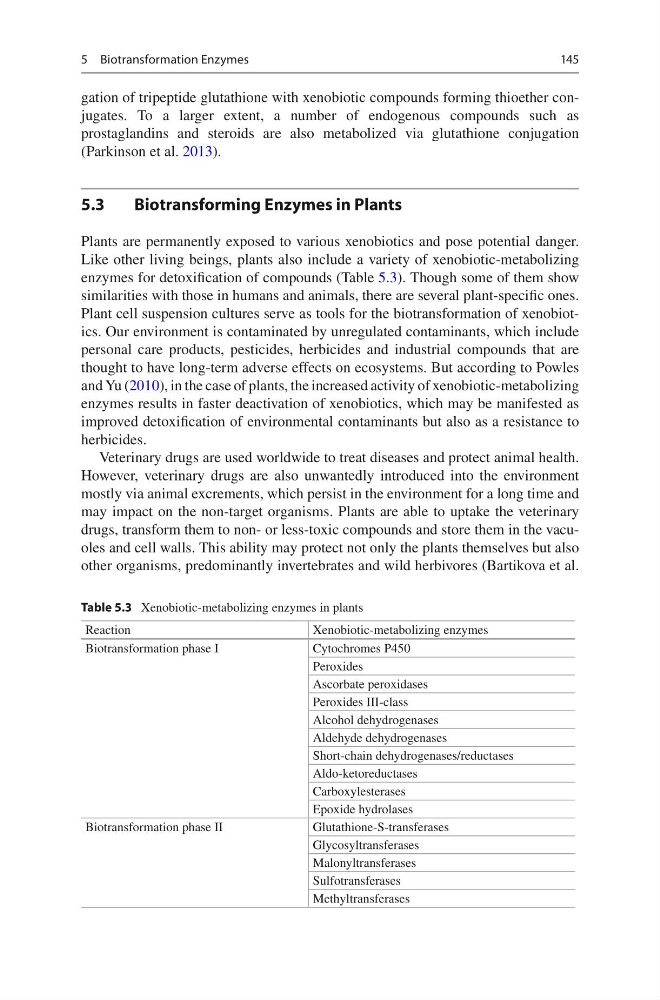
enzymes for detoxification of compounds (Table 5.3). Though some of them show
similarities with those in humans and animals, there are several plant-specific ones.
Plant cell suspension cultures serve as tools for the biotransformation of xenobiotics. Our environment is contaminated by unregulated contaminants, which include
personal care products, pesticides, herbicides and industrial compounds that are
thought to have long-term adverse effects on ecosystems. But according to Powles
and Yu (2010), in the case of plants, the increased activity of xenobiotic- metabolizing
enzymes results in faster deactivation of xenobiotics, which may be manifested as
improved detoxification of environmental contaminants but also as a resistance to
herbicides.
Veterinary drugs are used worldwide to treat diseases and protect animal health.
However, veterinary drugs are also unwantedly introduced into the environment
mostly via animal excrements, which persist in the environment for a long time and
may impact on the non-target organisms. Plants are able to uptake the veterinary
drugs, transform them to non- or less-toxic compounds and store them in the vacuoles and cell walls. This ability may protect not only the plants themselves but also
other organisms, predominantly invertebrates and wild herbivores (Bartikova et al.
Table 5.3 Xenobiotic-metabolizing enzymes in plants
Reaction
Xenobiotic-metabolizing enzymes
Biotransformation phase I
Cytochromes P450
Peroxides
Ascorbate peroxidases
Peroxides III-class
Alcohol dehydrogenases
Aldehyde dehydrogenases
Short-chain dehydrogenases/reductases
Aldo-ketoreductases
Carboxylesterases
Epoxide hydrolases
Biotransformation phase II
Glutathione-S-transferases
Glycosyltransferases
Malonyltransferases
Sulfotransferases
Methyltransferases
5 Biotransformation Enzymes
gation of tripeptide glutathione with xenobiotic compounds forming thioether conjugates. To a larger extent, a number of endogenous compounds such as
prostaglandins and steroids are also metabolized via glutathione conjugation
(Parkinson et al. 2013).
5.3
Biotransforming Enzymes in Plants
Plants are permanently exposed to various xenobiotics and pose potential danger.
Like other living beings, plants also include a variety of xenobiotic-metabolizing
enzymes for detoxification of compounds (Table 5.3). Though some of them show
similarities with those in humans and animals, there are several plant-specific ones.
Plant cell suspension cultures serve as tools for the biotransformation of xenobiotics. Our environment is contaminated by unregulated contaminants, which include
personal care products, pesticides, herbicides and industrial compounds that are
thought to have long-term adverse effects on ecosystems. But according to Powles
and Yu (2010), in the case of plants, the increased activity of xenobiotic- metabolizing
enzymes results in faster deactivation of xenobiotics, which may be manifested as
improved detoxification of environmental contaminants but also as a resistance to
herbicides.
Veterinary drugs are used worldwide to treat diseases and protect animal health.
However, veterinary drugs are also unwantedly introduced into the environment
mostly via animal excrements, which persist in the environment for a long time and
may impact on the non-target organisms. Plants are able to uptake the veterinary
drugs, transform them to non- or less-toxic compounds and store them in the vacuoles and cell walls. This ability may protect not only the plants themselves but also
other organisms, predominantly invertebrates and wild herbivores (Bartikova et al.
Table 5.3 Xenobiotic-metabolizing enzymes in plants
Reaction
Xenobiotic-metabolizing enzymes
Biotransformation phase I
Cytochromes P450
Peroxides
Ascorbate peroxidases
Peroxides III-class
Alcohol dehydrogenases
Aldehyde dehydrogenases
Short-chain dehydrogenases/reductases
Aldo-ketoreductases
Carboxylesterases
Epoxide hydrolases
Biotransformation phase II
Glutathione-S-transferases
Glycosyltransferases
Malonyltransferases
Sulfotransferases
Methyltransferases
5 Biotransformation Enzymes