

104
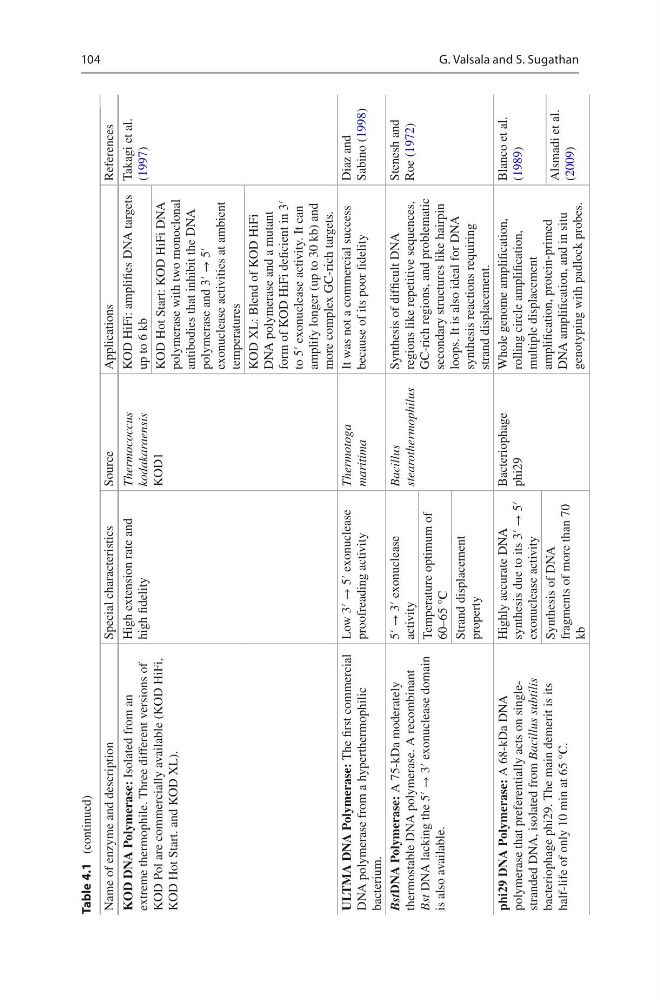
Table 4.1 (continued)
Name of enzyme and description
Special characteristics
Source
Applications
References
KOD DNA Polymerase: Isolated from an
extreme thermophile. Three different versions of
KOD Pol are commercially available (KOD HiFi,
KOD Hot Start. and KOD XL).
High extension rate and
high fidelity
Thermococcus
kodakaraensis
KOD1
KOD HiFi: amplifies DNA targets
up to 6 kb
Takagi et al.
(1997)
KOD Hot Start: KOD HiFi DNA
polymerase with two monoclonal
antibodies that inhibit the DNA
polymerase and 3′
→ 5′
exonuclease activities at ambient
temperatures
KOD XL: Blend of KOD HiFi
DNA polymerase and a mutant
form of KOD HiFi deficient in 3′
to 5′ exonuclease activity. It can
amplify longer (up to 30 kb) and
more complex GC-rich targets.
ULTMA DNA Polymerase: The first commercial
DNA polymerase from a hyperthermophilic
bacterium.
Low 3′
→ 5′ exonuclease
proofreading activity
Thermotoga
maritima
It was not a commercial success
because of its poor fidelity
Diaz and
Sabino (1998)
BstDNA Polymerase: A 75-kDa moderately
thermostable DNA polymerase. A recombinant
Bst
DNA lacking the 5′
→ 3′ exonuclease domain
is also available.
5′
→ 3′ exonuclease
activity
Bacillus
stearothermophilus
Synthesis of difficult DNA
regions like repetitive sequences,
GC-rich regions, and problematic
secondary structures like hairpin
loops. It is also ideal for DNA
synthesis reactions requiring
strand displacement.
Stenesh and
Roe (1972)
Temperature optimum of
60–65 °C
Strand displacement
property
phi29 DNA Polymerase: A 68-kDa DNA
polymerase that preferentially acts on singlestranded DNA, isolated from Bacillus subtilis
bacteriophage phi29. The main demerit is its
half-life of only 10 min at 65 °C.
Highly accurate DNA
synthesis due to its 3′
→ 5′
exonuclease activity
Bacteriophage
phi29
Whole genome amplification,
rolling circle amplification,
multiple displacement
amplification, protein-primed
DNA amplification, and in situ
genotyping with padlock probes.
Blanco et al.
(1989)
Synthesis of DNA
fragments of more than 70
kb
Alsmadi et al.
(2009)
G. Valsala and S. Sugathan
Table 4.1 (continued)
Name of enzyme and description
Special characteristics
Source
Applications
References
KOD DNA Polymerase: Isolated from an
extreme thermophile. Three different versions of
KOD Pol are commercially available (KOD HiFi,
KOD Hot Start. and KOD XL).
High extension rate and
high fidelity
Thermococcus
kodakaraensis
KOD1
KOD HiFi: amplifies DNA targets
up to 6 kb
Takagi et al.
(1997)
KOD Hot Start: KOD HiFi DNA
polymerase with two monoclonal
antibodies that inhibit the DNA
polymerase and 3′
→ 5′
exonuclease activities at ambient
temperatures
KOD XL: Blend of KOD HiFi
DNA polymerase and a mutant
form of KOD HiFi deficient in 3′
to 5′ exonuclease activity. It can
amplify longer (up to 30 kb) and
more complex GC-rich targets.
ULTMA DNA Polymerase: The first commercial
DNA polymerase from a hyperthermophilic
bacterium.
Low 3′
→ 5′ exonuclease
proofreading activity
Thermotoga
maritima
It was not a commercial success
because of its poor fidelity
Diaz and
Sabino (1998)
BstDNA Polymerase: A 75-kDa moderately
thermostable DNA polymerase. A recombinant
Bst
DNA lacking the 5′
→ 3′ exonuclease domain
is also available.
5′
→ 3′ exonuclease
activity
Bacillus
stearothermophilus
Synthesis of difficult DNA
regions like repetitive sequences,
GC-rich regions, and problematic
secondary structures like hairpin
loops. It is also ideal for DNA
synthesis reactions requiring
strand displacement.
Stenesh and
Roe (1972)
Temperature optimum of
60–65 °C
Strand displacement
property
phi29 DNA Polymerase: A 68-kDa DNA
polymerase that preferentially acts on singlestranded DNA, isolated from Bacillus subtilis
bacteriophage phi29. The main demerit is its
half-life of only 10 min at 65 °C.
Highly accurate DNA
synthesis due to its 3′
→ 5′
exonuclease activity
Bacteriophage
phi29
Whole genome amplification,
rolling circle amplification,
multiple displacement
amplification, protein-primed
DNA amplification, and in situ
genotyping with padlock probes.
Blanco et al.
(1989)
Synthesis of DNA
fragments of more than 70
kb
Alsmadi et al.
(2009)
G. Valsala and S. Sugathan