

Role of Hydrodynamic Shear on Activity and Structure of Proteins
63
A significant reduction in the number of small particles occurs during the aging
period. This result has been explained based on Smoluchowshi's collision
frequency theory which states that the probability of collision between small and
large particles is greater than the probability of collision between small particles,
hence large particles behave as nuclei around which small particles collect.
Aging for a short duration resulted in a wide size distribution of particles after
subsequent shearing. Shearing after prolonged aging times showed a bimodal
distribution of particles as a result of fragmentation, a peak between 4-8 pm
associated with fragmentation and an increase in the number of particles less
than 3.5 lam produced due to erosion. The median size of the fragments (5.8 gm)
was not affected by the time of aging. The results obtained suggest that aging
leads to an improvement in aggregate strength. Denser aggregate may be
formed by infilling of small, primary particles and by aggregate rearrangement.
This rearrangement is due to aggregate breakup followed by more stable
reaggregation and by the deformation of aggregate in the shear field in the
stirred tank. This process results in an increase in the interparticle contacts
leading to increased strength. Rearrangement of shear deformation is assisted by
the existence of a distribution of shear rates within the stirred vessel. The
impeller motion also causes the aggregate to pass from regions of low shear to
regions of relatively high shear, imposing a dynamic stress on the aggregate and
hence causing a shear induced rearrangement.
These mechanisms of improvement of aggregate strength depend upon the
effective pumping rate, the level of shear and the time of exposure in the tank.
These variables have been incorporated in an aging parameter Gt, where G is
the rms velocity gradient and t is the time of aging, expressed for a given impeller
and tank geometry.
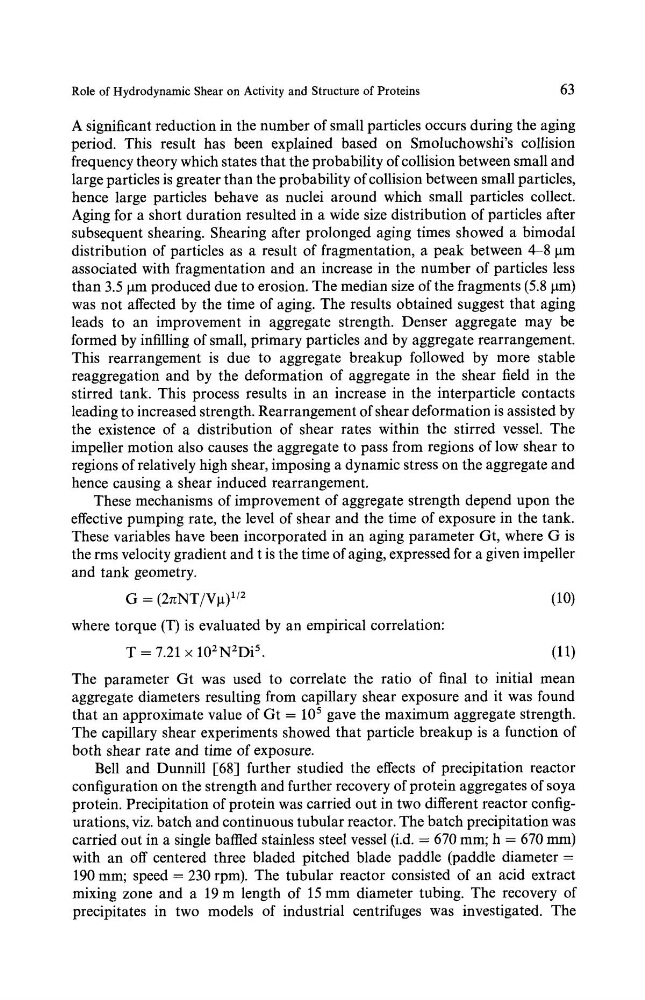
6 = (2nNT/VI.t) 1/2
(10)
where torque (T) is evaluated by an empirical correlation:
T = 7.21 x 10²N2Di 5.
(11)
The parameter Gt was used to correlate the ratio of final to initial mean
aggregate diameters resulting from capillary shear exposure and it was found
that an approximate value of Gt = l0 s gave the maximum aggregate strength.
The capillary shear experiments showed that particle breakup is a function of
both shear rate and time of exposure.
Bell and Dunnill [68] further studied the effects of precipitation reactor
configuration on the strength and further recovery of protein aggregates of soya
protein. Precipitation of protein was carried out in two different reactor configurations, viz. batch and continuous tubular reactor. The batch precipitation was
carried out in a single baffled stainless steel vessel (i.d. = 670 mm; h = 670 mm)
with an off centered three bladed pitched blade paddle (paddle diameter -190 mm; speed = 230 rpm). The tubular reactor consisted of an acid extract
mixing zone and a 19 m length of 15 mm diameter tubing. The recovery of
precipitates in two models of industrial centrifuges was investigated. The
63
A significant reduction in the number of small particles occurs during the aging
period. This result has been explained based on Smoluchowshi's collision
frequency theory which states that the probability of collision between small and
large particles is greater than the probability of collision between small particles,
hence large particles behave as nuclei around which small particles collect.
Aging for a short duration resulted in a wide size distribution of particles after
subsequent shearing. Shearing after prolonged aging times showed a bimodal
distribution of particles as a result of fragmentation, a peak between 4-8 pm
associated with fragmentation and an increase in the number of particles less
than 3.5 lam produced due to erosion. The median size of the fragments (5.8 gm)
was not affected by the time of aging. The results obtained suggest that aging
leads to an improvement in aggregate strength. Denser aggregate may be
formed by infilling of small, primary particles and by aggregate rearrangement.
This rearrangement is due to aggregate breakup followed by more stable
reaggregation and by the deformation of aggregate in the shear field in the
stirred tank. This process results in an increase in the interparticle contacts
leading to increased strength. Rearrangement of shear deformation is assisted by
the existence of a distribution of shear rates within the stirred vessel. The
impeller motion also causes the aggregate to pass from regions of low shear to
regions of relatively high shear, imposing a dynamic stress on the aggregate and
hence causing a shear induced rearrangement.
These mechanisms of improvement of aggregate strength depend upon the
effective pumping rate, the level of shear and the time of exposure in the tank.
These variables have been incorporated in an aging parameter Gt, where G is
the rms velocity gradient and t is the time of aging, expressed for a given impeller
and tank geometry.
6 = (2nNT/VI.t) 1/2
(10)
where torque (T) is evaluated by an empirical correlation:
T = 7.21 x 10²N2Di 5.
(11)
The parameter Gt was used to correlate the ratio of final to initial mean
aggregate diameters resulting from capillary shear exposure and it was found
that an approximate value of Gt = l0 s gave the maximum aggregate strength.
The capillary shear experiments showed that particle breakup is a function of
both shear rate and time of exposure.
Bell and Dunnill [68] further studied the effects of precipitation reactor
configuration on the strength and further recovery of protein aggregates of soya
protein. Precipitation of protein was carried out in two different reactor configurations, viz. batch and continuous tubular reactor. The batch precipitation was
carried out in a single baffled stainless steel vessel (i.d. = 670 mm; h = 670 mm)
with an off centered three bladed pitched blade paddle (paddle diameter -190 mm; speed = 230 rpm). The tubular reactor consisted of an acid extract
mixing zone and a 19 m length of 15 mm diameter tubing. The recovery of
precipitates in two models of industrial centrifuges was investigated. The