

56
C.B. Elias and J.B. Joshi
type and hence this is also referred to as couette viscometer. This comprises
a stationary inner cylindrical bob and an outer rotating cylindrical cup. The
sample to be subjected to shear is placed between the bob and the cup. The shear
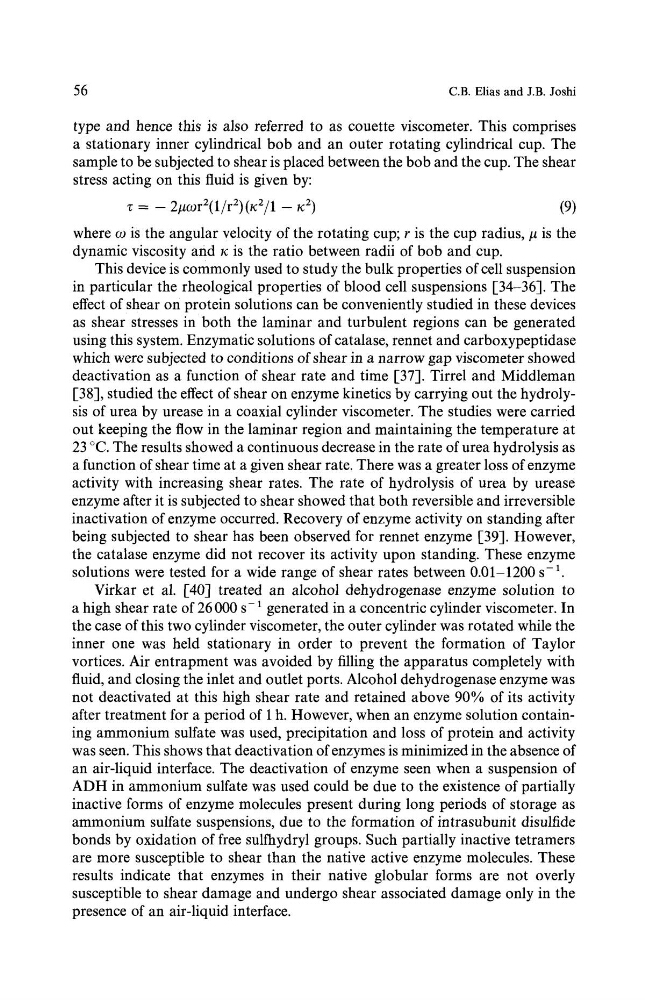
stress acting on this fluid is given by:
"c = -- 2#cor2(1/r 2) (•2/1 -/s
(9)
where co is the angular velocity of the rotating cup; r is the cup radius, # is the
dynamic viscosity and tc is the ratio between radii of bob and cup.
This device is commonly used to study the bulk properties of cell suspension
in particular the rheological properties of blood cell suspensions [34-36]. The
effect of shear on protein solutions can be conveniently studied in these devices
as shear stresses in both the laminar and turbulent regions can be generated
using this system. Enzymatic solutions of catalase, rennet and carboxypeptidase
which were subjected to conditions of shear in a narrow gap viscometer showed
deactivation as a function of shear rate and time [37]. Tirrel and Middleman
[38], studied the effect of shear on enzyme kinetics by carrying out the hydrolysis of urea by urease in a coaxial cylinder viscometer. The studies were carried
out keeping the flow in the laminar region and maintaining the temperature at
23 ~ The results showed a continuous decrease in the rate of urea hydrolysis as
a function of shear time at a given shear rate. There was a greater loss of enzyme
activity with increasing shear rates. The rate of hydrolysis of urea by urease
enzyme after it is subjected to shear showed that both reversible and irreversible
inactivation of enzyme occurred. Recovery of enzyme activity on standing after
being subjected to shear has been observed for rennet enzyme [39]. However,
the catalase enzyme did not recover its activity upon standing. These enzyme
solutions were tested for a wide range of shear rates between 0.01-1200 s-1.
Virkar et al. [40] treated an alcohol dehydrogenase enzyme solution to
a high shear rate of 26 000 s- 1 generated in a concentric cylinder viscometer. In
the case of this two cylinder viscometer, the outer cylinder was rotated while the
inner one was held stationary in order to prevent the formation of Taylor
vortices. Air entrapment was avoided by filling the apparatus completely with
fluid, and closing the inlet and outlet ports. Alcohol dehydrogenase enzyme was
not deactivated at this high shear rate and retained above 90% of its activity
after treatment for a period of 1 h. However, when an enzyme solution containing ammonium sulfate was used, precipitation and loss of protein and activity
was seen. This shows that deactivation of enzymes is minimized in the absence of
an air-liquid interface. The deactivation of enzyme seen when a suspension of
ADH in ammonium sulfate was used could be due to the existence of partially
inactive forms of enzyme molecules present during long periods of storage as
ammonium sulfate suspensions, due to the formation of intrasubunit disulfide
bonds by oxidation of free sulfhydryl groups. Such partially inactive tetramers
are more susceptible to shear than the native active enzyme molecules. These
results indicate that enzymes in their native globular forms are not overly
susceptible to shear damage and undergo shear associated damage only in the
presence of an air-liquid interface.
C.B. Elias and J.B. Joshi
type and hence this is also referred to as couette viscometer. This comprises
a stationary inner cylindrical bob and an outer rotating cylindrical cup. The
sample to be subjected to shear is placed between the bob and the cup. The shear
stress acting on this fluid is given by:
"c = -- 2#cor2(1/r 2) (•2/1 -/s
(9)
where co is the angular velocity of the rotating cup; r is the cup radius, # is the
dynamic viscosity and tc is the ratio between radii of bob and cup.
This device is commonly used to study the bulk properties of cell suspension
in particular the rheological properties of blood cell suspensions [34-36]. The
effect of shear on protein solutions can be conveniently studied in these devices
as shear stresses in both the laminar and turbulent regions can be generated
using this system. Enzymatic solutions of catalase, rennet and carboxypeptidase
which were subjected to conditions of shear in a narrow gap viscometer showed
deactivation as a function of shear rate and time [37]. Tirrel and Middleman
[38], studied the effect of shear on enzyme kinetics by carrying out the hydrolysis of urea by urease in a coaxial cylinder viscometer. The studies were carried
out keeping the flow in the laminar region and maintaining the temperature at
23 ~ The results showed a continuous decrease in the rate of urea hydrolysis as
a function of shear time at a given shear rate. There was a greater loss of enzyme
activity with increasing shear rates. The rate of hydrolysis of urea by urease
enzyme after it is subjected to shear showed that both reversible and irreversible
inactivation of enzyme occurred. Recovery of enzyme activity on standing after
being subjected to shear has been observed for rennet enzyme [39]. However,
the catalase enzyme did not recover its activity upon standing. These enzyme
solutions were tested for a wide range of shear rates between 0.01-1200 s-1.
Virkar et al. [40] treated an alcohol dehydrogenase enzyme solution to
a high shear rate of 26 000 s- 1 generated in a concentric cylinder viscometer. In
the case of this two cylinder viscometer, the outer cylinder was rotated while the
inner one was held stationary in order to prevent the formation of Taylor
vortices. Air entrapment was avoided by filling the apparatus completely with
fluid, and closing the inlet and outlet ports. Alcohol dehydrogenase enzyme was
not deactivated at this high shear rate and retained above 90% of its activity
after treatment for a period of 1 h. However, when an enzyme solution containing ammonium sulfate was used, precipitation and loss of protein and activity
was seen. This shows that deactivation of enzymes is minimized in the absence of
an air-liquid interface. The deactivation of enzyme seen when a suspension of
ADH in ammonium sulfate was used could be due to the existence of partially
inactive forms of enzyme molecules present during long periods of storage as
ammonium sulfate suspensions, due to the formation of intrasubunit disulfide
bonds by oxidation of free sulfhydryl groups. Such partially inactive tetramers
are more susceptible to shear than the native active enzyme molecules. These
results indicate that enzymes in their native globular forms are not overly
susceptible to shear damage and undergo shear associated damage only in the
presence of an air-liquid interface.