

54
C.B. Elias and J.B. Joshi
catalase, carboxypeptidase and rennet, by passing enzyme solutions through
capillary tubes. They observed that the degree of inactivation of these enzymes
depended on the shear rate and time of exposure. The combined effect of these
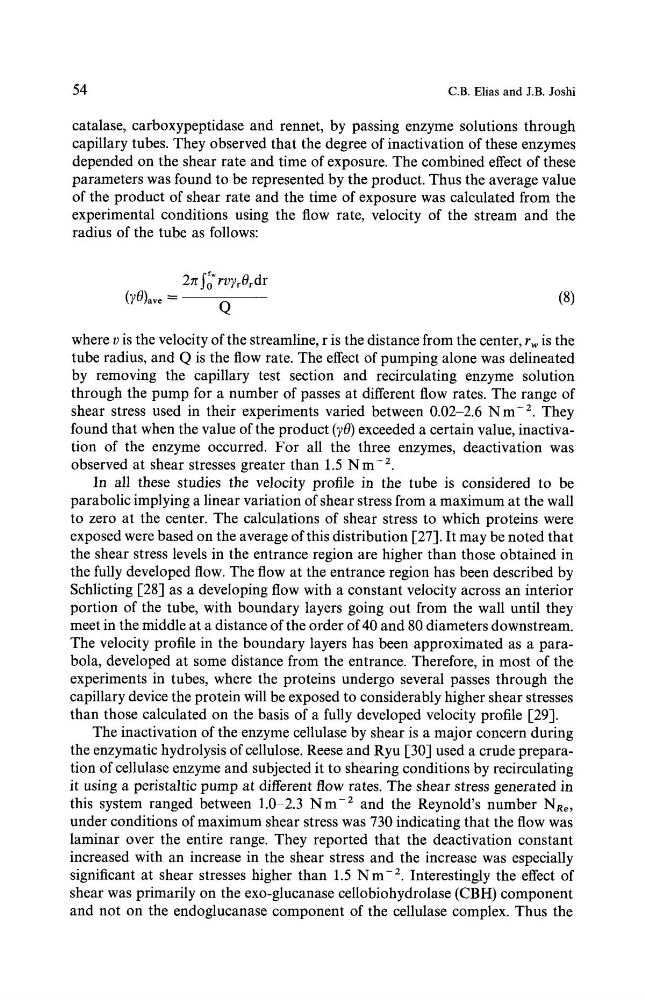
parameters was found to be represented by the product. Thus the average value
of the product of shear rate and the time of exposure was calculated from the
experimental conditions using the flow rate, velocity of the stream and the
radius of the tube as follows:
rw
2n~o rvTrOrdr
(~O)avo(8)
Q
where v is the velocity of the streamline, r is the distance from the center, rw is the
tube radius, and Q is the flow rate. The effect of pumping alone was delineated
by removing the capillary test section and recirculating enzyme solution
through the pump for a number of passes at different flow rates. The range of
shear stress used in their experiments varied between 0.02-2.6 N m -2. They
found that when the value of the product (70) exceeded a certain value, inactivation of the enzyme occurred. For all the three enzymes, deactivation was
observed at shear stresses greater than 1.5 Nm-2.
In all these studies the velocity profile in the tube is considered to be
parabolic implying a linear variation of shear stress from a maximum at the wall
to zero at the center. The calculations of shear stress to which proteins were
exposed were based on the average of this distribution [27]. It may be noted that
the shear stress levels in the entrance region are higher than those obtained in
the fully developed flow. The flow at the entrance region has been described by
Schlicting [28] as a developing flow with a constant velocity across an interior
portion of the tube, with boundary layers going out from the wall until they
meet in the middle at a distance of the order of 40 and 80 diameters downstream.
The velocity profile in the boundary layers has been approximated as a parabola, developed at some distance from the entrance. Therefore, in most of the
experiments in tubes, where the proteins undergo several passes through the
capillary device the protein will be exposed to considerably higher shear stresses
than those calculated on the basis of a fully developed velocity profile [29].
The inactivation of the enzyme cellulase by shear is a major concern during
the enzymatic hydrolysis of cellulose. Reese and Ryu [30] used a crude preparation of cellulase enzyme and subjected it to shearing conditions by recirculating
it using a peristaltic pump at different flow rates. The shear stress generated in
this system ranged between 1.0 2.3 Nm -z and the Reynold's number NR~,
under conditions of maximum shear stress was 730 indicating that the flow was
laminar over the entire range. They reported that the deactivation constant
increased with an increase in the shear stress and the increase was especially
significant at shear stresses higher than 1.5 Nm -2. Interestingly the effect of
shear was primarily on the exo-glucanase cellobiohydrolase (CBH) component
and not on the endoglucanase component of the cellulase complex. Thus the
C.B. Elias and J.B. Joshi
catalase, carboxypeptidase and rennet, by passing enzyme solutions through
capillary tubes. They observed that the degree of inactivation of these enzymes
depended on the shear rate and time of exposure. The combined effect of these
parameters was found to be represented by the product. Thus the average value
of the product of shear rate and the time of exposure was calculated from the
experimental conditions using the flow rate, velocity of the stream and the
radius of the tube as follows:
rw
2n~o rvTrOrdr
(~O)avo(8)
Q
where v is the velocity of the streamline, r is the distance from the center, rw is the
tube radius, and Q is the flow rate. The effect of pumping alone was delineated
by removing the capillary test section and recirculating enzyme solution
through the pump for a number of passes at different flow rates. The range of
shear stress used in their experiments varied between 0.02-2.6 N m -2. They
found that when the value of the product (70) exceeded a certain value, inactivation of the enzyme occurred. For all the three enzymes, deactivation was
observed at shear stresses greater than 1.5 Nm-2.
In all these studies the velocity profile in the tube is considered to be
parabolic implying a linear variation of shear stress from a maximum at the wall
to zero at the center. The calculations of shear stress to which proteins were
exposed were based on the average of this distribution [27]. It may be noted that
the shear stress levels in the entrance region are higher than those obtained in
the fully developed flow. The flow at the entrance region has been described by
Schlicting [28] as a developing flow with a constant velocity across an interior
portion of the tube, with boundary layers going out from the wall until they
meet in the middle at a distance of the order of 40 and 80 diameters downstream.
The velocity profile in the boundary layers has been approximated as a parabola, developed at some distance from the entrance. Therefore, in most of the
experiments in tubes, where the proteins undergo several passes through the
capillary device the protein will be exposed to considerably higher shear stresses
than those calculated on the basis of a fully developed velocity profile [29].
The inactivation of the enzyme cellulase by shear is a major concern during
the enzymatic hydrolysis of cellulose. Reese and Ryu [30] used a crude preparation of cellulase enzyme and subjected it to shearing conditions by recirculating
it using a peristaltic pump at different flow rates. The shear stress generated in
this system ranged between 1.0 2.3 Nm -z and the Reynold's number NR~,
under conditions of maximum shear stress was 730 indicating that the flow was
laminar over the entire range. They reported that the deactivation constant
increased with an increase in the shear stress and the increase was especially
significant at shear stresses higher than 1.5 Nm -2. Interestingly the effect of
shear was primarily on the exo-glucanase cellobiohydrolase (CBH) component
and not on the endoglucanase component of the cellulase complex. Thus the