

5O
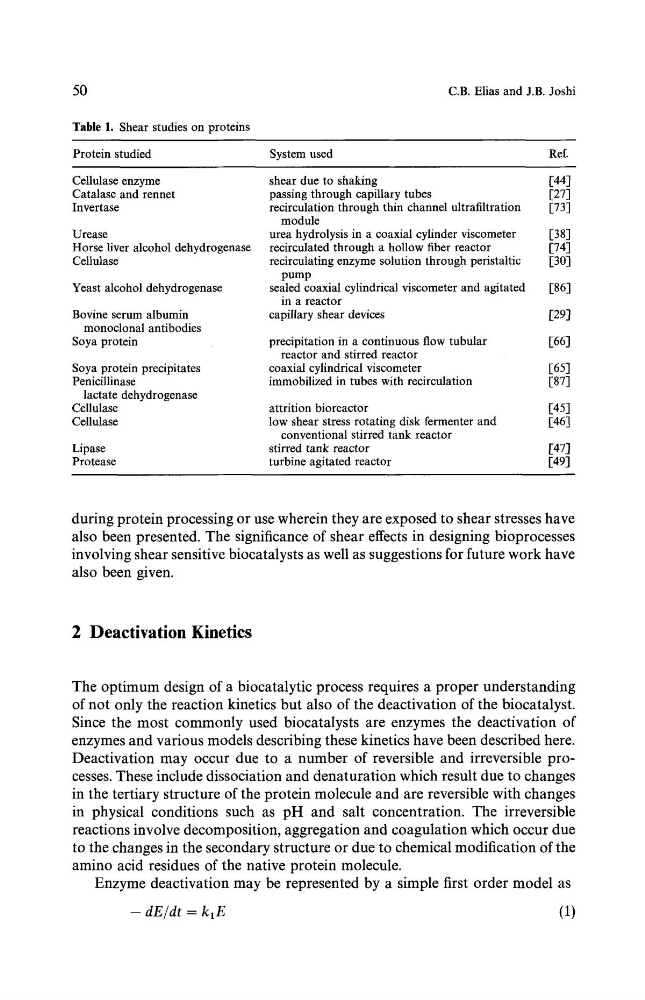
Table 1. Shear studies on proteins
C.B. Elias and J.B. Joshi
Protein studied
System used
Ref.
Cellulase enzyme
Catalase and rennet
Invertase
Urease
Horse liver alcohol dehydrogenase
Cellulase
Yeast alcohol dehydrogenase
Bovine serum albumin
monoclonal antibodies
Soya protein
Soya protein precipitates
Penicillinase
lactate dehydrogenase
Cellulase
Cellulase
Lipase
Protease
shear due to shaking
passing through capillary tubes
recirculation through thin channel ultrafiltration
module
urea hydrolysis in a coaxial cylinder viscometer
recirculated through a hollow fiber reactor
recirculating enzyme solution through peristaltic
pump
sealed coaxial cylindrical viscometer and agitated
in a reactor
capillary shear devices
precipitation in a continuous flow tubular
reactor and stirred reactor
coaxial cylindrical viscometer
immobilized in tubes with recirculation
attrition bioreactor
low shear stress rotating disk fermenter and
conventional stirred tank reactor
stirred tank reactor
turbine agitated reactor
[44]
[27]
[73]
[38]
[74]
[30]
[86]
[29]
[-66]
[-65]
[87]
[45]
[46]
[47]
[49]
during protein processing or use wherein they are exposed to shear stresses have
also been presented. The significance of shear effects in designing bioprocesses
involving shear sensitive biocatalysts as well as suggestions for future work have
also been given.
2 Deactivation Kinetics
The optimum design of a biocatalytic process requires a proper understanding
of not only the reaction kinetics but also of the deactivation of the biocatalyst.
Since the most commonly used biocatalysts are enzymes the deactivation of
enzymes and various models describing these kinetics have been described here.
Deactivation may occur due to a number of reversible and irreversible processes. These include dissociation and denaturation which result due to changes
in the tertiary structure of the protein molecule and are reversible with changes
in physical conditions such as pH and salt concentration. The irreversible
reactions involve decomposition, aggregation and coagulation which occur due
to the changes in the secondary structure or due to chemical modification of the
amino acid residues of the native protein molecule.
Enzyme deactivation may be represented by a simple first order model as
-- dE/dt = k~E
(1)
Table 1. Shear studies on proteins
C.B. Elias and J.B. Joshi
Protein studied
System used
Ref.
Cellulase enzyme
Catalase and rennet
Invertase
Urease
Horse liver alcohol dehydrogenase
Cellulase
Yeast alcohol dehydrogenase
Bovine serum albumin
monoclonal antibodies
Soya protein
Soya protein precipitates
Penicillinase
lactate dehydrogenase
Cellulase
Cellulase
Lipase
Protease
shear due to shaking
passing through capillary tubes
recirculation through thin channel ultrafiltration
module
urea hydrolysis in a coaxial cylinder viscometer
recirculated through a hollow fiber reactor
recirculating enzyme solution through peristaltic
pump
sealed coaxial cylindrical viscometer and agitated
in a reactor
capillary shear devices
precipitation in a continuous flow tubular
reactor and stirred reactor
coaxial cylindrical viscometer
immobilized in tubes with recirculation
attrition bioreactor
low shear stress rotating disk fermenter and
conventional stirred tank reactor
stirred tank reactor
turbine agitated reactor
[44]
[27]
[73]
[38]
[74]
[30]
[86]
[29]
[-66]
[-65]
[87]
[45]
[46]
[47]
[49]
during protein processing or use wherein they are exposed to shear stresses have
also been presented. The significance of shear effects in designing bioprocesses
involving shear sensitive biocatalysts as well as suggestions for future work have
also been given.
2 Deactivation Kinetics
The optimum design of a biocatalytic process requires a proper understanding
of not only the reaction kinetics but also of the deactivation of the biocatalyst.
Since the most commonly used biocatalysts are enzymes the deactivation of
enzymes and various models describing these kinetics have been described here.
Deactivation may occur due to a number of reversible and irreversible processes. These include dissociation and denaturation which result due to changes
in the tertiary structure of the protein molecule and are reversible with changes
in physical conditions such as pH and salt concentration. The irreversible
reactions involve decomposition, aggregation and coagulation which occur due
to the changes in the secondary structure or due to chemical modification of the
amino acid residues of the native protein molecule.
Enzyme deactivation may be represented by a simple first order model as
-- dE/dt = k~E
(1)