

36
J. Gomes and A.S. Menawat
7.3 Spectinomycin
Prediction of spectinomycin from the air flow rate data is the industrially more
important reconstruction problem. Since the hydrodynamic conditions in all the
bioproduction runs were maintained by controlling the operational conditions,
the relationship between air flow rate and spectinomycin is not dependent on
the physical conditions. Hence, for simplicity and to demonstrate that this
prediction is possible, it is assumed that spectinomycin varies linearly with the
air flow rate. The other variables are related according to the model. Thus,
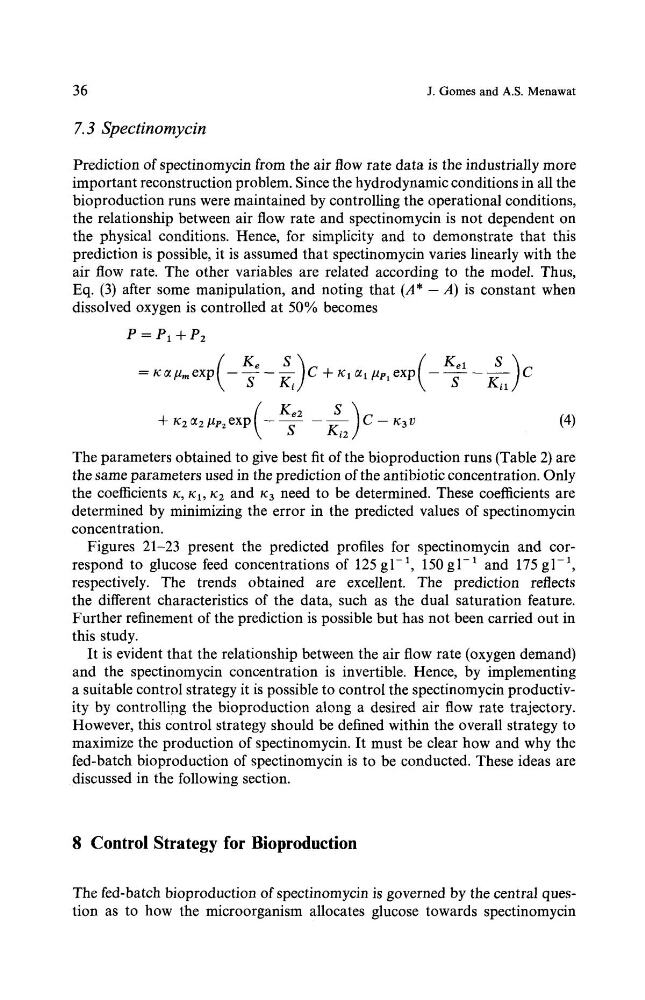
Eq. (3) after some manipulation, and noting that (A* -A) is constant when
dissolved oxygen is controlled at 50% becomes
P = P1 + Pz
=K~/Zmexp( Kes Si)C+ tcl~Izelexp( Kel K~.t)C
+tC2~z/~ezexp( /~ 2 K~.z)C-tr v
(4)
The parameters obtained to give best fit of the bioproduction runs (Table 2) are
the same parameters used in the prediction of the antibiotic concentration. Only
the coefficients to, tq,/s and ~:3 need to be determined. These coefficients are
determined by minimizing the error in the predicted values of spectinomycin
concentration.
Figures 21-23 present the predicted profiles for spectinomycin and correspond to glucose feed concentrations of 125 gl -a, 150g1-1 and 175 gl -~,
respectively. The trends obtained are excellent. The prediction reflects
the different characteristics of the data, such as the dual saturation feature.
Further refinement of the prediction is possible but has not been carried out in
this study.
It is evident that the relationship between the air flow rate (oxygen demand)
and the spectinomycin concentration is invertible. Hence, by implementing
a suitable control strategy it is possible to control the spectinomycin productivity by controlling the bioproduction along a desired air flow rate trajectory.
However, this control strategy should be defined within the overall strategy to
maximize the production of spectinomycin. It must be clear how and why the
fed-batch bioproduction of spectinomycin is to be conducted. These ideas are
discussed in the following section.
8 Control Strategy for Bioproduction
The fed-batch bioproduction of spectinomycin is governed by the central question as to how the microorganism allocates glucose towards spectinomycin
J. Gomes and A.S. Menawat
7.3 Spectinomycin
Prediction of spectinomycin from the air flow rate data is the industrially more
important reconstruction problem. Since the hydrodynamic conditions in all the
bioproduction runs were maintained by controlling the operational conditions,
the relationship between air flow rate and spectinomycin is not dependent on
the physical conditions. Hence, for simplicity and to demonstrate that this
prediction is possible, it is assumed that spectinomycin varies linearly with the
air flow rate. The other variables are related according to the model. Thus,
Eq. (3) after some manipulation, and noting that (A* -A) is constant when
dissolved oxygen is controlled at 50% becomes
P = P1 + Pz
=K~/Zmexp( Kes Si)C+ tcl~Izelexp( Kel K~.t)C
+tC2~z/~ezexp( /~ 2 K~.z)C-tr v
(4)
The parameters obtained to give best fit of the bioproduction runs (Table 2) are
the same parameters used in the prediction of the antibiotic concentration. Only
the coefficients to, tq,/s and ~:3 need to be determined. These coefficients are
determined by minimizing the error in the predicted values of spectinomycin
concentration.
Figures 21-23 present the predicted profiles for spectinomycin and correspond to glucose feed concentrations of 125 gl -a, 150g1-1 and 175 gl -~,
respectively. The trends obtained are excellent. The prediction reflects
the different characteristics of the data, such as the dual saturation feature.
Further refinement of the prediction is possible but has not been carried out in
this study.
It is evident that the relationship between the air flow rate (oxygen demand)
and the spectinomycin concentration is invertible. Hence, by implementing
a suitable control strategy it is possible to control the spectinomycin productivity by controlling the bioproduction along a desired air flow rate trajectory.
However, this control strategy should be defined within the overall strategy to
maximize the production of spectinomycin. It must be clear how and why the
fed-batch bioproduction of spectinomycin is to be conducted. These ideas are
discussed in the following section.
8 Control Strategy for Bioproduction
The fed-batch bioproduction of spectinomycin is governed by the central question as to how the microorganism allocates glucose towards spectinomycin