

24
J. Gomes and A.S. Menawat
spectinomycin productivity. Whereas, at glucose feed concentrations higher
than the optimum the residual glucose concentration represses spectinomycin
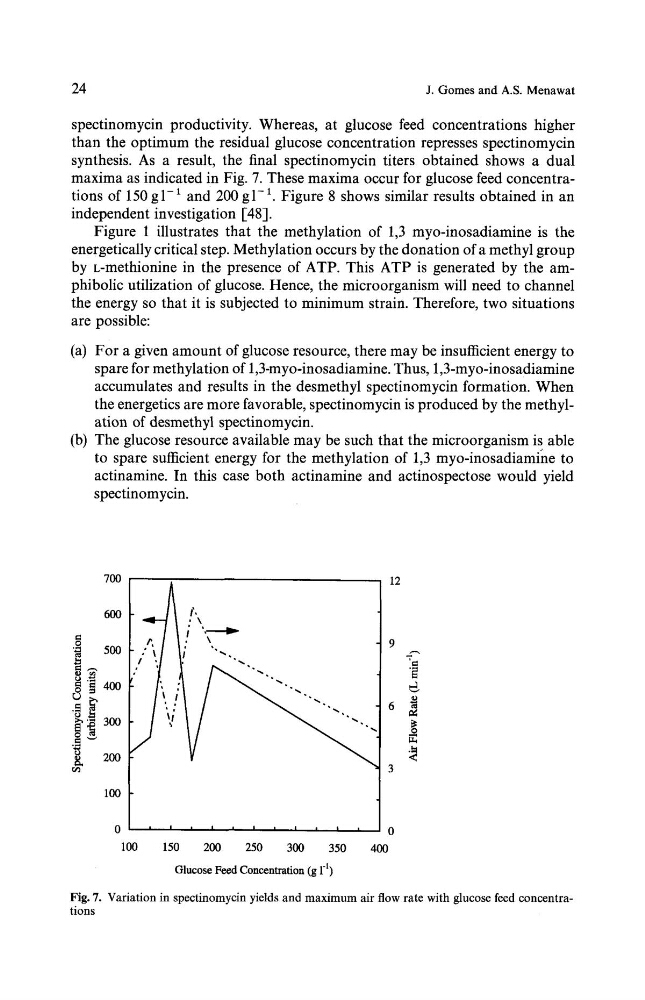
synthesis. As a result, the final spectinomycin titers obtained shows a dual
maxima as indicated in Fig. 7. These maxima occur for glucose feed concentrations of 150 g 1-1 and 200 g l-1. Figure 8 shows similar results obtained in an
independent investigation [48].
Figure 1 illustrates that the methylation of 1,3 myo-inosadiamine is the
energetically critical step. Methylation occurs by the donation of a methyl group
by L-methionine in the presence of ATP. This ATP is generated by the amphibolic utilization of glucose. Hence, the microorganism will need to channel
the energy so that it is subjected to minimum strain. Therefore, two situations
are possible:
(a) For a given amount of glucose resource, there may be insufficient energy to
spare for methylation of 1,3-myo-inosadiamine. Thus, 1,3-myo-inosadiamine
accumulates and results in the desmethyl spectinomycin formation. When
the energetics are more favorable, spectinomycin is produced by the methylation of desmethyl spectinomycin.
(b) The glucose resource available may be such that the microorganism is able
to spare sufficient energy for the methylation of 1,3 myo-inosadiamine to
actinamine. In this case both actinamine and actinospectose would yield
spectinomycin.
700
12
600
o
'~
500
200
r/)
100
. \
.,...---.
0
i
,
i
,
|
.
I
i
|
0
100
150
200
250
300
350
400
Glucose Feed Concentration (g 1 -t)
9 v'-"
0)
6
3
Fig. 7. Variation in spectinomycin yields and maximum air flow rate with glucose feed concentrations
J. Gomes and A.S. Menawat
spectinomycin productivity. Whereas, at glucose feed concentrations higher
than the optimum the residual glucose concentration represses spectinomycin
synthesis. As a result, the final spectinomycin titers obtained shows a dual
maxima as indicated in Fig. 7. These maxima occur for glucose feed concentrations of 150 g 1-1 and 200 g l-1. Figure 8 shows similar results obtained in an
independent investigation [48].
Figure 1 illustrates that the methylation of 1,3 myo-inosadiamine is the
energetically critical step. Methylation occurs by the donation of a methyl group
by L-methionine in the presence of ATP. This ATP is generated by the amphibolic utilization of glucose. Hence, the microorganism will need to channel
the energy so that it is subjected to minimum strain. Therefore, two situations
are possible:
(a) For a given amount of glucose resource, there may be insufficient energy to
spare for methylation of 1,3-myo-inosadiamine. Thus, 1,3-myo-inosadiamine
accumulates and results in the desmethyl spectinomycin formation. When
the energetics are more favorable, spectinomycin is produced by the methylation of desmethyl spectinomycin.
(b) The glucose resource available may be such that the microorganism is able
to spare sufficient energy for the methylation of 1,3 myo-inosadiamine to
actinamine. In this case both actinamine and actinospectose would yield
spectinomycin.
700
12
600
o
'~
500
200
r/)
100
. \
.,...---.
0
i
,
i
,
|
.
I
i
|
0
100
150
200
250
300
350
400
Glucose Feed Concentration (g 1 -t)
9 v'-"
0)
6
3
Fig. 7. Variation in spectinomycin yields and maximum air flow rate with glucose feed concentrations