

16
J. Gomes and A.S. Menawat
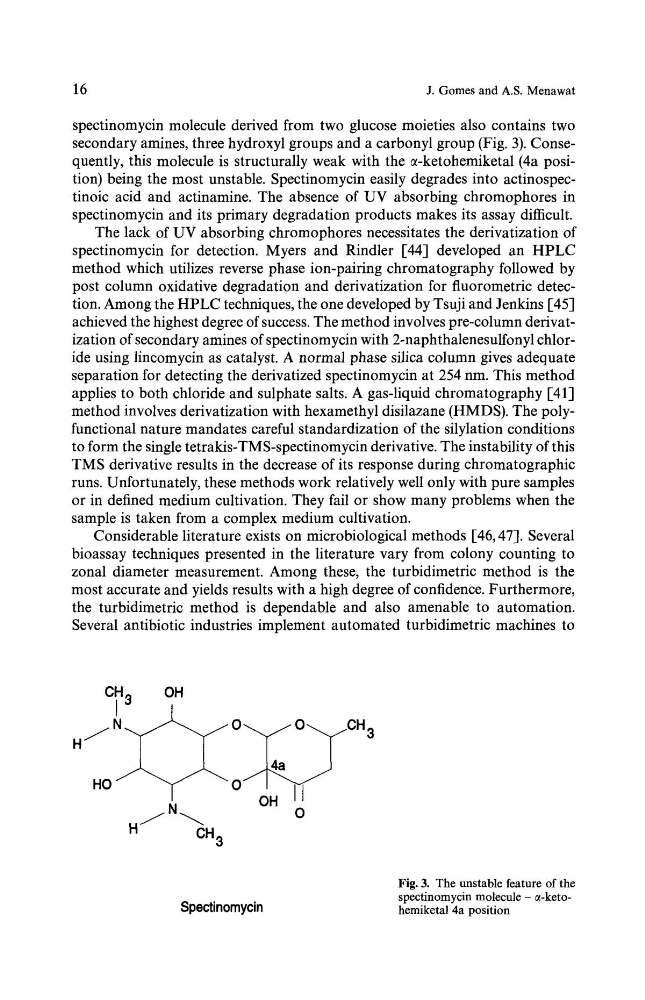
spectinomycin molecule derived from two glucose moieties also contains two
secondary amines, three hydroxyl groups and a carbonyl group (Fig. 3). Consequently, this molecule is structurally weak with the ct-ketohemiketal (4a position) being the most unstable. Spectinomycin easily degrades into actinospectinoic acid and actinamine. The absence of UV absorbing chromophores in
spectinomycin and its primary degradation products makes its assay difficult.
The lack of UV absorbing chromophores necessitates the derivatization of
spectinomycin for detection. Myers and Rindler [44] developed an HPLC
method which utilizes reverse phase ion-pairing chromatography followed by
post column oxidative degradation and derivatization for fluorometric detection. Among the HPLC techniques, the one developed by Tsuji and Jenkins [45]
achieved the highest degree of success. The method involves pre-column derivatization of secondary amines of spectinomycin with 2-naphthalenesulfonyl chloride using lincomycin as catalyst. A normal phase silica column gives adequate
separation for detecting the derivatized spectinomycin at 254 nm. This method
applies to both chloride and sulphate salts. A gas-liquid chromatography [41]
method involves derivatization with hexamethyl disilazane (HMDS). The polyfunctional nature mandates careful standardization of the silylation conditions
to form the single tetrakis-TMS-spectinomycin derivative. The instability of this
TMS derivative results in the decrease of its response during chromatographic
runs. Unfortunately, these methods work relatively well only with pure samples
or in defined medium cultivation. They fail or show many problems when the
sample is taken from a complex medium cultivation.
Considerable literature exists on microbiological methods [46, 47]. Several
bioassay techniques presented in the literature vary from colony counting to
zonal diameter measurement. Among these, the turbidimetric method is the
most accurate and yields results with a high degree of confidence. Furthermore,
the turbidimetric method is dependable and also amenable to automation.
Several antibiotic industries implement automated turbidimetric machines to
CH3 OH
H~N~
O
CH 3
Spectinomycin
Fig. 3. The unstable feature of the
spectinomycin molecule - ~-ketohemiketal 4a position
J. Gomes and A.S. Menawat
spectinomycin molecule derived from two glucose moieties also contains two
secondary amines, three hydroxyl groups and a carbonyl group (Fig. 3). Consequently, this molecule is structurally weak with the ct-ketohemiketal (4a position) being the most unstable. Spectinomycin easily degrades into actinospectinoic acid and actinamine. The absence of UV absorbing chromophores in
spectinomycin and its primary degradation products makes its assay difficult.
The lack of UV absorbing chromophores necessitates the derivatization of
spectinomycin for detection. Myers and Rindler [44] developed an HPLC
method which utilizes reverse phase ion-pairing chromatography followed by
post column oxidative degradation and derivatization for fluorometric detection. Among the HPLC techniques, the one developed by Tsuji and Jenkins [45]
achieved the highest degree of success. The method involves pre-column derivatization of secondary amines of spectinomycin with 2-naphthalenesulfonyl chloride using lincomycin as catalyst. A normal phase silica column gives adequate
separation for detecting the derivatized spectinomycin at 254 nm. This method
applies to both chloride and sulphate salts. A gas-liquid chromatography [41]
method involves derivatization with hexamethyl disilazane (HMDS). The polyfunctional nature mandates careful standardization of the silylation conditions
to form the single tetrakis-TMS-spectinomycin derivative. The instability of this
TMS derivative results in the decrease of its response during chromatographic
runs. Unfortunately, these methods work relatively well only with pure samples
or in defined medium cultivation. They fail or show many problems when the
sample is taken from a complex medium cultivation.
Considerable literature exists on microbiological methods [46, 47]. Several
bioassay techniques presented in the literature vary from colony counting to
zonal diameter measurement. Among these, the turbidimetric method is the
most accurate and yields results with a high degree of confidence. Furthermore,
the turbidimetric method is dependable and also amenable to automation.
Several antibiotic industries implement automated turbidimetric machines to
CH3 OH
H~N~
O
CH 3
Spectinomycin
Fig. 3. The unstable feature of the
spectinomycin molecule - ~-ketohemiketal 4a position