

Kinetics and Energetics of Photosynthetic Micro-Organisms in Photobioreactors
203
1 -
under nitrate or sulfate limitations, the mean volumetric rate of phycocyanin
or protein uptake and the mean volumetric rate of biomass synthesis are both
proportional to the mean linear volumetric rate of biomass under light limitation (Rx) alone (Eq. 99). This linear volumetric rate possesses two important
characteristics:
- it is unaffected by mineral limitations, which induce the synthesis of
intracellular glycogen and exopolysaccharides under nitrate or sulfate starvation;
-
it remains constant during the time course of the culture, since the mean
quantum yield does not change, even during mineral limitations.
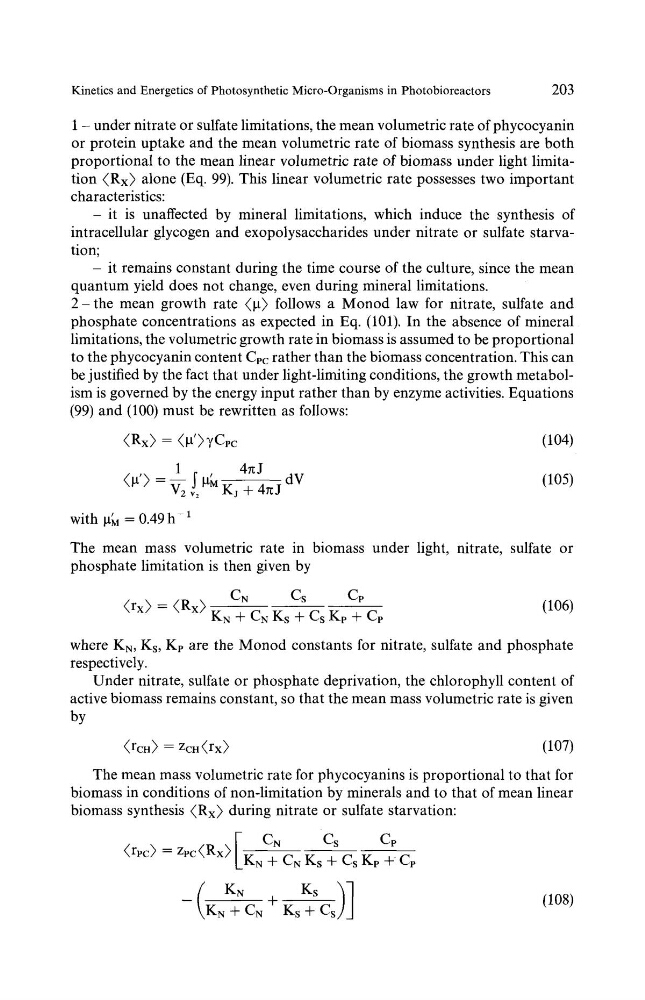
2- the mean growth rate (p) follows a Monod law for nitrate, sulfate and
phosphate concentrations as expected in Eq. (101). In the absence of mineral
limitations, the volumetric growth rate in biomass is assumed to be proportional
to the phycocyanin content Cec rather than the biomass concentration. This can
be justified by the fact that under light-limiting conditions, the growth metabolism is governed by the energy input rather than by enzyme activities. Equations
(99) and (100) must be rewritten as follows:
1 v~ 2
4nJ
dV
(105)
The mean mass volumetric rate in biomass under light, nitrate, sulfate or
phosphate limitation is then given by
C N
C S
Cp
- -
(106)
KN + CN Ks + Cs Kp + Cp
where KN, Ks, Kp are the Monod constants for nitrate, sulfate and phosphate
respectively.
Under nitrate, sulfate or phosphate deprivation, the chlorophyll content of
active biomass remains constant, so that the mean mass volumetric rate is given
by
(rcH) = ZcH(rx)
(107)
The mean mass volumetric rate for phycocyanins is proportional to that for
biomass in conditions of non-limitation by minerals and to that of mean linear
biomass synthesis (Rx) during nitrate or sulfate starvation:
I
C N
C S
Cp
KN+ CNKs+CsKp+ Cp
Ks
(lO8)
203
1 -
under nitrate or sulfate limitations, the mean volumetric rate of phycocyanin
or protein uptake and the mean volumetric rate of biomass synthesis are both
proportional to the mean linear volumetric rate of biomass under light limitation (Rx) alone (Eq. 99). This linear volumetric rate possesses two important
characteristics:
- it is unaffected by mineral limitations, which induce the synthesis of
intracellular glycogen and exopolysaccharides under nitrate or sulfate starvation;
-
it remains constant during the time course of the culture, since the mean
quantum yield does not change, even during mineral limitations.
2- the mean growth rate (p) follows a Monod law for nitrate, sulfate and
phosphate concentrations as expected in Eq. (101). In the absence of mineral
limitations, the volumetric growth rate in biomass is assumed to be proportional
to the phycocyanin content Cec rather than the biomass concentration. This can
be justified by the fact that under light-limiting conditions, the growth metabolism is governed by the energy input rather than by enzyme activities. Equations
(99) and (100) must be rewritten as follows:
1 v~ 2
4nJ
dV
(105)
The mean mass volumetric rate in biomass under light, nitrate, sulfate or
phosphate limitation is then given by
C N
C S
Cp
- -
(106)
KN + CN Ks + Cs Kp + Cp
where KN, Ks, Kp are the Monod constants for nitrate, sulfate and phosphate
respectively.
Under nitrate, sulfate or phosphate deprivation, the chlorophyll content of
active biomass remains constant, so that the mean mass volumetric rate is given
by
(rcH) = ZcH(rx)
(107)
The mean mass volumetric rate for phycocyanins is proportional to that for
biomass in conditions of non-limitation by minerals and to that of mean linear
biomass synthesis (Rx) during nitrate or sulfate starvation:
I
C N
C S
Cp
Ks
(lO8)