

194
J.-F. Cornet et al.
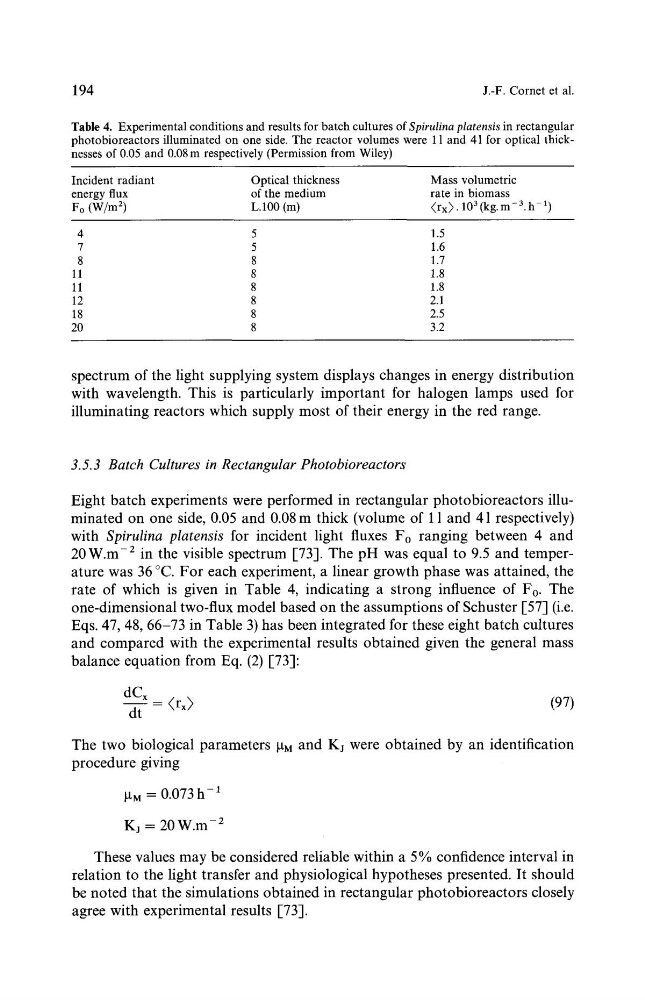
Table 4. Experimental conditions and results for batch cultures of Spirulina platensis in rectangular
photobioreactors illuminated on one side. The reactor volumes were 11 and 41 for optical thicknesses of 0.05 and 0.08 m respectively (Permission from Wiley)
Incident radiant
Optical thickness
Mass volumetric
energy flux
of the medium
rate in biomass
Fo (W/m 2)
L.100 (m)
(rx). 103 (kg. m - 3. h - 1)
4
5
1.5
7
5
1.6
8
8
1.7
11
8
1.8
11
8
1.8
12
8
2.1
18
8
2.5
20
8
3.2
spectrum of the light supplying system displays changes in energy distribution
with wavelength. This is particularly important for halogen lamps used for
illuminating reactors which supply most of their energy in the red range.
3.5.3 Batch Cultures in Rectangular Photobioreactors
Eight batch experiments were performed in rectangular photobioreactors illuminated on one side, 0.05 and 0.08 m thick (volume of 11 and 41 respectively)
with Spirulina platensis for incident light fluxes Fo ranging between 4 and
20W.m -2 in the visible spectrum [73]. The pH was equal to 9.5 and temperature was 36 ~ For each experiment, a linear growth phase was attained, the
rate of which is given in Table 4, indicating a strong influence of F0. The
one-dimensional two-flux model based on the assumptions of Schuster [57] (i.e.
Eqs. 47, 48, 66-73 in Table 3) has been integrated for these eight batch cultures
and compared with the experimental results obtained given the general mass
balance equation from Eq. (2) [73]:
dCx
dt - (r.)
(97)
The two biological parameters ~tM and Kj were obtained by an identification
procedure giving
~tM = 0.073 h- 1
Kj = 20 W.m- 2
These values may be considered reliable within a 5 % confidence interval in
relation to the light transfer and physiological hypotheses presented. It should
be noted that the simulations obtained in rectangular photobioreactors closely
agree with experimental results [73].
J.-F. Cornet et al.
Table 4. Experimental conditions and results for batch cultures of Spirulina platensis in rectangular
photobioreactors illuminated on one side. The reactor volumes were 11 and 41 for optical thicknesses of 0.05 and 0.08 m respectively (Permission from Wiley)
Incident radiant
Optical thickness
Mass volumetric
energy flux
of the medium
rate in biomass
Fo (W/m 2)
L.100 (m)
(rx). 103 (kg. m - 3. h - 1)
4
5
1.5
7
5
1.6
8
8
1.7
11
8
1.8
11
8
1.8
12
8
2.1
18
8
2.5
20
8
3.2
spectrum of the light supplying system displays changes in energy distribution
with wavelength. This is particularly important for halogen lamps used for
illuminating reactors which supply most of their energy in the red range.
3.5.3 Batch Cultures in Rectangular Photobioreactors
Eight batch experiments were performed in rectangular photobioreactors illuminated on one side, 0.05 and 0.08 m thick (volume of 11 and 41 respectively)
with Spirulina platensis for incident light fluxes Fo ranging between 4 and
20W.m -2 in the visible spectrum [73]. The pH was equal to 9.5 and temperature was 36 ~ For each experiment, a linear growth phase was attained, the
rate of which is given in Table 4, indicating a strong influence of F0. The
one-dimensional two-flux model based on the assumptions of Schuster [57] (i.e.
Eqs. 47, 48, 66-73 in Table 3) has been integrated for these eight batch cultures
and compared with the experimental results obtained given the general mass
balance equation from Eq. (2) [73]:
dCx
dt - (r.)
(97)
The two biological parameters ~tM and Kj were obtained by an identification
procedure giving
~tM = 0.073 h- 1
Kj = 20 W.m- 2
These values may be considered reliable within a 5 % confidence interval in
relation to the light transfer and physiological hypotheses presented. It should
be noted that the simulations obtained in rectangular photobioreactors closely
agree with experimental results [73].