

Fed-Batch Bioproduction of Spectinomycin
11
there is a high probability of carbon catabolite regulation. Hence, it is not
surprising that the level of residual glucose in the medium determines the start of
spectinomycin production.
The microorganism can channel glucose in two possible ways: (i) utilize
glucose predominantly for growth until the stationary phase, then predominantly for synthesis of the antibiotic and (ii) utilize glucose simultaneously for
growth and production. The first method of glucose utilization corroborates
carbon catabolite regulation whereas the second method does not. Evidence in
the literature suggests that antibiotic-producing microorganisms usually follow
the first method of glucose utilization.
The biosynthetic pathway presented in Fig. 1 shows that either the conversion of D-glucose to myo-inositol or the methylation reactions control the rate of
antibiotic synthesis. The conversion of D-glucose to myo-inositol involves the
reduction of NAD § to NADH and its reoxidization to NAD § in a subsequent
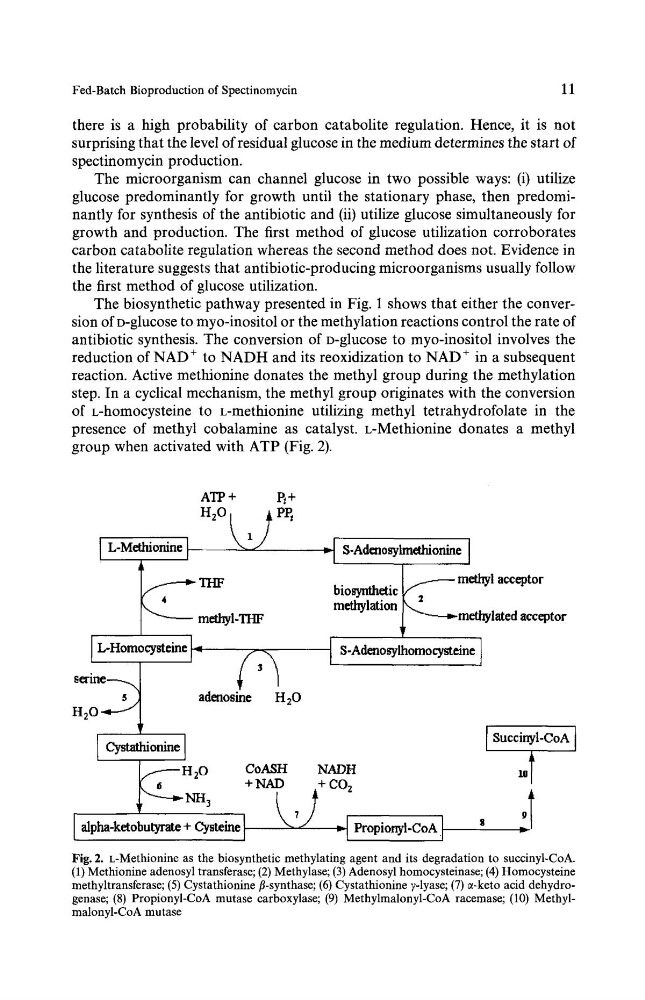
reaction. Active methionine donates the methyl group during the methylation
step. In a cyclical mechanism, the methyl group originates with the conversion
of L-homocysteine to L-methionine utilizing methyl tetrahydrofolate in the
presence of methyl cobalamine as catalyst. L-Methionine donates a methyl
group when activated with ATP (Fig. 2).
ATP+
P~+
H20~I: PP~
I L-Methionine I
methyl-rI-~
[ L-Homocysteine I~
H20
H20 -4----" ~
I Cystathionine
a~-- H 20
CoASH NADH
+ NAD
+ CO z
alpha-ketobutyrate + Oysteine
7
~- Propionyl-CoA.
v[- [ S-Adenosylmahionine ]
biosynthetic 2~ --- methyl acceptor
methylation I ~-----~methylated acceptor
I $-Admosylhomocysteine ]
I 8uccinyl-OoA ]
, :T
Fig. 2. L-Methionine as the biosynthetic methylating agent and its degradation to succinyl-CoA.
(1) Methionine adenosyl transferase; (2) Methylase; (3) Adenosyl homocysteinase; (4) Homocysteine
methyltransferase; (5) Cystathionine fl-synthase; (6) Cystathionine y-lyase; (7) ct-keto acid dehydrogenase; (8) Propionyl-CoA mutase carboxylase; (9) Methylmalonyl-CoA racemase; (10) Methylmalonyl-CoA mutase
11
there is a high probability of carbon catabolite regulation. Hence, it is not
surprising that the level of residual glucose in the medium determines the start of
spectinomycin production.
The microorganism can channel glucose in two possible ways: (i) utilize
glucose predominantly for growth until the stationary phase, then predominantly for synthesis of the antibiotic and (ii) utilize glucose simultaneously for
growth and production. The first method of glucose utilization corroborates
carbon catabolite regulation whereas the second method does not. Evidence in
the literature suggests that antibiotic-producing microorganisms usually follow
the first method of glucose utilization.
The biosynthetic pathway presented in Fig. 1 shows that either the conversion of D-glucose to myo-inositol or the methylation reactions control the rate of
antibiotic synthesis. The conversion of D-glucose to myo-inositol involves the
reduction of NAD § to NADH and its reoxidization to NAD § in a subsequent
reaction. Active methionine donates the methyl group during the methylation
step. In a cyclical mechanism, the methyl group originates with the conversion
of L-homocysteine to L-methionine utilizing methyl tetrahydrofolate in the
presence of methyl cobalamine as catalyst. L-Methionine donates a methyl
group when activated with ATP (Fig. 2).
ATP+
P~+
H20~I: PP~
I L-Methionine I
methyl-rI-~
[ L-Homocysteine I~
H20
H20 -4----" ~
I Cystathionine
a~-- H 20
CoASH NADH
+ NAD
+ CO z
alpha-ketobutyrate + Oysteine
7
~- Propionyl-CoA.
v[- [ S-Adenosylmahionine ]
biosynthetic 2~ --- methyl acceptor
methylation I ~-----~methylated acceptor
I $-Admosylhomocysteine ]
I 8uccinyl-OoA ]
, :T
Fig. 2. L-Methionine as the biosynthetic methylating agent and its degradation to succinyl-CoA.
(1) Methionine adenosyl transferase; (2) Methylase; (3) Adenosyl homocysteinase; (4) Homocysteine
methyltransferase; (5) Cystathionine fl-synthase; (6) Cystathionine y-lyase; (7) ct-keto acid dehydrogenase; (8) Propionyl-CoA mutase carboxylase; (9) Methylmalonyl-CoA racemase; (10) Methylmalonyl-CoA mutase